
Restaurant POS System in Albuquerque, NM
Restaurants in Albuquerque charge 7.625% gross receipts tax in sales tax on meals and pay at least $12.00 an hour. Here is what that means for your POS setup.
ALBUQUERQUE RESTAURANT NUMBERS
Checked 11/18/2026 against official sources
What these rules mean for Albuquerque restaurants
New Mexico has a gross receipts tax instead of a sales tax. It is charged to the business, and most restaurants pass it on to the guest. Most of Albuquerque is at 7.625% after the council voted down an increase in March 2026. The city sets tipped staff at 60% of its minimum wage.
Combined sales tax on restaurant meals: New Mexico TRD gross receipts tax rate schedule, July 2026.
Minimum wage: City of Albuquerque minimum wage.
Tipped minimum cash wage: City of Albuquerque minimum wage.
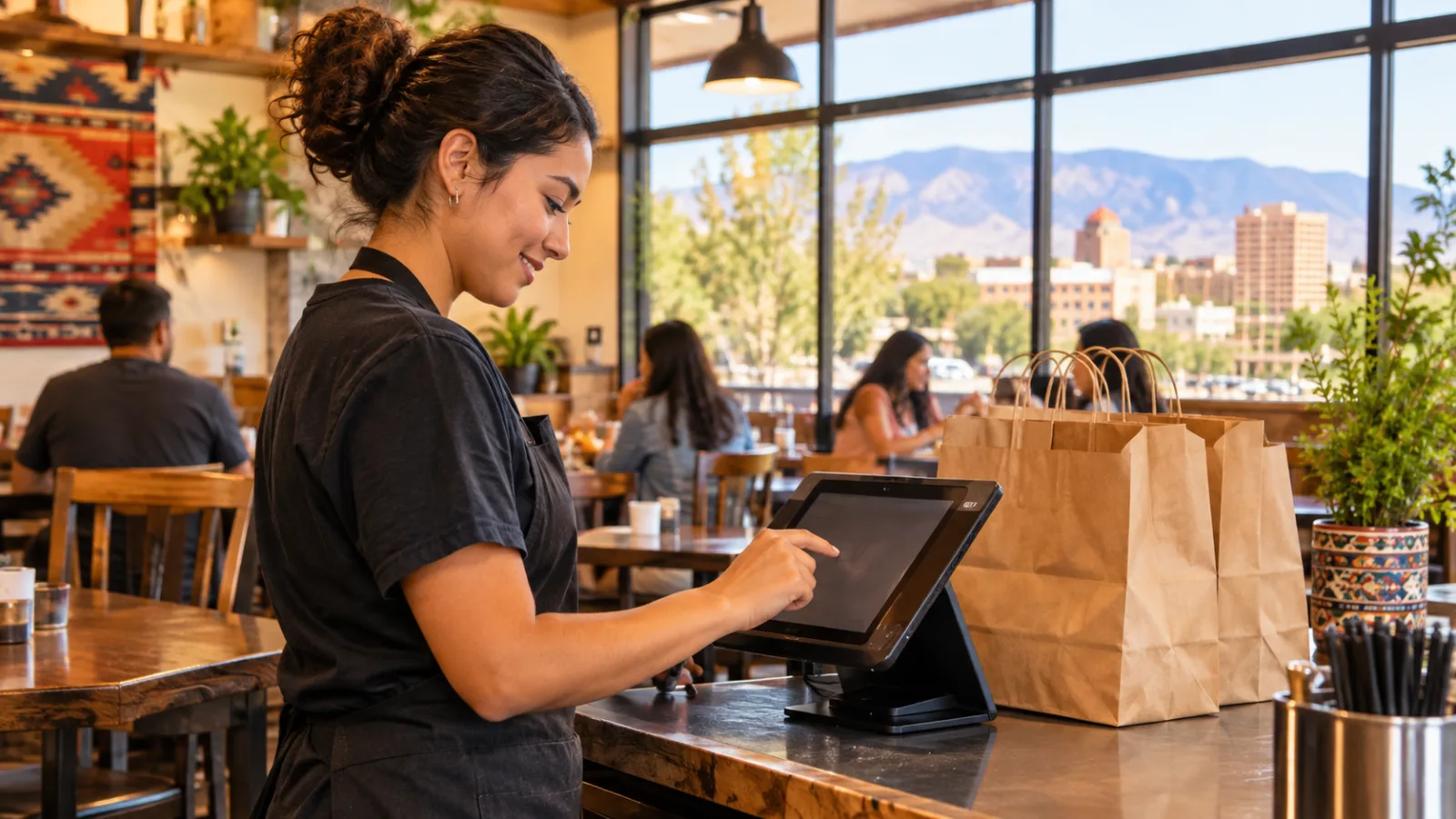
Keeping More From Every Delivery and Takeout Order: A Restaurant Owner's Guide to Albuquerque, NM
Delivery and takeout can keep a restaurant busy, but a full order screen does not necessarily mean a profitable shift. For Albuquerque restaurant owners, the key is to understand the true cost of each order, price delivery areas carefully, set sensible minimums, and decide when bringing customers directly to your own ordering channel makes better business sense.
Start by calculating what each delivery order actually earns
The first mistake many restaurant owners make is measuring delivery success by gross sales. A busy takeout operation can generate impressive daily revenue while quietly reducing the money available to cover rent, payroll, utilities, and food purchases.
Consider a typical delivery order. The customer pays for the food, but that amount is not what the restaurant keeps.
Before calculating profit, account for:
- Food ingredients and recipe costs.
- Packaging, containers, bags, napkins, and utensils.
- Kitchen and packing labor.
- Payment processing costs.
- Delivery-related charges and commissions, where applicable.
- Discounts, promotional offers, and refunds.
- Gross receipts tax obligations.
- Any additional operating expenses directly associated with fulfilling the order.
The important distinction is between revenue, contribution, and profit.
Revenue is what the restaurant receives from selling the food and related items. Contribution is what remains after the variable costs of preparing and fulfilling the order. Profit comes after accounting for the wider operating expenses of the restaurant.
For delivery decisions, contribution is particularly useful.
A restaurant might sell a meal at a price that looks profitable when compared with ingredient costs alone. Once packaging, additional labor, and delivery-related expenses are included, however, the actual contribution can be much smaller.
Start with a simple calculation:
Order contribution = Food revenue - Food cost - Packaging - Direct labor - Payment costs - Delivery-related costs - Discounts.
Keep taxes separate in your accounting rather than treating collected tax as additional food revenue.
Calculate this figure for several common order types, not just the average order. A large family order, a single lunch, and a multi-item dinner order can have very different cost structures.
A POS system should make it possible to review sales by order type, payment method, product, and fulfillment method. Ideally, you can distinguish dine-in, pickup, and delivery rather than combining everything into one sales total.
That separation makes it easier to identify which orders are helping the restaurant and which are consuming too much of its margin.
Albuquerque's gross receipts tax belongs in your order calculations
New Mexico uses a gross receipts tax (GRT), not a conventional sales tax. The tax is imposed on the business, although restaurants commonly pass it on to customers as a separately stated charge.
For most of Albuquerque, the combined rate is 7.625%. The City Council voted down a proposed increase in March 2026, leaving the rate unchanged.
For restaurant operators, the practical issue is making sure the POS calculates the correct amount and records it consistently.
Hypothetical example:
A customer places an order with a $48.00 food check.
- Food check: $48.00
- GRT at 7.625%: $3.66
- Customer total: $51.66
The $3.66 is the tax amount in this hypothetical guest-facing calculation. It should not be mistaken for additional food revenue.
This distinction matters when comparing delivery and pickup sales. If one report includes tax in its displayed total and another excludes it, the restaurant may incorrectly conclude that one ordering channel generates more revenue.
Set up your POS so that tax is calculated consistently and reports distinguish taxable sales, tax collected or passed through, discounts, and refunds.
Also check how your system handles tax when an order includes different product categories. Do not assume every item should automatically receive identical treatment without confirming the applicable rules.
The New Mexico Taxation and Revenue Department publishes the applicable GRT information and rate resources. Confirm the current rate for your business and the correct treatment of each transaction with the official agency or a qualified tax professional.
Calculate the labor cost of fulfilling an order
Food cost receives plenty of attention, but delivery and takeout labor can be overlooked.
Someone must receive the order, check its contents, prepare or coordinate the food, package it, organize the handoff, and handle customer questions. During a busy period, these tasks can pull employees away from dine-in service.
For 2026, use the following Albuquerque wage figures in your initial planning:
- Minimum wage: $12.00 per hour.
- Tipped minimum cash wage: $7.20 per hour.
- The tipped cash wage represents 60% of the minimum wage.
These figures should be considered alongside the applicable requirements for tipped employees and any employer obligations. Do not assume that tips automatically eliminate the requirement to meet the applicable minimum wage.
Hypothetical labor example:
One employee working a six-hour shift at $12.00 per hour costs:
$12.00 × 6 hours = $72.00 in base wages before payroll taxes.
That is the starting point, not the employee's complete labor cost.
Payroll taxes and other employer expenses must also be considered.
Now look at how that employee spends the shift. If the person handles both counter service and delivery packing, the restaurant needs a reasonable way to understand how much labor is being consumed by each activity.
This is where good POS reporting becomes useful.
Review order volume by hour, pickup versus delivery mix, average preparation time, and the number of orders handled during each shift. Compare those figures with employee clock-in and clock-out records.
The goal is not to make every employee work faster regardless of circumstances. It is to identify periods when the restaurant is scheduling more labor than the actual order volume requires, or when delivery work is disrupting the kitchen.
Divide delivery coverage into zones that reflect real operating costs
A delivery radius is not necessarily a useful delivery plan.
Two customers at similar distances from a restaurant can require very different amounts of time to reach. Traffic, road conditions, weather, parking, building access, and the time required to complete a handoff all affect the cost of fulfilling an order.
Albuquerque's changing seasons and weather conditions make it sensible to review delivery performance over time rather than assuming that a fixed delivery estimate will always hold.
Instead of treating the entire delivery area as one service zone, divide it into practical areas.
For each zone, consider:
- Expected travel time.
- Typical preparation and handoff time.
- Delivery staffing requirements.
- The cost of getting an order to its destination.
- The minimum order value needed to justify the trip.
- Whether the estimated delivery time is realistic during busy periods.
The restaurant should be able to answer a straightforward question: does an order from this area contribute enough to justify the time and resources required to complete it?
A delivery zone that generates frequent small orders may be less attractive than a farther area that produces larger family or group orders.
Likewise, an area that is profitable during quieter periods may become difficult to serve during a busy dinner rush.
Do not set delivery coverage only by drawing a circle on a map. Use actual delivery performance to establish where service makes financial sense.
A good POS should let you configure delivery areas separately, rather than forcing one fee and one estimated time across the entire service area.
Review those settings regularly. If a zone consistently produces late deliveries or weak contribution, adjust the coverage, minimum, or estimated time.
Set minimum order values to protect the economics of delivery
A delivery minimum is not simply a way to encourage customers to spend more. It is a tool for protecting the restaurant from orders that cost almost as much to fulfill as larger ones.
Think about the work involved in delivering a small order.
The kitchen still receives and processes it. Someone still checks the items, packages them, and prepares them for collection. The delivery process still consumes time.
The customer may spend relatively little, but the restaurant still performs most of the same operational steps.
That is why minimums should be based on order economics.
Start by calculating the contribution from a typical order in each delivery zone. Then identify the minimum order value needed to cover the variable costs and leave an acceptable contribution.
Consider these questions:
- How much packaging does a typical order require?
- How much employee time is needed to prepare and pack it?
- What does the delivery arrangement cost the restaurant?
- Does the order contain enough items to justify the fulfillment effort?
- How much contribution remains after all direct costs?
A single restaurant-wide minimum may not be appropriate if different zones have different delivery costs.
For example, a closer zone may support a lower minimum because the delivery takes less time. A more distant zone may require a higher minimum to justify the additional resources.
Be careful not to confuse a higher minimum with higher profitability. If the minimum becomes unreasonable, customers may abandon the order or choose pickup instead.
The objective is to establish a threshold that protects the restaurant without unnecessarily discouraging legitimate orders.
Price delivery and takeout separately when their costs differ
Pickup and delivery are not interchangeable from an operating-cost perspective.
Pickup orders generally avoid the restaurant's delivery-related fulfillment costs. Customers collect the food themselves, but the restaurant still has to prepare, package, and organize the order.
Delivery requires additional coordination and potentially additional expense.
That difference should be visible in your reports.
Start by comparing the contribution from pickup and delivery orders with similar food baskets. This helps separate differences in menu selection from differences in fulfillment costs.
Next, review the pricing structure.
Some restaurants maintain the same menu prices across all channels. Others adjust prices or delivery charges to account for additional costs.
Neither approach should be adopted automatically.
If you charge a delivery fee, make sure you understand what that fee covers. A fee that does not cover the actual delivery expense may create a false impression that delivery is profitable.
Likewise, avoid assuming that every customer will accept a higher menu price simply because the order is being delivered.
Your pricing should be understandable, consistent, and supported by the actual cost of serving the customer.
A POS that separates delivery charges, menu sales, taxes, discounts, and payment totals makes this analysis considerably easier.
Decide when your own ordering channel makes financial sense
Restaurants often become dependent on outside ordering channels because they provide convenient access to customers.
That convenience has a cost.
Depending on the arrangement, outside ordering can involve commissions, promotional expenses, payment-related costs, or other charges. Those expenses reduce the amount the restaurant retains from each transaction.
The alternative is to develop a direct ordering channel through which customers can browse the menu, place pickup orders, or request delivery.
But direct ordering is not automatically cheaper.
The restaurant must consider the cost of attracting customers, maintaining the ordering process, handling payments, answering questions, and fulfilling the orders.
Compare both channels using contribution rather than sales volume alone.
A useful comparison includes:
- Food revenue before tax.
- Food and packaging costs.
- Direct labor.
- Payment processing.
- Outside ordering or promotional expenses, where applicable.
- Delivery-related expenses.
- Discounts and refunds.
Calculate the contribution for comparable orders from each channel.
If your own ordering channel produces more contribution, even without generating the same order volume, it may be worth developing.
Start by making direct ordering easy for existing customers. Put clear ordering instructions on receipts, packaging, and your restaurant's own communication channels.
Keep the menu accurate, show availability, and make pickup instructions straightforward.
A direct ordering system should not create additional confusion for employees. Orders need to reach the correct kitchen workflow, payment status must be clear, and staff should know whether an order is waiting for pickup or delivery.
The best approach is to build a channel that reduces unnecessary friction for both the customer and the restaurant.
Choose a POS that connects ordering, labor, and financial reporting
A restaurant POS should do more than record completed transactions.
For Albuquerque operators trying to improve delivery profitability, the important question is whether the system gives you enough information to understand the entire order process.
Look for capabilities that support:
- Separate dine-in, pickup, and delivery reporting.
- Accurate GRT configuration.
- Product and category-level sales reports.
- Discounts, refunds, and void tracking.
- Delivery-area configuration.
- Estimated preparation and delivery times.
- Employee timekeeping.
- Tip distribution.
- Reporting that helps reconcile sales and payments.
The system should also be practical for the people using it.
Kitchen employees need clear order information. Counter staff need to identify pickup orders quickly. Managers need to review sales and labor without manually combining several unrelated reports.
Before choosing a system, walk through a complete hypothetical order.
Enter the order, apply the correct tax, select pickup or delivery, assign the delivery area, process payment, and review the resulting reports.
Check whether the final figures make sense.
A system that records sales but cannot clearly explain the difference between food revenue, tax, delivery charges, and discounts will make financial analysis unnecessarily difficult.
Use CounterChef to organize the ordering and operating workflow
CounterChef lets restaurants enter the combined sales tax rate with up to three decimals and configure different rates by category. Delivery areas use ZIP codes, with their own fee and estimated time. Employees clock in on a tablet or computer, and tips can be shared by percentage or by hours worked. The system runs on iPad, Android tablet, iPhone, and computer.
Make delivery profitability part of your monthly closing routine
Delivery profitability should not be reviewed only when something goes wrong.
Build a recurring process into your monthly financial close.
Start with sales by channel. Separate dine-in, pickup, and delivery, and make sure tax and discounts are treated consistently.
Next, review the direct costs associated with each channel. Include ingredients, packaging, labor, payment expenses, and applicable delivery costs.
Then compare the performance of your delivery zones.
Look for areas with declining order contribution, frequent delays, or unusually small orders. Review whether minimums, fees, or estimated times need adjustment.
Check the labor reports as well. Confirm that clocked hours align with payroll records and that delivery preparation is not consuming more employee time than expected.
Finally, compare your direct ordering performance with outside ordering activity. Track contribution, not just the number of transactions.
Write down any operational changes you make and review their effects in the following month.
This creates a useful feedback loop: measure, adjust, and measure again.
The objective is not to eliminate delivery expenses. Delivery and takeout are valuable services when they contribute positively to the restaurant's financial performance.
The objective is to understand what each order costs, charge appropriately for the service, and avoid allowing busy order screens to disguise weak margins.
Albuquerque restaurant questions
What is the gross receipts tax rate for restaurants in Albuquerque?
The combined gross receipts tax rate for most of Albuquerque is 7.625%. New Mexico imposes GRT on businesses rather than a conventional sales tax, although restaurants commonly pass the tax on to customers as a separately stated charge. Confirm the applicable rate for your specific business and transaction with the New Mexico Taxation and Revenue Department.
How should a restaurant calculate the minimum delivery order?
Start with the direct costs of preparing, packaging, and delivering an order. Determine how much contribution the restaurant needs to retain after those expenses, then establish a minimum order value that supports that target. Consider different minimums for delivery zones with different operating costs.
Is direct online ordering better than outside ordering channels?
It depends on the actual contribution from each channel. Direct ordering can reduce certain outside ordering expenses, but it still requires payment processing, customer acquisition, order management, and fulfillment. Compare equivalent orders and include all relevant costs before deciding which channel makes better financial sense.
What should an Albuquerque restaurant look for in a POS system?
Look for accurate tax configuration, separate pickup and delivery reporting, configurable delivery zones, order management, employee timekeeping, tip distribution, and clear financial reports. The system should help you understand what each order earns after direct costs, not simply how much the restaurant sold. Before making tax or payroll decisions, confirm current rates and labor rules with the appropriate official agency or a qualified tax or employment professional.
How to set this up in CounterChef
Enter your tax rate
Set 7.625% gross receipts tax in Settings, under Tax, then ring a test item and check the receipt. Confirm the rate for your exact address first.
Read about restaurant posPrice delivery by ZIP code
Create areas for the Albuquerque ZIP codes you can reach well, each with its own fee and estimated time.
Read about zones and fees by zipRun delivery yourself
Keep your own menu and drivers in one system, from the order to the driver settlement.
Read about delivery overviewMore for Albuquerque restaurant owners
Running a restaurant in Albuquerque?
Tell us how your restaurant runs. We will walk you through the parts that matter to you.