
Restaurant Credit Card Reconciliation: How to Match Sales, Tips, Fees, and Bank Deposits
Restaurant credit card reconciliation is the process of matching what your restaurant records in card sales against what your payment processor reports and what actually reaches your bank account. The trick is to stop treating those three numbers as if they should always match on the same day, then build a weekly routine that explains every difference instead of letting small discrepancies accumulate.
Start by separating the three numbers you are trying to reconcile
A restaurant can have a perfectly accurate sales report and still receive a bank deposit that looks wrong. That is because the point-of-sale (POS) system, payment processor, and bank each record a different stage of the transaction.
Think of reconciliation as three connected records.
1. Your restaurant's sales record
This is what your POS records when guests pay. It should include:
- Gross credit card sales.
- Refunds and voids.
- Discounts and promotions.
- Tips charged to credit cards.
- Sales tax collected.
- Other card-funded transactions.
- Cash and other payment methods, recorded separately.
Your POS closing report tells you what the restaurant believes it processed. It is the starting point, not proof that the money arrived.
2. Your payment processor's settlement record
The processor records the card transactions it accepts and groups them into batches for settlement. Its reports may show:
- Captured transactions.
- Refunds.
- Chargebacks.
- Processing fees.
- Adjustments.
- Batch settlement amounts.
- Settlement dates.
The processor's settlement report is the bridge between restaurant sales and the bank.
3. Your bank statement
The bank shows the deposits and withdrawals that actually posted to your account.
A deposit may combine several batches, arrive on a different business day, or reflect deductions made before the money reaches your account.
Your reconciliation job is to explain the movement from the first record to the third.
Establish one consistent reporting period before comparing numbers
One of the easiest ways to create a false discrepancy is to compare reports that cover different periods.
Restaurants often operate past midnight. A Saturday dinner shift may finish at 1:30 a.m. Sunday, while the POS assigns the transactions to Saturday's business date. The processor may use the actual transaction date, and the bank may not show the resulting deposit until Monday.
These are not necessarily errors.
Before comparing records, establish three rules:
- Business date: The date assigned by your POS closing procedure.
- Settlement date: The date the processor groups or releases the batch.
- Bank posting date: The date the deposit appears in your bank account.
Keep all three dates in your reconciliation worksheet.
Also, use the same time zone across reports whenever possible. If your processor operates using a different time zone, document the difference.
For restaurants, a weekly reconciliation is usually easier to manage than trying to force every daily deposit to match every daily sales report.
A practical schedule is to reconcile Monday through Sunday after the processor has had enough time to settle the final weekend batches.
Use this one-week reconciliation table as your working model
The following example demonstrates how to reconcile card activity over one restaurant week.
All amounts, dates, transaction counts, fees, and business activity in this example are hypothetical. The figures are illustrative, not industry averages or recommended processing rates.
Assume the restaurant closes its weekly reporting period on Sunday and reviews the records on Tuesday.
Hypothetical weekly POS card activity
| Day | Gross card sales | Card refunds | Card tips |
|---|---|---|---|
| Monday | $2,400 | $50 | $360 |
| Tuesday | $2,650 | $0 | $400 |
| Wednesday | $2,800 | $100 | $420 |
| Thursday | $3,100 | $0 | $465 |
| Friday | $4,800 | $75 | $720 |
| Saturday | $5,600 | $125 | $840 |
| Sunday | $4,200 | $50 | $630 |
| Total | $25,550 | $400 | $3,835 |
For this example, gross card sales include the card-funded guest checks and their associated tips. Refunds are shown separately.
The first calculation is:
- Hypothetical gross card sales: $25,550
- Hypothetical card refunds: $400
- Hypothetical net card activity before processing fees: $25,150
The $25,150 is the amount to compare with the processor's settlement activity, subject to timing differences and any additional adjustments.
Hypothetical processor reconciliation
Assume the processor reports the following:
| Item | Hypothetical amount |
|---|---|
| Gross captured card transactions | $25,550 |
| Refunds | -$400 |
| Processing fees | -$638.75 |
| Chargebacks | -$50 |
| Expected net settlement | $24,461.25 |
The calculation is:
$25,550 - $400 - $638.75 - $50 = $24,461.25.
Now suppose the bank statement shows three deposits:
| Bank posting date | Hypothetical deposit |
|---|---|
| Tuesday | $8,200.00 |
| Thursday | $7,900.00 |
| Monday (following week) | $8,361.25 |
| Total deposits | $24,461.25 |
The total bank deposits match the expected net settlement.
However, the deposits do not match the individual daily sales totals. That is not a problem by itself. The processor has grouped transactions into settlement batches, and some funds arrived after the restaurant's Sunday reporting cutoff.
The important result is that the weekly activity is accounted for.
If the final deposit had been $8,300 instead of $8,361.25, the restaurant would have an unexplained $61.25 difference to investigate.
That difference should not be written off as a processing fee without supporting documentation.
Check these five usual reasons deposits do not match
Most reconciliation problems come from a small number of recurring situations. Work through them in a consistent order rather than immediately assuming the processor made a mistake.
1. Settlement timing crosses business dates
A restaurant may process transactions on Friday night, but the processor may not release the funds until Saturday or Monday.
Weekends, bank holidays, cutoff times, and processing schedules all affect settlement timing.
What to do: Compare the processor's batch ID and settlement date against the bank deposit date. If a batch is still pending, list it as outstanding rather than recording it as missing.
A useful practice is to maintain an outstanding-settlement column. Every batch should eventually be marked as deposited, adjusted, or under investigation.
2. Processing fees reduce the deposit
Your POS may report $5,000 in card activity while the processor deposits less because it deducts fees.
Depending on the agreement, fees may include transaction charges, percentage-based processing charges, authorization charges, and other contracted items.
Some processors deduct fees from individual settlements. Others may bill them separately.
What to do: Obtain the actual processor fee statement. Compare its individual charges against the terms of your processing agreement.
Never estimate fees using a percentage from an old statement when the actual charges are available.
Also, avoid recording the entire difference between gross sales and deposits as one unexplained bank fee. Separate refunds, processing charges, chargebacks, and adjustments.
3. Tips are recorded differently across systems
Tips can create confusion because the POS may record them when a guest closes a check, while the processor captures the final transaction after tip adjustment.
For example, a guest may initially authorize $80 and leave a $16 tip. The final captured amount may be $96.
If the restaurant compares the original authorization against the final settlement, the numbers will differ.
Tip handling can also involve separate employee payout procedures, depending on how the restaurant distributes tips.
What to do: Compare final captured amounts rather than initial authorizations. Reconcile card tips separately from food and beverage sales.
Do not assume that a card tip is additional restaurant revenue. It is generally an amount collected for distribution under the restaurant's applicable tip policies and legal obligations.
Confirm tip distribution, payroll treatment, and recordkeeping requirements with an appropriate professional and the relevant state or local authorities.
4. Refunds, voids, and chargebacks appear in different places
A refund entered on Wednesday might not reduce a bank deposit until Thursday or later.
A void may cancel a transaction before settlement, while a refund may be processed after the original payment has already settled.
A chargeback is different again: it represents a disputed transaction and may produce a separate debit or adjustment.
What to do: Keep a refund and dispute log with these fields:
- Original transaction date.
- Refund or dispute date.
- Original transaction amount.
- Refund or disputed amount.
- Reason.
- Approval or reference number.
- Processor adjustment date.
- Final resolution.
This makes it easier to explain why a particular week's bank deposits include activity from an earlier week.
5. Batches are missing, duplicated, or assigned to the wrong account
Sometimes the issue is operational rather than financial.
An employee may forget to close a batch. A manager may accidentally close it twice. A terminal may process under a different merchant account. A processor account may be linked to the wrong bank account.
Multiple terminals and locations make these problems harder to spot.
What to do: Compare terminal IDs, merchant account identifiers, batch numbers, and settlement totals.
If the POS shows a batch that the processor does not show, investigate the terminal and batch status before assuming the money is lost.
If the processor shows a settlement but the bank does not, confirm the destination account and ask the processor for the settlement reference.
Reconcile tips separately so they do not disappear inside sales totals
Tips deserve their own reconciliation because the money belongs to a different operational process than ordinary restaurant revenue.
Consider a hypothetical Friday:
| Item | Hypothetical amount |
|---|---|
| Food and beverage sales | $4,000 |
| Sales tax | $320 |
| Card tips | $600 |
| Total card capture | $4,920 |
Assume the hypothetical processing fee is $123.
The expected settlement is:
$4,920 - $123 = $4,797.
The $600 in tips is included in the card capture, but that does not mean the restaurant earned another $600 in sales.
The restaurant must account for the tips payable to employees and their eventual distribution.
For example, if the restaurant distributes the $600 through payroll, the accounting records should reflect the applicable tip liability and payout. If tips are distributed through another approved process, the records should reflect that process instead.
The exact accounting and payroll treatment depends on the restaurant's circumstances and applicable rules.
The important operational point is simple: reconcile the money collected for employees separately from the money earned by the restaurant.
Build a weekly reconciliation worksheet that explains every difference
A useful worksheet should answer five questions:
- How much did the restaurant capture?
- How much did the processor settle?
- What deductions or adjustments occurred?
- How much reached the bank?
- What remains outstanding?
Here is a ready-to-copy template.
| Reconciliation item | Amount |
|---|---|
| POS gross card sales | $________ |
| Less: card refunds | $________ |
| Add: other documented card adjustments | $________ |
| Expected card activity | $________ |
| Processor gross captured | $________ |
| Processor refunds | $________ |
| Processing fees | $________ |
| Chargebacks and adjustments | $________ |
| Expected net settlement | $________ |
| Bank deposits received | $________ |
| Outstanding settlements | $________ |
| Unexplained difference | $________ |
Use separate columns for the POS amount, processor amount, bank amount, and explanation if you maintain the worksheet in a spreadsheet.
One important detail: do not subtract an outstanding settlement twice. If it is included in the expected settlement but has not yet reached the bank, identify it as a timing difference, not a loss.
Try three practical changes that make reconciliation easier this week
You do not need a complicated accounting project to improve your process. A few small operating changes can make discrepancies easier to prevent and resolve.
Create a batch-close responsibility for every shift
Assign one person to confirm that the card batch has been closed or that the terminal's settlement process is functioning as expected.
Include the following in the closing procedure:
- Confirm all terminals are accounted for.
- Check whether transactions remain unsettled.
- Record the batch reference.
- Record the total card activity.
- Initial the closing report.
This creates a clear handoff between the shift manager and whoever handles the books.
It also makes it easier to identify which shift needs attention when a batch is missing.
Keep a five-minute exception log instead of investigating everything immediately
Not every difference needs a full investigation.
Create a short log for unresolved items with the amount, date, reason, responsible person, and next action.
For example:
| Date | Difference | Possible cause | Next action |
|---|---|---|---|
| Friday | $75 | Pending settlement | Check Monday |
| Saturday | $25 | Refund timing | Verify processor |
| Sunday | $40 | Unknown terminal batch | Check terminal report |
These are hypothetical examples.
The exception log prevents managers from repeatedly investigating the same issue. It also makes unresolved discrepancies visible instead of burying them in email or handwritten notes.
Set a specific deadline for each item. An outstanding $75 should not remain on the list indefinitely just because someone believes it will probably appear later.
Run a reverse reconciliation once a week
Most restaurants start with POS sales and work toward the bank deposit.
Try the opposite once a week.
Start with every card-related bank deposit and trace it backward to the processor settlement report and then to the POS batches.
This catches a different class of problem: deposits that appear in the bank but are not connected to the expected restaurant reporting period.
It can reveal deposits from older batches, unexpected adjustments, or activity from another merchant account.
The reverse check is particularly useful when the restaurant uses multiple terminals or operates more than one location.
Give unresolved discrepancies a deadline and an owner
A reconciliation process is only useful if someone is responsible for finishing it.
A practical division of responsibility might look like this:
| Responsibility | Assigned person |
|---|---|
| POS closing reports | Shift manager |
| Batch and terminal checks | Closing manager |
| Processor settlement review | Bookkeeper |
| Bank deposit matching | Bookkeeper |
| Unexplained difference approval | Owner or finance manager |
For small restaurants, one person may perform several of these duties. That is fine, provided the records are reviewed and discrepancies are not simply approved without explanation.
Set internal rules for escalation.
For example, a restaurant might require any unexplained discrepancy to be reviewed by the owner within two business days. This is an internal control suggestion, not an industry benchmark.
Also, preserve supporting documents. Keep POS closing reports, processor statements, bank statements, refund records, and adjustment documentation together by reporting period.
Do not rely on the bank statement alone as proof that every transaction was correctly recorded.
Use accounting records to keep the reconciliation connected to the books
Once the processor and bank records agree, the accounting entries must reflect what actually happened.
A simplified accounting structure may include:
- Card sales and applicable sales tax liabilities.
- Tips payable.
- Refunds and sales adjustments.
- Processing fees.
- Chargebacks and disputed amounts.
- Funds awaiting settlement.
- Bank deposits.
The exact accounts and journal entries depend on the restaurant's accounting method and chart of accounts.
One common mistake is recording the net bank deposit as the restaurant's total sales. That understates gross card activity and hides processing fees.
Another is recording tips as restaurant revenue without accounting for the corresponding employee obligation.
Work with your bookkeeper or accountant to establish a consistent posting method. Confirm tax and payroll treatment with a qualified professional, especially when local requirements affect tips, service charges, or sales tax.
Keep the reconciliation process simple as the restaurant grows
A single-location restaurant with two terminals may be able to reconcile using a weekly spreadsheet.
A restaurant with multiple locations, several merchant accounts, and different settlement schedules needs a more structured process.
Regardless of size, keep these records connected:
- Daily POS closing reports.
- Processor batch and settlement reports.
- Refund and chargeback records.
- Bank statements.
- Weekly reconciliation worksheets.
- Supporting explanations for adjustments.
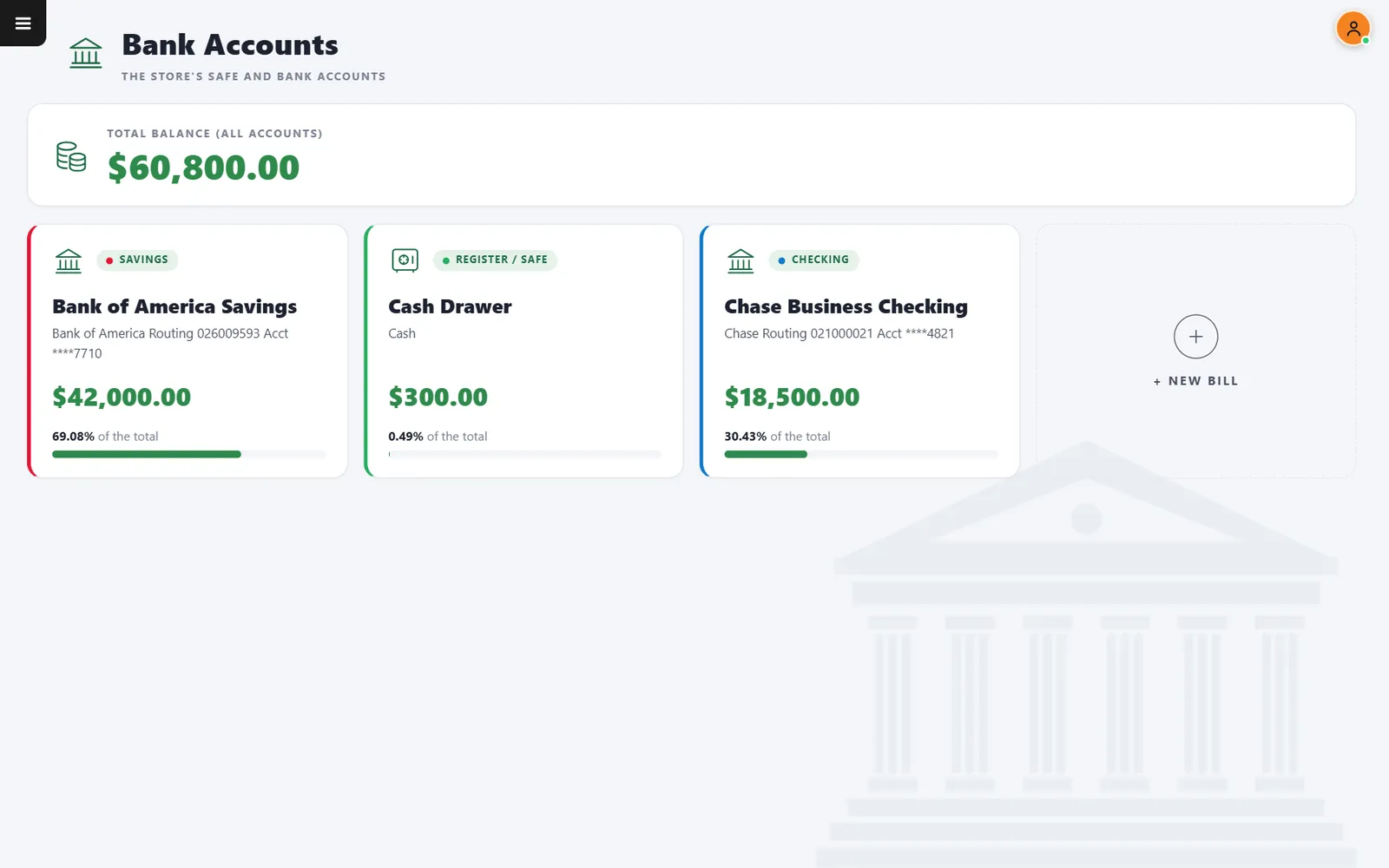
CounterChef's Finance includes bank accounts and register reconciliation.
The important thing is to maintain a process in which every deposit has a supporting explanation and every unresolved difference has someone responsible for investigating it.
Frequently asked questions
How often should a restaurant reconcile credit card sales?
A restaurant should review its POS closing reports and batch activity daily, then complete a fuller reconciliation weekly.
Daily checks catch missing batches and operational mistakes quickly. Weekly reconciliation allows time for settlement timing differences to resolve.
Monthly reconciliation should also confirm that the accounting records agree with bank statements and processor statements.
Why are credit card deposits lower than restaurant sales?
Deposits may be lower because of processing fees, refunds, chargebacks, settlement timing, or adjustments.
Tips may also be included in card transactions without representing additional restaurant revenue.
Compare the POS report with the processor settlement statement before deciding that a deposit is incorrect.
Should credit card tips be included in restaurant sales?
Card tips are included in the amount collected through card transactions, but they should be accounted for separately from the restaurant's earned sales.
They generally represent amounts owed to employees, subject to applicable tip-sharing and payroll rules.
Confirm the appropriate accounting and reporting treatment with your accountant and relevant state or local authorities.
What should an owner do when a credit card deposit is missing?
First, check whether the batch was closed and whether the processor marked it as settled.
Next, verify the settlement date, batch reference, merchant account, and destination bank account.
If the processor reports that the funds were released but the bank does not show them, contact the processor and bank with the settlement reference and supporting reports.
Record the amount as outstanding while investigating it. Do not classify it as a processing fee or write it off without documentation.
A good restaurant credit card reconciliation process does not depend on every daily number matching perfectly. It depends on being able to explain every difference, trace every deposit, and identify every amount that still needs attention.
Related feature: Finance.