
How to Set Restaurant Delivery Fees, Zones, Minimums, and Free-Delivery Thresholds
A delivery fee should reflect what it actually costs your restaurant to complete an order, not simply what nearby restaurants charge. Start with the cost of one delivery, separate that cost by distance and service area, and use the numbers to build a pricing structure that protects your margin without making customers feel that every order comes with a penalty.
Calculate the true cost of completing one delivery before setting a fee
The first mistake restaurant owners make when setting a restaurant delivery fee is starting with a number they think customers will accept.
They might charge $2.99 because it looks reasonable, $4.99 because another restaurant charges that amount, or nothing because they want to encourage more orders.
None of those decisions answers the important question: How much does it cost your restaurant to get one order from the kitchen to the customer's door?
You need to calculate that number before deciding what to charge.
Start by listing every expense that changes when you complete a delivery.
Your delivery cost may include:
- Driver wages and payroll-related expenses.
- Employer payroll taxes and other applicable labor costs.
- Vehicle mileage, fuel, maintenance, and depreciation.
- Parking, tolls, and other trip expenses.
- Delivery packaging, including bags, seals, and containers.
- Payment processing costs, where applicable.
- Time spent dispatching, coordinating, and resolving delivery problems.
- Remakes, refunds, and other delivery-related losses.
Separate expenses that happen on every order from expenses that happen only on certain routes.
For example, packaging is generally an order-level expense. Driver labor is a delivery expense, but its allocation depends on how many orders a driver completes during a shift. Vehicle expenses depend more heavily on mileage and time.
You should also distinguish between costs that belong in your delivery calculation and costs that belong in your general restaurant operating budget.
Your rent does not automatically become a delivery expense just because you sell food for delivery. However, additional dispatch labor or extra vehicle capacity required specifically for delivery should be included.
Build an actual cost-per-delivery calculation
Use this basic formula:
Cost per delivery = Total delivery operating costs ÷ Number of completed deliveries
For a more useful calculation, divide your expenses into three groups:
- Order-level costs: packaging, seals, and other supplies.
- Route-level costs: driver labor, mileage, parking, and vehicle expenses.
- Delivery-management costs: dispatch time, customer service, and delivery-related administrative work.
Consider this hypothetical example.
All figures below are hypothetical and are provided only to demonstrate the calculation.
A restaurant completes 400 deliveries during one month.
| Expense | Hypothetical monthly cost |
|---|---|
| Driver wages allocated to delivery | $2,400 |
| Employer payroll-related costs | $360 |
| Fuel and mileage expenses | $480 |
| Vehicle maintenance allocation | $160 |
| Delivery packaging | $320 |
| Dispatch labor | $280 |
| Delivery-related refunds and remakes | $120 |
| Total delivery costs | $4,120 |
The restaurant completed 400 deliveries.
$4,120 ÷ 400 = $10.30.
Hypothetical cost per completed delivery: $10.30
That number is the starting point, not necessarily the delivery fee you should charge.
If you charge customers $10.30, you recover the calculated delivery cost but leave no contribution toward other restaurant expenses or unexpected operating changes.
If you charge $4.00, the restaurant absorbs $6.30 per delivery before considering any other financial benefits from the order.
That might be a reasonable decision if the food order generates enough contribution margin to support the subsidy. But it should be a deliberate decision.
Calculate the cost of an unsuccessful delivery
One additional expense is easy to overlook: the delivery that does not go as planned.
A driver may arrive and discover that the customer entered an incorrect address. The customer may not answer the phone. An order may need to be remade because it arrived damaged.
These events consume labor and resources even when the restaurant does not complete a successful delivery.
Instead of treating each incident as an isolated problem, record the monthly cost of delivery failures.
Include these expenses in your delivery cost calculation, but avoid counting the same refund or remake twice if it already appears in your food-cost or accounting reports.
A useful weekly exercise is to review the five most expensive delivery problems and identify whether they came from distance, packaging, dispatch timing, address accuracy, or food preparation.
That exercise can reduce costs without changing your customer-facing fee.
Separate fixed delivery costs from distance-related costs
Not every delivery costs the same amount.
A customer who lives four blocks away may require less driver time and mileage than someone who lives several miles outside your immediate neighborhood.
A flat fee makes pricing simple, but it can create two problems.
First, nearby customers may pay more than the actual cost of serving them.
Second, distant customers may receive a delivery subsidy that is larger than the restaurant can comfortably afford.
The solution is to separate your delivery costs into a base amount and a distance-related amount.
Base delivery cost covers expenses that occur regardless of how far the driver travels.
Examples include:
- Dispatch and order coordination.
- Basic packaging.
- Driver preparation and handoff time.
- Administrative work associated with the delivery.
Distance-related delivery cost covers expenses that increase as the route gets longer.
Examples include:
- Additional driver time.
- Additional mileage.
- Fuel consumption.
- Vehicle wear.
- Tolls and parking, where applicable.
This distinction gives you a more accurate way to price delivery zones.
Use time as well as mileage
Mileage alone does not tell the whole story.
A three-mile delivery through a congested commercial district may take longer than a five-mile delivery on an open road.
The driver is being paid for time, not just distance.
For that reason, track actual delivery times alongside mileage.
Record:
- Time from driver departure to arrival.
- Total time from dispatch to return.
- Distance traveled.
- Whether the route involved unusual delays.
- Whether multiple orders were delivered during the same trip.
The distinction between arrival time and total driver time matters.
If a driver delivers two orders on one trip, allocating the entire trip cost to both orders independently would overstate your expenses.
Instead, allocate the shared trip cost using a consistent method, such as route time, incremental mileage, or another reasonable allocation based on your operating model.
Keep the method consistent so that you can compare zones accurately.
Create delivery zones around actual operating costs
A delivery zone is not just a circle drawn around your restaurant.
It is an operating area with a predictable cost, reasonable delivery time, and sufficient customer demand.
Start by looking at the ZIP codes or neighborhoods where your customers already live.
If you do not have enough historical delivery information, begin with a small geographic area and collect data before expanding.
A practical structure might include:
- Zone 1: Immediate neighborhood.
- Zone 2: Nearby residential areas.
- Zone 3: Outer neighborhoods.
- Zone 4: Extended delivery area.
You do not need four zones. Two or three may be enough for a small independent restaurant.
The important point is that each zone should represent a meaningful difference in delivery cost or service conditions.
Build a zone-cost worksheet
For each proposed zone, calculate:
- Average round-trip mileage.
- Average total driver time.
- Average number of orders delivered per trip.
- Allocated driver labor cost.
- Allocated vehicle cost.
- Order-level packaging and dispatch costs.
- Total estimated cost per completed order.
Here is a hypothetical zone calculation.
All figures in the following table are hypothetical.
| Cost component | Zone 1 | Zone 2 | Zone 3 |
|---|---|---|---|
| Driver labor per order | $3.00 | $4.50 | $6.50 |
| Vehicle expense per order | $0.70 | $1.20 | $2.00 |
| Packaging | $0.80 | $0.80 | $0.80 |
| Dispatch allocation | $0.50 | $0.50 | $0.50 |
| Total cost per delivery | $5.00 | $7.00 | $9.80 |
The figures suggest that Zone 3 requires almost twice the delivery resources of Zone 1.
Charging the same amount for every order would conceal that difference.
You could use a flat fee across all three zones, but you would need to decide whether the restaurant can afford to subsidize the more distant deliveries.
Alternatively, you can charge different fees by zone.
Avoid expanding your delivery area just because an address is technically reachable
A delivery may be physically possible but financially unattractive.
For example, a restaurant might receive an order from an address outside its normal delivery area. The driver could complete the trip, but the round trip might take 40 minutes.
That creates an opportunity cost.
During those 40 minutes, the driver might have completed several shorter deliveries.
This is why delivery zones should be based on operating capacity as well as geography.
Try this exercise this week:
Look at your 20 most distant completed deliveries from the previous month. Calculate their average round-trip time, mileage, and delivery contribution.
If the results are consistently poor, consider moving those addresses into a higher-fee zone or removing them from your delivery area.
Do not make the decision based on one unusually difficult trip. Look for a repeatable pattern.
Turn your delivery costs into a customer-facing pricing table
Once you know the cost of serving each zone, you can decide how much of that cost the customer should pay.
The restaurant does not necessarily need to recover 100% of delivery expenses through the delivery fee.
Food sales contribute toward labor, occupancy, utilities, and other operating expenses. Delivery may also create incremental revenue during slower periods.
However, the amount subsidized by the restaurant should be visible in your calculations.
Use this formula:
Restaurant delivery subsidy = Actual delivery cost − Customer delivery fee
If the result is positive, the restaurant absorbs the difference.
If the result is negative, the customer fee exceeds the calculated delivery cost. That may be intentional, but the restaurant should understand how that pricing affects demand and customer perception.
Worked example: Converting zone costs into delivery fees
Consider an independent restaurant with three delivery zones.
Every number in this example is hypothetical.
The restaurant has calculated these delivery costs:
| Zone | Hypothetical cost per order |
|---|---|
| Zone 1 | $5.00 |
| Zone 2 | $7.00 |
| Zone 3 | $9.80 |
Management decides to recover part of the delivery cost through customer fees while allowing food-order contribution to support the remaining expense.
It chooses these hypothetical fees:
| Zone | Delivery cost | Customer fee | Restaurant subsidy |
|---|---|---|---|
| Zone 1 | $5.00 | $2.00 | $3.00 |
| Zone 2 | $7.00 | $3.50 | $3.50 |
| Zone 3 | $9.80 | $5.50 | $4.30 |
The restaurant is not claiming that delivery is free. It is making a controlled investment in the delivery channel.
Now assume the restaurant completes the following hypothetical monthly order volumes:
| Zone | Orders | Customer fee | Monthly fee revenue |
|---|---|---|---|
| Zone 1 | 200 | $2.00 | $400 |
| Zone 2 | 120 | $3.50 | $420 |
| Zone 3 | 80 | $5.50 | $440 |
| Total | 400 | $1,260 |
The total hypothetical delivery cost is:
- Zone 1: 200 × $5.00 = $1,000.
- Zone 2: 120 × $7.00 = $840.
- Zone 3: 80 × $9.80 = $784.
Total delivery cost: $2,624.
Total customer delivery fees: $1,260.
Restaurant delivery subsidy: $2,624 − $1,260 = $1,364.
Average delivery cost: $2,624 ÷ 400 = $6.56.
Average customer fee: $1,260 ÷ 400 = $3.15.
Average restaurant subsidy: $1,364 ÷ 400 = $3.41.
This is a much more useful picture than simply knowing that the restaurant charges $3.15 on average.
You can now evaluate whether the food orders generate enough contribution to support the $3.41 average subsidy.
Ready-to-copy restaurant delivery pricing table
Use this as a starting template for your own operation.
The fees below are hypothetical examples, not recommended industry benchmarks.
| Delivery zone | Customer fee | Minimum order | Estimated delivery time |
|---|---|---|---|
| Zone 1 - Nearby | $2.00 | $15 | 25-35 minutes |
| Zone 2 - Local | $3.50 | $20 | 35-45 minutes |
| Zone 3 - Extended | $5.50 | $25 | 45-60 minutes |
Before publishing the table, confirm that the estimated delivery times reflect your actual kitchen and driver capacity.
A low delivery fee does not help if customers regularly receive orders later than promised.
Also decide whether the minimum order applies to food subtotal before tax, tips, and delivery charges. State that clearly in your ordering instructions.
Set minimum order amounts to protect contribution margin
A delivery minimum is not simply a way to encourage customers to buy more food.
It is a way to avoid accepting orders that cannot reasonably support the cost of preparing, packaging, dispatching, and delivering them.
Consider two hypothetical orders.
Order A:
- Food subtotal: $12.00.
- Delivery fee: $2.00.
- Delivery cost: $5.00.
Order B:
- Food subtotal: $32.00.
- Delivery fee: $2.00.
- Delivery cost: $5.00.
Both orders require a delivery, but the first order has much less food revenue available to contribute toward the restaurant's operating expenses.
The food subtotal alone does not tell you whether either order is profitable. You need the contribution margin after food and other variable order costs.
Use this formula:
Delivery order contribution = Food sales − Food cost − Order-specific variable costs − Delivery cost + Delivery fee
For this calculation, include the customer fee as revenue and avoid counting any expense twice.
Here is another hypothetical comparison.
| Item | Small order | Larger order |
|---|---|---|
| Food sales | $12.00 | $32.00 |
| Food cost | $3.60 | $9.60 |
| Packaging | $0.80 | $1.20 |
| Delivery cost | $5.00 | $5.00 |
| Customer delivery fee | $2.00 | $2.00 |
| Contribution before other operating expenses | $4.60 | $18.20 |
All amounts are hypothetical.
The larger order produces substantially more contribution toward the restaurant's other expenses.
That does not mean every small order should be rejected. A nearby small order may fit into an existing delivery route and have a relatively low incremental cost.
But you need a minimum that prevents low-value orders from consuming disproportionate resources.
Calculate your minimum instead of guessing
Start with the amount of contribution you want an average delivery order to generate.
Then work backward.
A simplified formula is:
Required food subtotal = (Target contribution + Delivery cost − Delivery fee + Fixed order-level variable costs) ÷ Contribution margin percentage before delivery
For example, assume the following hypothetical figures:
- Target contribution: $12.00.
- Delivery cost: $5.00.
- Delivery fee: $2.00.
- Packaging and other order-level variable costs: $1.00.
- Food contribution margin before delivery: 65%.
Calculation:
($12.00 + $5.00 − $2.00 + $1.00) ÷ 0.65
= $16.00 ÷ 0.65
= $24.62.
The restaurant could set a hypothetical minimum of $25.00.
This calculation gives management a starting point. It does not replace a complete profitability review, particularly when labor, payment processing, or other costs vary significantly by order.
Use different minimums when the zones have different costs
A single minimum may not work across your entire delivery area.
An order from the closest neighborhood might be economical at $15, while an order from a distant neighborhood may need to be $25.
Your minimums can reflect that difference.
One practical approach is to use a modest minimum in the closest zone and gradually increase it as delivery costs rise.
However, avoid creating so many different minimums that customers and employees cannot explain them.
Two or three clearly defined minimums are often easier to operate than a complicated collection of special rules.
Set free-delivery thresholds using incremental contribution
Free delivery is not free for the restaurant.
It means the restaurant agrees to absorb the delivery fee that the customer would otherwise pay.
The important question is whether the additional food sales generated by the offer contribute enough to cover that expense.
A common mistake is to set free delivery at an arbitrary food subtotal.
For example, an owner might choose $35 because it sounds like a reasonable amount.
But if most customers already spend $34, the offer may simply remove delivery revenue from orders that would have happened anyway.
You need to know what customers currently spend and how much additional contribution a higher order generates.
Calculate the additional contribution required
Use this formula:
Additional contribution = Additional food sales × Contribution margin percentage
Then compare that amount with the delivery fee you are waiving.
For example, consider these hypothetical figures:
- Current average food subtotal: $25.
- Proposed free-delivery threshold: $40.
- Additional food sales required: $15.
- Contribution margin on additional food sales: 65%.
- Delivery fee being waived: $3.50.
The additional contribution is:
$15 × 65% = $9.75.
The restaurant gives up $3.50 in delivery-fee revenue but receives $9.75 in additional contribution before other incremental expenses.
The difference is:
$9.75 − $3.50 = $6.25.
In this hypothetical example, the higher order generates $6.25 more contribution than the delivery fee being waived.
But there is an important qualification: the calculation assumes the customer increases spending because of the offer.
If that customer was already going to spend $40, the restaurant has not generated $15 in additional food sales. It has simply waived $3.50.
That distinction should guide your promotion.
Use the threshold to encourage specific additional purchases
Instead of telling customers to spend more, make it easy for them to understand what additional items would bring their order to the free-delivery threshold.
For example:
- Add a side dish.
- Add a dessert.
- Add a beverage.
- Add another entrée for a household member.
Review the contribution margin of those items before using them in the promotion.
A low-margin add-on may increase the food subtotal without generating enough contribution to cover the waived fee.
You should also compare the threshold against different days and meal periods.
A free-delivery offer during a slow weekday lunch may make sense if the kitchen and drivers have available capacity.
The same offer during a fully booked Friday dinner may create additional operational pressure without providing much incremental benefit.
Test delivery pricing without disrupting the entire restaurant
You do not need to redesign every delivery fee at once.
In fact, changing all fees, minimums, zones, and promotions simultaneously makes it difficult to understand what worked.
Use a controlled test.
Change one variable at a time
Suppose your restaurant currently charges:
- $2.99 for all delivery areas.
- $15 minimum order.
- Free delivery on orders above $40.
You want to introduce distance-based fees.
For the first test, change only the delivery fee by zone. Keep the minimum and free-delivery threshold unchanged.
Measure:
- Number of delivery orders.
- Average food subtotal.
- Average delivery fee collected.
- Actual delivery cost.
- Delivery contribution.
- Cancellation rate.
- Delivery times.
- Customer complaints.
Once the results stabilize, consider testing a different minimum.
This prevents you from attributing a change in order volume to the wrong decision.
Compare similar operating periods
Comparing a Monday lunch with a Saturday dinner is not particularly useful.
Compare similar days and meal periods.
If possible, account for weather, local events, holidays, staffing shortages, and unusual demand.
Also avoid drawing conclusions from a handful of orders. A small sample can be heavily influenced by individual customers or unusual routes.
The objective is to identify a pattern that is repeatable.
Try a delivery-fee experiment this week
Choose one zone and record its current performance for a full operating week.
Then make one adjustment, such as increasing the delivery fee by $0.50 or raising the minimum order.
Track the same measures for a comparable period.
Do not judge the test only by delivery volume.
If order volume declines slightly but contribution per order improves, the change may still be beneficial.
If contribution improves but complaints increase sharply, investigate whether the fee is clear, whether estimated delivery times are accurate, and whether customers understand the zone boundaries.
The goal is not to maximize the number of deliveries. It is to operate a delivery service that makes financial sense.
Use delivery pricing to improve route efficiency, not just recover expenses
Here is an operational opportunity many restaurants overlook.
You can sometimes reduce the cost of delivery without changing the customer's fee.
The key is to improve how orders are grouped and dispatched.
Identify neighborhoods where deliveries can be combined
Look at your delivery history and identify addresses that frequently appear close together.
For example, a restaurant may receive several orders from the same apartment complex, office building, or residential neighborhood.
If the orders can be delivered together without compromising food quality or promised delivery times, the driver may complete more deliveries during one trip.
That reduces the allocated cost per order.
Start with a simple manual review:
- Identify recurring delivery clusters.
- Record the average time between orders.
- Estimate the additional time required to combine stops.
- Check whether food quality will remain acceptable.
- Establish a maximum additional wait time.
Do not combine orders simply because they are geographically close. A delay that harms food quality can cost more than the labor saved.
Build a difficult-address list
Some addresses consistently consume more time than others.
Examples include:
- Large apartment complexes.
- Buildings with restricted access.
- Office buildings with complicated reception procedures.
- Properties with difficult parking.
- Locations where customers frequently provide incomplete instructions.
Create an internal list of addresses that require additional delivery time.
You can then decide whether to:
- Ask customers for more detailed delivery instructions.
- Call ahead when necessary.
- Adjust the estimated delivery time.
- Reconsider the zone assignment.
- Exclude addresses that cannot be served reliably.
This is more useful than automatically increasing fees for an entire neighborhood because of a few difficult buildings.
Review delivery density before extending your area
A new neighborhood may look attractive because it contains many potential customers.
But potential demand is not the same as profitable delivery density.
A restaurant might spend more time driving between scattered addresses than delivering several orders in a concentrated neighborhood.
Try mapping the last 50 delivery addresses and grouping them by neighborhood or ZIP code.
Look for areas where orders cluster.
Those areas may deserve priority when you advertise delivery or evaluate new zones.
An area with fewer potential customers but more concentrated demand may be easier and cheaper to serve.
Make delivery fees clear before customers place an order
A delivery fee that appears unexpectedly at checkout can create frustration.
Customers should understand the fee, minimum order, and delivery area before they spend time building an order.
Your online ordering instructions should explain:
- Which ZIP codes you serve.
- The fee for each zone.
- The minimum food subtotal.
- Whether tax and tips count toward the minimum.
- The free-delivery threshold, if applicable.
- The estimated delivery time.
- Any limitations involving difficult-to-access locations.
Avoid language that makes the delivery fee sound optional if it is mandatory.
Also distinguish the delivery fee from a driver tip.
A delivery fee is revenue collected by the restaurant under its stated pricing policy. A tip is a separate payment governed by your business practices and applicable rules.
Do not imply that the entire delivery fee goes to the driver unless that is actually how your arrangement works.
Confirm applicable fee disclosures, tip practices, and employee compensation requirements with your state or city and an appropriate professional.
Give employees a simple explanation
Your phone staff should not have to invent explanations for different fees.
Give them a short script.
For example:
"Our delivery fees depend on the delivery area because the time and distance involved vary. Your address is in Zone 2, where the delivery fee is $3.50 and the minimum food order is $20. Orders of $45 or more qualify for free delivery."
The amounts in this script are hypothetical.
The script is short, direct, and explains the reason for the difference without apologizing for a pricing decision the restaurant has made intentionally.
Keep a weekly delivery-fee review instead of setting prices once
Delivery costs change.
Fuel expenses, wages, staffing availability, order volume, and delivery patterns can all affect your actual cost per order.
A fee that worked six months ago may no longer cover the same operating expenses.
Set aside time every week to review delivery performance.
You do not need a complicated financial model. A spreadsheet with a few consistent measures is enough to identify problems.
Ready-to-copy weekly delivery pricing checklist
Use this checklist during your weekly management meeting.
Delivery cost
- Record completed deliveries by zone.
- Calculate total driver labor allocated to delivery.
- Record mileage and vehicle expenses.
- Include packaging and dispatch costs.
- Record delivery-related refunds and remakes.
- Recalculate actual cost per completed delivery.
Zone performance
- Compare average delivery time by zone.
- Compare average mileage by zone.
- Identify neighborhoods with repeated delivery delays.
- Review unusually expensive addresses.
- Check whether zone boundaries still reflect actual operating conditions.
Pricing
- Compare customer fees with actual delivery costs.
- Calculate the restaurant subsidy by zone.
- Review minimum order performance.
- Check whether free-delivery orders generate sufficient additional contribution.
- Confirm that all customer-facing prices and conditions are accurate.
Operations
- Review driver utilization.
- Identify opportunities to combine nearby orders.
- Check packaging-related complaints.
- Review dispatch delays.
- Identify the three most expensive delivery problems from the week.
Management decision
- Keep current pricing if the results are acceptable.
- Adjust one fee, minimum, or threshold if the numbers justify it.
- Document the reason for the adjustment.
- Set a date to review the results.
The final step matters.
Write down why you changed a price. Otherwise, a few weeks later, you may not remember whether a fee increase was intended to cover mileage, reduce distant orders, or improve contribution per delivery.
Use CounterChef to organize delivery-area pricing
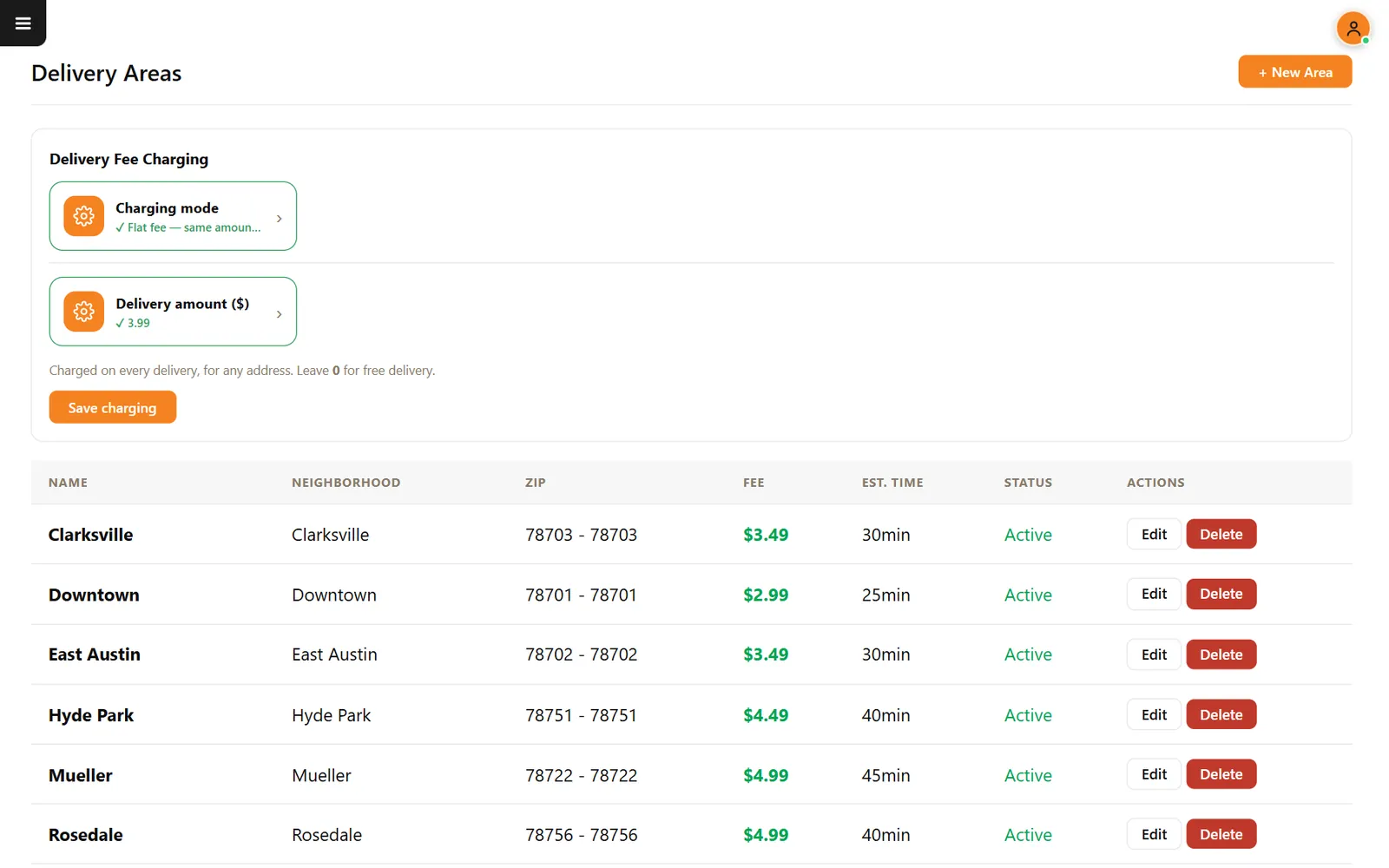
CounterChef allows restaurants to create delivery areas by ZIP code, with each area having its own delivery fee and estimated delivery time, or to use one flat delivery fee.
The delivery fee can also be waived automatically when items reach an amount you choose.
These options can help put your delivery pricing structure into practice once you have calculated the costs and decided on your zones, fees, and free-delivery threshold.
Frequently asked questions
How much should a restaurant charge for delivery?
Start with your actual cost per completed delivery, then decide how much the customer should pay and how much the restaurant can afford to subsidize.
Your fee should reflect driver labor, mileage, vehicle expenses, packaging, dispatch, and other delivery-related costs.
Some restaurants use fees of a few dollars, but any typical range varies by concept, geography, order size, and delivery model. Treat general market figures as a rule of thumb, not a substitute for calculating your own costs.
Should every delivery zone have a different fee?
Not necessarily.
Different fees make sense when the cost of serving each area differs meaningfully.
If your delivery area is compact and your delivery costs are relatively consistent, one flat fee may be easier to manage.
If distant neighborhoods require considerably more driver time and mileage, separate fees can help prevent nearby customers from subsidizing every long-distance order.
What is a good minimum order for restaurant delivery?
A good minimum is the food subtotal required to make an order economically worthwhile.
Calculate it using your contribution margin, delivery cost, customer delivery fee, and other variable expenses.
Consider different minimums for different zones if their delivery costs vary substantially.
Make sure customers understand whether the minimum applies before tax, tips, and delivery charges.
When should a restaurant offer free delivery?
Offer free delivery when the additional contribution generated by qualifying orders can reasonably cover the fee you waive.
Compare the proposed threshold with your current average food subtotal and the contribution margin of additional items customers might purchase.
Also consider delivery capacity. A promotion that generates more orders than your kitchen or drivers can handle may create delays, refunds, and customer complaints.
Review the results regularly and remove or adjust the offer if it stops producing enough incremental contribution.
Related feature: Zones and fees by ZIP.