
Managing Restaurant Delivery Drivers: A Complete Shift from Clock-In to Cash Settlement
Managing restaurant delivery drivers starts before the first order leaves the kitchen and ends after the last driver has returned, reconciled their money, and reported any problems. A reliable system follows each driver through the entire shift, with clear rules for dispatch, customer handoffs, vehicle safety, cash handling, and closing procedures.
Start the shift by checking the driver, vehicle, and equipment
At 4:30 p.m., your delivery driver arrives for a dinner shift. Before assigning an order, you need to know three things: whether the driver is ready to work, whether the vehicle is ready for the road, and whether the driver has everything needed to complete deliveries.
This sounds basic, but skipping the opening check creates problems that follow the driver throughout the night.
Start with attendance. Record the actual clock-in time, not the time the driver was scheduled to arrive. If the driver is late, record the difference and follow your normal attendance policy. Do not quietly adjust time records to make the schedule look better.
Next, check the driver's equipment.
A practical opening check should include:
- A charged phone with working navigation.
- A reliable phone mount.
- A working charging cable or power bank.
- An insulated delivery bag in clean condition.
- Appropriate clothing for the weather.
- A pen or another way to record delivery exceptions.
- Any restaurant-issued identification or delivery documentation.
- The correct starting cash float, if drivers handle cash.
Vehicle checks depend on whether the driver uses a personal vehicle or a restaurant-owned vehicle.
For a personal vehicle, ask the driver to confirm that it is available, roadworthy, and covered by insurance appropriate for the intended work. For a restaurant vehicle, establish a formal inspection process covering tires, lights, mirrors, brakes, fuel or battery charge, and visible damage.
Do not assume a personal auto insurance policy covers commercial delivery activity.
Confirm employment classification, wage and hour obligations, vehicle-use rules, insurance coverage, and any required documentation with your attorney and insurer. Requirements vary by state and city, and the distinction between an employee and an independent contractor can affect the entire operating arrangement.
Make the opening inspection a recorded routine
A verbal question such as "Everything good?" is not a useful inspection system.
Give the driver a short checklist and have them report problems before receiving the first order.
For example:
| Opening item | Driver confirms |
|---|---|
| Clock-in | Actual time recorded |
| Phone | Charged and operational |
| Navigation | Working |
| Delivery bag | Clean and functional |
| Vehicle | No known safety problems |
| Fuel or charge | Sufficient for planned shift |
| Insurance and documents | Current and appropriate |
| Starting cash | Counted and recorded |
If a vehicle has a safety problem, do not dispatch it just because the restaurant is busy.
The owner needs a backup plan: another approved driver, a temporary reduction in delivery coverage, or a change in the delivery promise.
A missed delivery is inconvenient. An accident caused by sending out an unsafe vehicle is a much more serious problem.
Give the driver a clear operating area before dispatch begins
Once the driver is checked in, explain which delivery areas they are covering.
Do not rely on a driver remembering an informal boundary discussed during hiring.
Create a delivery-zone map that identifies:
- Areas the restaurant normally serves.
- Streets or neighborhoods that create difficult access.
- Locations with parking restrictions.
- Buildings that require special entry instructions.
- Areas that are excluded because travel time is unreliable.
- Boundaries where an owner or manager must approve an exception.
A driver should know whether a particular address is inside the normal delivery area before accepting the assignment.
This prevents a common problem: the restaurant accepts an order, the kitchen prepares it, and the driver then discovers that the destination is outside the practical service area.
Use a zone card rather than relying on memory
A simple table works well.
| Zone | General description | Dispatch rule |
|---|---|---|
| A | Closest neighborhoods | Normal dispatch |
| B | Intermediate distance | Check current workload |
| C | Outer delivery area | Manager approval during busy periods |
| D | Outside regular coverage | Decline or review individually |
These labels are illustrative. Your actual zones should reflect your restaurant's location, traffic patterns, staffing, and delivery promises.
There is another useful distinction: geographic distance is not the same as delivery difficulty.
A nearby apartment building with difficult parking, controlled access, and a long walk to the unit can consume more driver time than a farther house with easy access.
After several weeks, compare actual delivery times by address and zone. Use that information to refine your boundaries.
An idea to try this week: Identify five addresses that repeatedly cause delays. Write down the specific reason for each delay, such as parking, building access, confusing entrances, or traffic. Use those findings to update your delivery instructions rather than simply telling drivers to work faster.
Dispatch the first order only after checking the driver's capacity
At 5:00 p.m., the first dinner orders begin appearing.
The dispatcher or manager should decide which order goes to the driver, rather than allowing assignments to happen informally.
The most important question is not simply which order came in first.
It is whether the driver can complete the delivery within the restaurant's service promise without creating an unreasonable delay for another customer.
Before dispatching, check:
- Is the food ready or close to ready?
- Is the address within the driver's approved zone?
- Does the route make sense with the driver's current location?
- Is there another order that can reasonably be combined?
- Will combining orders compromise food quality or promised delivery times?
- Does the driver have the correct payment and collection instructions?
A driver should not be sent out while the kitchen is still waiting on an important item unless the restaurant has deliberately chosen that workflow.
Otherwise, the driver may spend time waiting in the parking lot, then rush to recover the lost time.
Establish a dispatch handoff
Every order should have a clear handoff between the kitchen and the driver.
The driver should receive:
- Order number.
- Customer name.
- Full delivery address.
- Phone number or approved contact method.
- Delivery instructions.
- Amount due.
- Payment status.
- Special collection instructions.
The kitchen should also confirm that the order is complete.
A useful practice is to have the driver verify the order number and package count before leaving.
For example, if an order includes two bags, a drink carrier, and a dessert container, the driver should know that before departure.
This prevents the restaurant from treating an incomplete handoff as a driver's delivery mistake.
Give drivers authority to reject an unsafe route
A delivery driver should not feel pressured to accept an assignment that creates an obvious safety problem.
Examples include:
- Severe weather.
- A vehicle malfunction.
- A road closure.
- An unsafe destination or handoff situation.
- A route that exceeds approved coverage.
- An instruction that would require illegal parking or another unsafe action.
The driver should contact the manager, explain the issue, and wait for an alternative instruction.
Make this policy explicit during training. Employees should understand that refusing an unsafe assignment is not the same as refusing ordinary work.
Follow one delivery from departure to customer handoff
At 5:20 p.m., the driver receives a completed order and leaves the restaurant.
This is where managing restaurant delivery drivers becomes a question of communication and accountability.
The driver needs to know the expected route, the delivery instructions, and what to do when the customer is unavailable.
The manager needs enough information to answer customer questions without constantly calling the driver.
A straightforward delivery process has five stages.
Stage 1: Departure
The driver confirms that the correct order is in the vehicle and records the departure time.
Stage 2: Travel
The driver follows a safe route and does not use the phone while driving. Navigation should be set before departure, and any necessary communication should happen while safely stopped.
Stage 3: Arrival
The driver reaches the address and follows the customer's instructions.
Stage 4: Handoff
The driver confirms the correct recipient or follows the restaurant's approved contactless delivery procedure.
Stage 5: Completion
The driver records the delivery as completed, including any required payment collection.
This sequence gives the restaurant a consistent record of what happened.
Create a standard procedure for unavailable customers
An unavailable customer is one of the most common sources of confusion.
Without a defined procedure, one driver may leave food at the entrance, another may return it to the restaurant, and another may wait indefinitely.
Set a consistent process.
For example:
- Check the delivery instructions.
- Contact the customer using the approved method.
- Wait the restaurant's defined contact period.
- Notify the manager if there is no response.
- Follow the manager's instruction.
- Record the outcome.
The manager should decide whether the order can be left in a safe, authorized location, returned to the restaurant, or handled another way.
Never assume that a driver has permission to leave an order unattended simply because the customer is not answering.
Also establish how to handle incorrect addresses, missing apartment numbers, inaccessible buildings, and requests to change the destination after departure.
These are operational decisions, not situations where each driver should invent a solution.
Keep communication short and useful during busy periods
At 6:15 p.m., the restaurant is receiving several orders, the kitchen is working through a backlog, and the driver is already on the road.
This is when poor communication becomes expensive.
Managers often make two mistakes.
The first is calling drivers repeatedly for updates that do not change the dispatch decision.
The second is failing to communicate information that would actually prevent a problem.
Build a communication routine around exceptions.
Drivers should contact the restaurant when:
- An address cannot be located.
- The customer does not respond.
- The payment amount is different from the expected amount.
- An accident or vehicle problem occurs.
- Food is damaged or spilled.
- A customer disputes the order.
- A delivery is likely to miss its promised time.
- The driver feels unsafe completing the handoff.
For ordinary deliveries, use a simple status system: assigned, picked up, on the way, delivered, or exception.
The restaurant does not need a lengthy phone conversation every time an order is completed.
Try a two-minute exception log
Here is an inexpensive operating improvement that many restaurants overlook.
Keep a shared daily log where managers record delivery problems in a consistent format.
| Time | Order | Problem | Action | Follow-up |
|---|---|---|---|---|
| 6:10 p.m. | 104 | Missing apartment number | Customer contacted | Correct address saved |
| 6:35 p.m. | 109 | Parking unavailable | Alternate handoff arranged | Review building instructions |
| 7:05 p.m. | 113 | Payment discrepancy | Manager verified amount | Check order record |
The entries above are hypothetical examples.
The point is to record the cause, not simply the outcome.
If three different drivers encounter the same access problem at the same building, the restaurant has an address-data problem. It does not necessarily have a driver-performance problem.
Review the log at the end of each shift and assign someone to correct recurring issues.
Manage multiple orders without sacrificing delivery quality
At 7:00 p.m., the restaurant has more orders than one driver can reasonably handle individually.
Now the manager needs to decide whether to group deliveries.
Combining orders can reduce unnecessary travel, but only when the destinations and timing make sense.
A good multi-order route considers:
- Geographic proximity.
- Food readiness.
- Promised delivery times.
- Food temperature and quality.
- Vehicle capacity.
- Special handling requirements.
- The amount of time each order will spend waiting.
Do not combine orders simply because they are going in roughly the same direction.
A route that adds substantial time to the first customer's delivery can create complaints and refunds that outweigh the savings from the combined trip.
Set a maximum route complexity
One practical improvement is to define a maximum number of stops a driver may receive at once.
This is an internal operating rule, not a universal industry benchmark.
A restaurant might begin with one or two stops for new drivers and review whether additional stops are manageable as the team gains experience.
The right limit depends on the menu, delivery distances, traffic, packaging, and service promise.
Also distinguish between a route with two nearby houses and one with two apartment buildings requiring separate access procedures.
The number of stops alone does not describe the difficulty of a route.
An idea to try this week: Take the last ten multi-order routes and reconstruct them using actual departure and completion times. Compare the planned sequence with what happened. Identify whether the delay came from the order sequence, food readiness, access, or traffic. Change one dispatch rule based on the most common cause.
Use a worked example to understand the cost of a driver's shift
Managing drivers requires understanding what each shift costs the restaurant.
Paying an hourly rate is only one part of the calculation. Depending on the arrangement, the restaurant may also have payroll-related expenses, vehicle costs, insurance expenses, mileage reimbursement, equipment, and administrative time.
The following example uses entirely hypothetical numbers. It is an illustration, not a wage recommendation or industry benchmark.
Hypothetical driver shift
Assume the restaurant schedules one employee driver for a four-hour dinner shift.
| Item | Hypothetical amount |
|---|---|
| Hours worked | 4 hours |
| Hourly wage | $18.00 |
| Gross wages | $72.00 |
| Employer payroll-related costs | $9.00 |
| Vehicle mileage | 40 miles |
| Hypothetical mileage reimbursement rate | $0.70 per mile |
| Mileage reimbursement | $28.00 |
| Allocated delivery equipment cost | $4.00 |
| Allocated insurance cost | $6.00 |
Hypothetical shift cost:
- Gross wages: $72.00
- Employer payroll-related costs: $9.00
- Mileage reimbursement: $28.00
- Equipment allocation: $4.00
- Insurance allocation: $6.00
Total hypothetical shift cost: $119.00
Now assume the driver completes eight deliveries.
The hypothetical operating cost is $14.875 per completed delivery, before considering any other costs not included in the example.
Suppose the restaurant collects a hypothetical delivery fee of $5.00 on each of the eight orders.
The hypothetical delivery fees collected total $40.00.
That does not mean the remaining $79.00 is automatically a loss attributable to delivery. The restaurant may earn revenue from food sales that contributes toward labor and overhead. The important point is to understand how much delivery service costs and whether the overall order economics support it.
Also, a driver who completes fewer deliveries because the kitchen is slow should not automatically be blamed for low productivity.
This is why delivery performance and kitchen performance need to be reviewed together.
Track driver performance using measures that explain what happened
A manager who evaluates drivers only by the number of completed deliveries can create the wrong incentives.
Drivers may rush, accept poor routes, or avoid reporting problems because they believe every delay will count against them.
Use a balanced scorecard instead.
| Measure | What it tells you |
|---|---|
| On-time delivery rate | Whether delivery promises are being met |
| Average delivery time | How long orders take after dispatch |
| Completed deliveries | Driver workload |
| Customer complaints | Handoff and service problems |
| Failed delivery attempts | Address, access, or customer issues |
| Cash discrepancies | Settlement accuracy |
| Vehicle incidents | Safety and maintenance concerns |
| Mileage per delivery | Route efficiency |
Do not treat every metric as a measure of individual performance.
For example, average delivery time includes more than driving. It can be affected by food preparation, dispatch delays, traffic, weather, and customer access.
Separate the parts of the process wherever possible.
Record:
- Order ready time.
- Driver departure time.
- Arrival time.
- Completion time.
This allows the manager to distinguish kitchen delays from travel delays and handoff delays.
Try a delivery delay code
Another practical idea is to assign a short reason code whenever a delivery exceeds its expected time.
For example:
| Code | Meaning |
|---|---|
| K | Kitchen delay |
| A | Address or access issue |
| T | Traffic or road conditions |
| C | Customer unavailable |
| V | Vehicle issue |
| D | Dispatch delay |
These codes make weekly reviews much more useful.
If most delays are coded K, adding another driver may not solve the problem. The kitchen may need better order pacing or a different pickup process.
If most delays are coded A, improve address instructions.
If most delays are coded D, review how orders are assigned.
The objective is to fix the cause rather than punish the person closest to the problem.
Train drivers to handle cash, tips, and payment discrepancies
At 8:00 p.m., the driver returns from a delivery with cash collected from a customer.
This is where restaurants need precise procedures.
Cash should never be handled through informal verbal agreements.
Every driver should know:
- Which orders require cash collection.
- Which orders are already paid.
- Whether change must be carried.
- How customer tips are recorded.
- Where collected cash is stored.
- When cash must be returned.
- How discrepancies are reported.
Start by recording the amount of cash the driver receives at dispatch, if the restaurant provides a starting float.
At delivery, the driver should collect only the amount shown in the order record unless the manager authorizes a correction.
If a customer disputes the amount, the driver should contact the restaurant rather than negotiate a different total.
Separate cash collected from driver tips
This distinction is important.
Cash received from customers for restaurant orders is not the same as money belonging to the driver.
Likewise, tips must be recorded and handled according to the restaurant's applicable policies and legal obligations.
Do not treat customer tips as a convenient way to balance a cash drawer.
Keep records that distinguish:
- Starting cash float.
- Cash collected from customers.
- Cash returned to the restaurant.
- Tips received.
- Approved advances.
- Documented adjustments.
Confirm applicable tip, wage, payroll, and recordkeeping requirements with a qualified professional in your state or city.
Give drivers a discrepancy procedure
A cash shortage should trigger a review, not an immediate accusation.
For example, the driver might have collected the wrong amount because the order total changed after dispatch.
Or the restaurant might have recorded an incorrect payment status.
The manager should compare the order record, the amount due, the amount collected, and the cash returned.
Document the result.
Do not make undocumented wage deductions or automatically charge drivers for shortages. Wage deduction rules vary, and the restaurant should obtain professional advice before adopting any recovery policy.
Keep vehicle safety and maintenance separate from delivery pressure
At 8:30 p.m., the driver reports that a tire appears to be losing pressure.
The restaurant still has orders waiting.
The correct decision is to remove that vehicle from delivery service until the problem is assessed.
Managers sometimes allow small vehicle problems to continue because the restaurant is busy. That creates unnecessary risk.
A written vehicle policy should explain:
- Who is responsible for vehicle maintenance.
- Which vehicles are authorized for deliveries.
- What insurance documentation is required.
- How mileage is recorded.
- What happens after an accident.
- How drivers report mechanical problems.
- Whether passengers are permitted.
- Whether personal errands are prohibited during delivery time.
- What happens if a vehicle becomes unavailable.
The details depend on whether the restaurant owns the vehicle or the employee uses a personal vehicle.
For restaurant-owned vehicles, maintain a service history and inspection records.
For personal vehicles, establish documentation and reporting requirements consistent with applicable law and insurance coverage.
Confirm all employment, vehicle-use, insurance, and liability rules with your attorney and insurer before putting the policy into practice. Do not assume that an employee's personal policy, a restaurant's general business coverage, or a particular employment classification automatically covers every delivery situation.
Establish an accident procedure before an accident happens
Drivers should know what to do if they are involved in a collision.
The written procedure should tell them to:
- Stop in a safe location.
- Contact emergency services when necessary.
- Obtain appropriate medical assistance.
- Notify the restaurant as soon as safely possible.
- Follow applicable reporting requirements.
- Exchange information as required.
- Document the incident without admitting fault or speculating.
- Follow the insurer's instructions.
Managers should know who receives the report and who contacts the insurance provider.
Do not ask a driver to continue deliveries in a damaged or potentially unsafe vehicle.
Bring the driver back through a consistent closing routine
At 9:15 p.m., the driver returns after the final delivery.
The shift is not finished just because the last customer has received the order.
The restaurant still needs to confirm that all orders have been closed, money has been reconciled, equipment has been returned, and any problems have been documented.
A proper closing process has four parts.
1. Confirm delivery completion
Review the driver's assigned orders.
Each should have a clear final status:
- Delivered.
- Returned to restaurant.
- Cancelled.
- Customer unavailable.
- Exception pending review.
There should be no unexplained orders left open.
2. Reconcile collected cash
Compare the driver's records against the order totals and payment information.
Do not rely on the driver's memory or an estimated amount.
3. Return equipment
Collect restaurant-owned bags, keys, identification, cash boxes, and other equipment.
Check for damage or missing items.
4. Record the actual end of shift
Record the actual time the driver finishes work, including required closing duties.
Do not automatically stop the time record at the scheduled end of the shift if the driver is still performing work.
The manager should also ask whether the driver experienced any problems that need attention before the next shift.
Use this ready-to-copy driver closing checklist
The following checklist can be printed or added to a daily operations sheet.
RESTAURANT DELIVERY DRIVER , SHIFT CLOSING
| Item | Confirmation |
|---|---|
| All assigned orders have a final status | ☐ |
| Failed deliveries have been documented | ☐ |
| Customer complaints have been reported | ☐ |
| Cash collected has been reconciled | ☐ |
| Starting float has been accounted for | ☐ |
| Tips have been recorded separately | ☐ |
| Advances have been documented | ☐ |
| Delivery bags have been returned | ☐ |
| Vehicle issues have been reported | ☐ |
| Accidents or safety incidents have been reported | ☐ |
| Actual clock-out time has been recorded | ☐ |
Driver: ____________________
Date: ____________________
Manager: ____________________
Cash expected: $__________
Cash returned: $__________
Difference: $__________
Outstanding issues: ______________________________
Driver signature: ____________________
Manager signature: ____________________
A signed checklist is not a substitute for accurate payroll or accounting records. It is a way to make sure the closing conversation covers the same subjects every time.
Settle each driver's shift using a documented calculation
Settlement should be a separate process from simply counting the cash in the driver's hand.
The restaurant needs to understand what the driver completed, what money was collected, what fees or rates apply under the agreed arrangement, and whether any advances were issued.
For a restaurant that pays drivers according to hourly wages, settlement should not be confused with payroll. Wages, overtime, reimbursements, tips, and deductions must be handled under the applicable employment and payroll rules.
For other arrangements, use the written agreement and obtain professional advice about whether the arrangement is legally appropriate.
A useful settlement record should include:
- Driver name.
- Settlement period.
- Number of completed deliveries.
- Applicable delivery fees, if relevant to the arrangement.
- Agreed daily rates, if applicable.
- Cash received.
- Starting float returned.
- Approved advances.
- Documented adjustments.
- Amount outstanding, if any.
Work through a hypothetical settlement
Assume a hypothetical driver has the following shift records:
| Item | Hypothetical amount |
|---|---|
| Completed deliveries | 9 |
| Agreed daily rate | $90.00 |
| Cash collected for restaurant orders | $145.00 |
| Starting cash float | $30.00 |
| Cash returned to restaurant | $175.00 |
| Approved advance | $20.00 |
The cash reconciliation is:
The driver returned the full hypothetical amount expected.
The restaurant also has a hypothetical agreed daily rate of $90.00 and an approved advance of $20.00.
If the advance is an amount already paid toward the agreed amount, the remaining amount under this simplified hypothetical arrangement is:
The restaurant would record $70.00 remaining under that agreement, subject to its actual payment terms and applicable legal requirements.
Notice that the $145.00 in customer collections does not belong to the driver simply because the driver carried it.
It is restaurant money being reconciled.
Likewise, the $30.00 starting float is not delivery revenue. It is cash provided to facilitate the shift.
This separation makes settlement easier to audit and prevents confusion between restaurant funds and driver compensation.
Use the closing report to improve the next shift
Once the driver has settled, the manager should take a few minutes to review the shift.
This is a step many independent restaurants skip.
They close the cash, put away the bags, and move on to the next day's work.
But the closing report contains information that can improve staffing, delivery zones, customer communication, and kitchen coordination.
Ask four questions:
- Which deliveries took longer than expected?
- Which problems were outside the driver's control?
- Did the restaurant send the driver out with incomplete orders?
- What should change before the next shift?
Record one operational improvement for the next day.
It might be updating an apartment entrance instruction, changing the dispatch sequence for a particular neighborhood, preparing additional delivery bags, or adjusting the driver's scheduled start time to match the actual dinner rush.
Try a five-minute next-shift review
Instead of conducting a long meeting, use three short categories.
| Category | Question | Action |
|---|---|---|
| Keep | What worked well? | Preserve the process |
| Fix | What caused unnecessary delay? | Assign an owner |
| Watch | What could become a recurring problem? | Monitor next shift |
For example, if a driver repeatedly waits for drinks, the issue may belong to the kitchen handoff process.
If the driver repeatedly returns with cash discrepancies, the restaurant may need to improve payment instructions or order verification.
If a particular zone consistently produces late deliveries, the manager may need to change the delivery promise or coverage rules.
The important part is assigning responsibility.
A problem without an owner usually appears again.
Use CounterChef to organize delivery information and settlement
For restaurants that want a structured way to handle driver assignments and reconciliation, CounterChef provides a defined delivery workflow.
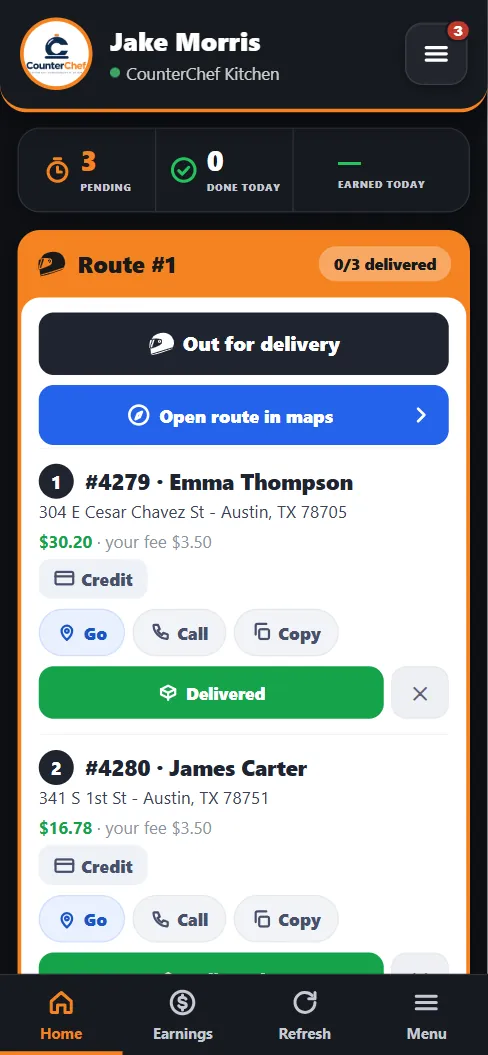
Each driver gets a personal link with stops, addresses, amounts to collect, navigation, call and delivered buttons. Routes are built by selecting orders in sequence. Driver settlement covers deliveries, fees, daily rates, cash received and advances by period.
The restaurant should still establish its own driver training, safety procedures, employment policies, and accounting controls. A delivery workflow does not replace those responsibilities.
Frequently asked questions
How many delivery drivers should a small restaurant schedule?
Start with actual order volume, delivery distances, and the time required to complete each route.
Review the number of orders arriving during each part of the shift, rather than relying only on the daily total.
A restaurant might need one driver during slower periods and additional coverage during dinner. The right staffing level varies by concept, location, menu, and service promise.
Track completed deliveries, waiting time, and overlapping routes before changing the schedule.
Should restaurant delivery drivers use their own vehicles?
That depends on the restaurant's business model, local requirements, insurance coverage, and employment arrangement.
A personal vehicle arrangement may reduce the restaurant's need to own and maintain vehicles, but it creates questions about insurance, mileage reimbursement, vehicle condition, and permitted use.
A restaurant-owned vehicle gives the business more direct control over maintenance and equipment but also creates ownership, operating, and insurance responsibilities.
Confirm the arrangement with your attorney and insurer before hiring drivers or allowing personal vehicles to be used for deliveries.
How should a restaurant handle a driver who is consistently late?
First, identify where the delay occurs.
Review order-ready times, departure times, delivery times, route assignments, and customer access problems.
If the driver is repeatedly arriving late at the restaurant, review attendance and scheduling records.
If the driver leaves on time but deliveries are late, examine route planning, traffic, and service-area expectations.
Discuss documented patterns with the employee, explain the expected procedure, and follow a consistent performance-management policy.
Do not assume every late delivery is a driver problem.
What should a restaurant do when a delivery driver loses cash or reports a shortage?
Reconcile the starting float, assigned orders, amounts due, recorded collections, tips, and cash returned.
Check for payment-status mistakes, incorrect order totals, and authorized changes before reaching a conclusion.
Document the discrepancy and give the driver an opportunity to explain what happened.
Do not automatically deduct the shortage from wages or withhold tips. Employment and wage deduction rules vary by jurisdiction, so consult your attorney or payroll professional before taking any recovery action.
A well-managed delivery shift should be predictable for the driver and understandable to the manager. When clock-in, dispatch, customer handoff, safety, cash handling, and settlement follow the same documented process, the restaurant can identify problems accurately and make better decisions about its delivery operation.
Related feature: Delivery drivers.