
Restaurant POS System in Providence, RI
Restaurants in Providence charge 8.00% in sales tax on meals and pay at least $16.00 an hour. Here is what that means for your POS setup.
PROVIDENCE RESTAURANT NUMBERS
Checked 11/18/2026 against official sources
What these rules mean for Providence restaurants
Restaurants charge 7% Rhode Island sales tax plus a 1% local meals and beverage tax. The state wants the 1% shown separately on the bill, and allows a combined 8% on receipts only if your books still track the two taxes apart. Mandatory gratuities are taxed; voluntary tips are not.
Combined sales tax on restaurant meals: RI Division of Taxation, meals and beverage tax.
Minimum wage: US Department of Labor, state tipped wage table.
Tipped minimum cash wage: US Department of Labor, state tipped wage table.
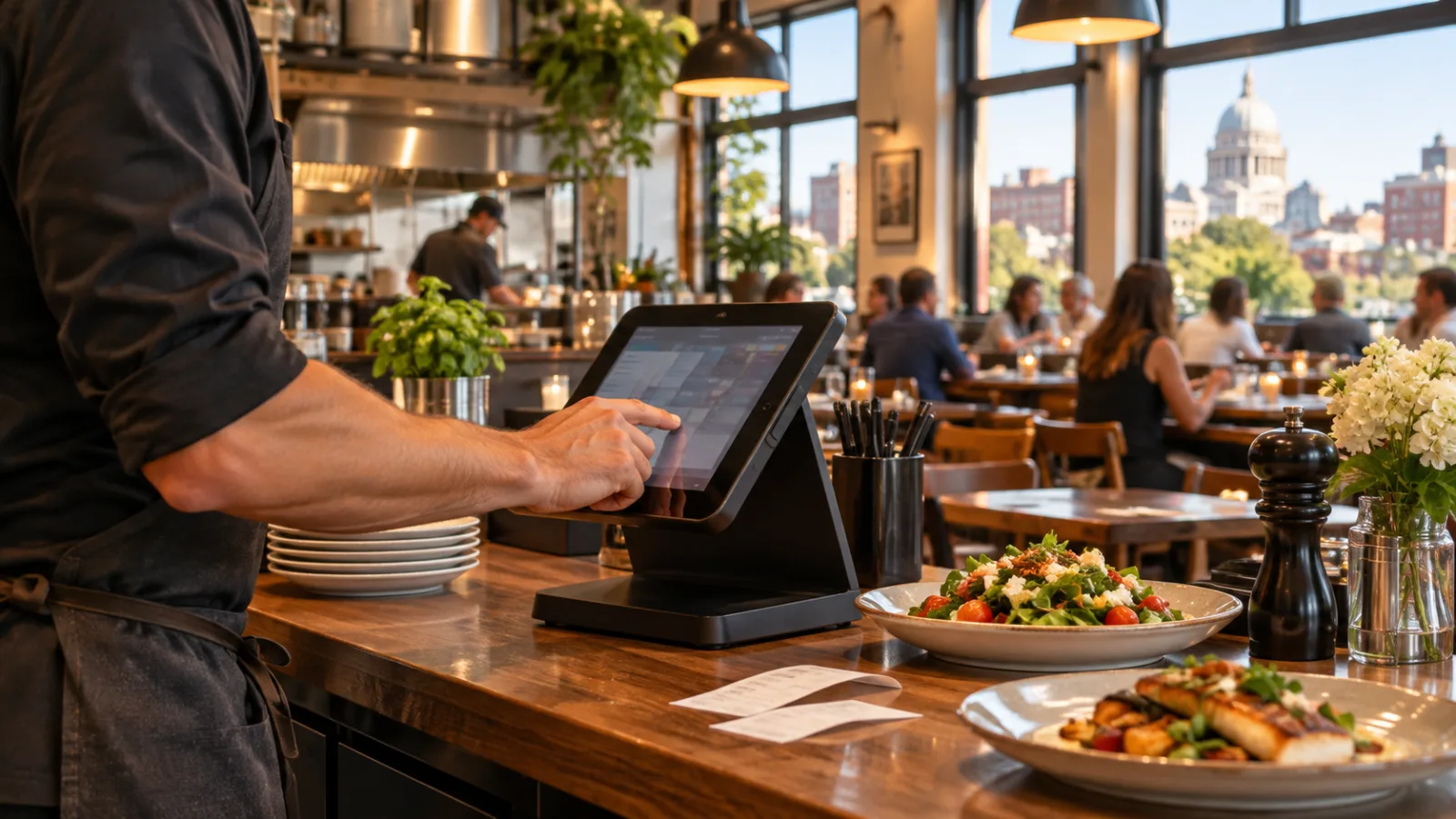
Restaurant POS System in Providence: Questions Owners Ask Before Opening, Hiring, and Serving
Running a restaurant in Providence means balancing customer service, food costs, staffing, taxes, and the pace of daily service without losing sight of the numbers. These are the practical questions I would sit down and answer with an owner over coffee, especially if they are choosing a restaurant POS system in Providence and want something that makes running the business easier rather than adding another headache.
What should I actually look at before choosing a POS system?
I would start with how the restaurant operates on an ordinary busy day, not with a list of software features.
A restaurant that mostly serves customers at tables has different needs from a counter-service restaurant, a café, a bar, or a kitchen handling a steady stream of pickup orders. The system should reflect how orders move from the customer to the cashier, kitchen, staff, and ultimately the payment.
Ask yourself a few practical questions:
- Can employees enter orders without navigating through unnecessary screens?
- Can the kitchen see what needs to be prepared, in the right order?
- Can I correct an order without creating confusion?
- Can I see what is selling and what is costing me money?
- Can I review sales and staff activity without being physically at the register?
A POS should simplify the work that already happens in your restaurant.
I would prioritize a reliable checkout, clear order management, straightforward reporting, and an interface that employees can learn quickly. Fancy features mean little if the cashier struggles during the lunch rush.
Does the POS need to be different for Providence restaurants?
Not necessarily because of the city itself, but because of how your restaurant operates within it.
Providence restaurants may experience a mix of regular customers, visitors, changing seasonal activity, dine-in traffic, and takeout demand. A restaurant's daily rhythm can vary, so your system needs to handle different types of service without requiring you to reorganize your entire operation.
I would look for flexibility in the way orders are handled. If you serve tables, table management matters. If you primarily serve at the counter, speed at checkout matters more. If you have a kitchen that handles multiple types of orders, clear communication between the front and back of house becomes essential.
Do not choose a system based on what another restaurant appears to use. Choose one that fits your menu, staff, service style, and daily workload.
How should I handle Rhode Island's restaurant sales taxes?
The combined sales tax on restaurant meals is 8.00%.
Rhode Island restaurant owners need to account for two separate taxes on qualifying restaurant meals:
- 7% Rhode Island sales tax
- 1% local meals and beverage tax
The state requires the 1% local meals and beverage tax to be separately stated on the customer's bill. If a business qualifies for the hardship provision allowing the taxes to be combined on receipts, it may display the combined 8% rate, but its books must still track the two taxes separately.
This is an important distinction when setting up your POS. The customer-facing receipt and your accounting records do not necessarily have to display the taxes in the same format, provided you follow the applicable requirements.
Hypothetical example: A $48.00 food check at 8.00% carries $3.84 in sales tax for a total of $51.84.
That is the kind of calculation your POS should handle consistently. Your reports should also make it possible to reconcile the separate tax obligations instead of treating the combined amount as a single unexplained figure.
Confirm your current tax requirements and reporting procedures with the Rhode Island Division of Taxation or a qualified tax professional before configuring your system. Rhode Island Department of State
Should I show the combined 8% tax or separate taxes on receipts?
I would make this a setup decision before your first day of service.
The state generally wants the 1% local meals and beverage tax separately identified from the 7% state sales tax. A combined 8% display may be permitted under the specified hardship provision, but combining the display does not eliminate the requirement to maintain separate records.
Your POS should allow you to configure the appropriate tax treatment, generate useful reports, and support the way you reconcile your books.
Before opening, print a few test receipts. Check whether the tax is calculated correctly, whether the receipt format meets your requirements, and whether the reports distinguish the taxes appropriately.
A small configuration mistake can become a recurring bookkeeping problem if it goes unnoticed for weeks.
Are mandatory gratuities taxed differently from voluntary tips?
Yes, and I would make sure the distinction is clear to everyone handling the register.
Mandatory gratuities are taxed; voluntary tips are not.
A mandatory gratuity is treated differently from a voluntary tip for tax purposes. This matters when you add charges to larger parties, private dining arrangements, or other situations where a gratuity is automatically included.
Your POS should not confuse a mandatory charge with a voluntary tip entered by the customer. If those amounts are categorized incorrectly, you may create unnecessary reporting and tax complications.
Review how your system handles both types of payment and make sure the categories are correctly configured. Employees should also understand what the customer is being charged and how the receipt presents it.
Confirm the applicable tax treatment with the official agency or a tax professional, particularly if you use different service charges or gratuity policies.
How much should I budget for employee wages?
Labor is one of the costs that deserves attention every single week. I would not wait until the end of the month to discover that scheduling decisions are affecting the business more than expected.
The verified Rhode Island wage figures provided for this guide are:
| Wage category | Rate |
|---|---|
| Minimum wage | $16.00 |
| Tipped minimum cash wage | $3.89 |
These figures are useful for building a basic labor budget, but they are not the complete cost of employing someone. Payroll taxes, applicable overtime, scheduling, benefits, and other employer obligations can affect the total.
Hypothetical example: One employee on a 6-hour shift at $16.00 costs $96.00 in base wages before payroll taxes.
That calculation is straightforward, but your actual payroll budget needs more than hourly wages. I would track labor hours against sales, look for recurring staffing patterns, and pay attention to shifts that consistently require more people than the business needs.
Confirm wage requirements, tipped employee rules, overtime, and other labor obligations with the official agency or a qualified payroll professional. Do not assume a POS payroll report by itself establishes compliance.
How can a POS help me control labor without making scheduling miserable?
I would use reporting to understand where labor is being spent, not simply to pressure employees to work faster.
Start by reviewing sales and hours worked across different days and shifts. Look for patterns: periods when the restaurant is consistently busy, shifts when employees are waiting for work, or times when the kitchen is overloaded while the front of house is underused.
A good POS makes it easier to review employee clock-in and clock-out records, compare sales activity, and understand what happened during a shift.
The goal is to make better scheduling decisions. Cutting too much labor can hurt service, create mistakes, and put unnecessary pressure on the people doing the work. Adding staff without understanding demand can make the business unnecessarily expensive.
I would review labor regularly and make adjustments based on actual operating patterns rather than relying on guesswork.
What reports should I check every day?
If I were running a restaurant, I would not spend hours staring at reports. I would build a short daily routine that answers the questions that affect decisions.
These are the reports I would pay attention to:
- Daily sales: How much did the restaurant sell?
- Sales by category: Which categories contributed to sales?
- Sales by item: Which menu items are moving, and which are rarely ordered?
- Discounts and voids: What was removed or discounted, and why?
- Labor hours: How many hours were worked during the reporting period?
- Payment reconciliation: Do the recorded transactions match what needs to be reconciled?
- Tax reporting: Are taxable sales and tax categories being recorded correctly?
I would also review trends rather than reacting to a single slow day. A restaurant can have an unusually quiet afternoon or a particularly busy evening without that being a meaningful long-term pattern.
Consistent reporting helps you make decisions about purchasing, staffing, pricing, and menu adjustments.
How can I use my POS to make better menu decisions?
Your menu is not just a list of dishes. It is one of the most important tools you have for controlling the restaurant's financial performance.
I would start with the cost of each menu item. If you do not know how much a dish costs to produce, it is difficult to judge whether its selling price makes sense.
A proper cost calculation should account for the ingredients used in the recipe, their quantities, and the cost of purchasing those ingredients. Where relevant, it should also consider waste, portion consistency, and changes in supplier pricing.
Then compare the costs with actual sales. An item that sells frequently may not be as profitable as you assume. Another item may sell less often but contribute more to your margins.
The POS is only part of this process. You need accurate recipes, ingredient prices, and consistent portioning to make the reports useful.
I would review menu performance periodically and adjust prices or recipes thoughtfully rather than making changes based on intuition alone.
What should I look for in a POS when handling delivery and pickup?
I would want the system to organize orders clearly and prevent unnecessary confusion between dine-in, pickup, and delivery workflows.
Even if you have a relatively small operation, orders can arrive while customers are standing at the counter, employees are serving tables, and the kitchen is preparing food. The system should make it obvious which order belongs to which customer and how it needs to be handled.
For delivery, I would look at whether the system can organize delivery areas, manage applicable fees, and provide estimated delivery times. Those settings should be easy to adjust as the restaurant's operation changes.
I would also check whether the system allows employees to update order statuses without repeatedly navigating through unrelated screens.
The practical question is simple: when five orders arrive at once, can your team manage them without losing track of what needs to be prepared, packed, or handed off?
What is the difference between a POS that looks good and one that actually works?
A polished interface is useful, but reliability and usability are what matter during service.
I would test the system with the people who will use it every day. Ask a cashier to enter an order, modify an item, apply an appropriate discount, split a payment, and complete a transaction. Ask kitchen staff whether they can read orders clearly. Ask a manager whether the reports make sense.
Do not assume that a system is easy to use because it looks modern in a demonstration.
Pay attention to the number of steps required for common tasks, the clarity of buttons, how errors are corrected, and whether employees can navigate it without constant assistance.
I would also test the system on the actual hardware you intend to use and make sure the restaurant has a workable plan for connectivity interruptions and other operational problems.
A POS should be dependable enough that the team can focus on customers, food, and service instead of troubleshooting the register.
What POS features should I consider before making my final decision?
I would compare systems based on how well they support the restaurant's everyday operations, rather than buying a system with features I may never use.
For example, CounterChef allows you to enter a combined sales tax rate with up to three decimals and set different rates by category; delivery areas use ZIP codes with their own fee and estimated time; employees clock in on a tablet or computer; tips can be shared by percentage or by hours worked; and it runs on iPad, Android tablet, iPhone and computer.
Those are the types of operational capabilities I would evaluate alongside the system's overall ease of use, reporting, order management, and ability to fit the way your restaurant operates.
Before committing to any POS, I would test the workflows that matter most to the business and verify that the configuration supports your accounting, staffing, and service requirements.
Providence restaurant questions
What is the most important feature of a restaurant POS system in Providence?
Reliable order management, accurate tax configuration, clear reporting, and ease of use. The system should support the restaurant's actual workflow and help the owner understand sales, labor, and operating performance.
What sales tax should a restaurant charge in Providence?
The combined sales tax on restaurant meals is 8.00%, consisting of 7% Rhode Island sales tax and 1% local meals and beverage tax. The local tax generally must be separately stated, with a permitted combined display under the applicable hardship provision, provided the books maintain the taxes separately. Confirm the current requirements with the Rhode Island Division of Taxation.
How should restaurant owners track employee hours and wages?
Use reliable time records, review hours regularly, and maintain accurate payroll records. Consider base wages, payroll taxes, and other applicable employer obligations when budgeting labor, and confirm current labor rules with the official agency or a qualified professional.
When should I replace my restaurant's POS system?
Consider replacing it when it repeatedly slows down service, makes reporting difficult, creates avoidable errors, or cannot support the restaurant's changing needs. Evaluate the practical problems you want to solve before choosing a replacement. A restaurant in Providence does not need complicated technology to run well. It needs a system that makes the everyday work of serving customers, managing employees, tracking costs, and keeping accurate records more manageable, so the owner can spend less time fixing operational problems and more time building a restaurant that works.
How to set this up in CounterChef
Enter your tax rate
Set 8.00% in Settings, under Tax, then ring a test item and check the receipt. Confirm the rate for your exact address first.
Read about restaurant posPrice delivery by ZIP code
Create areas for the Providence ZIP codes you can reach well, each with its own fee and estimated time.
Read about zones and fees by zipRun delivery yourself
Keep your own menu and drivers in one system, from the order to the driver settlement.
Read about delivery overviewMore for Providence restaurant owners
Running a restaurant in Providence?
Tell us how your restaurant runs. We will walk you through the parts that matter to you.