
Food Truck Management: How to Run Your Truck Day to Day, One Week at a Time
Running a food truck means managing a restaurant that changes its location, working conditions, and customer flow throughout the week. Good food truck management comes down to making deliberate decisions about where to park, what to prep, how to handle service, and how to account for every dollar after the truck returns.
The work is different from running a fixed restaurant, but the operating principles are familiar: control food costs, schedule labor carefully, keep service consistent, and know which locations actually make money.
Monday is for reviewing last week's numbers before choosing new stops
Monday should start with a review, not a new menu idea or a search for somewhere interesting to park.
Pull together the previous week's sales, food purchases, labor hours, fuel expenses, event fees, and cash records. Look at each service location separately. A busy lunch stop might generate plenty of sales but still produce a poor result if parking fees are high, customers order inexpensive items, or the line moves too slowly.
Build a simple location record with these details:
- Date and service hours.
- Location and type of service.
- Gross sales.
- Number of transactions.
- Average transaction value.
- Food and packaging used.
- Staff hours.
- Location or event fees.
- Fuel and travel expenses.
- Weather and unusual operating conditions.
The goal is to understand the economics of each stop.
For example, compare an office park where customers arrive in a predictable lunch window with a weekend market where visitors browse for several hours. The office park may have a shorter service period but more predictable demand. The market may produce more transactions but require additional labor and a longer setup.
Do not judge either location by revenue alone.
One useful practice is to calculate contribution after direct service costs for every location. Subtract food, packaging, direct labor, location fees, and travel expenses from sales. This will not include every overhead expense, but it gives you a better basis for comparing stops.
Also record what went wrong. A location with good sales might have had a slow payment process, a poorly positioned menu board, or an unusually high amount of food waste.
These details matter when deciding whether to return.
Tuesday is for choosing stops based on customers and operating conditions
A food truck cannot assume that a good location last month will remain a good location this month.
Your schedule should account for customer demand, permission to operate, accessibility, weather exposure, and the practical cost of reaching each stop.
Start with a list of possible locations:
- Office parks and business districts.
- Industrial areas with limited nearby lunch options.
- Breweries and other permitted private properties.
- Farmers markets and community markets.
- Sporting events and local festivals.
- College campuses and approved institutional locations.
- Private catering bookings.
Each location has a different operating pattern.
An office park may need a reliable weekly schedule so employees know when to expect you. A festival may require advance booking, additional inventory, and more staff. A private catering event may offer predictable revenue but involve a longer setup and cleanup period.
Confirm permission before putting a location on the schedule. Food truck permits and operating requirements vary by city and locality. Parking rules, fire inspections, health department approvals, commissary requirements, zoning restrictions, and event permissions may all apply. Confirm the rules with the relevant city, county, or state authorities before operating.
Do not assume that a permit issued in one municipality automatically allows you to operate in another.
Use a location scorecard before committing
A practical way to compare potential stops is to score them using the same criteria.
| Factor | What to check |
|---|---|
| Customer fit | Are people nearby likely to buy your menu? |
| Service window | Are customers available during your operating hours? |
| Competition | Are other food options already serving the area? |
| Access | Can customers reach the truck safely and conveniently? |
| Operating permission | Are parking and vending arrangements approved? |
| Cost | Are there fees, travel costs, or additional staffing needs? |
| Repeat potential | Can the location support regular service? |
One idea worth testing is a two-week location experiment. Keep your menu, prices, and service hours consistent while testing a new stop against an established one.
Record transactions per hour, average ticket, and contribution after direct costs.
This helps separate a genuinely productive location from one that simply looks busy.
Wednesday is for commissary preparation and inventory control
Wednesday is a good time to organize the ingredients and supplies needed for the next several services.
Many food trucks use an approved commissary or commercial kitchen for storage, preparation, cleaning, and other required activities. Your local health department determines what arrangements are permitted, so confirm the requirements for your operation.
Preparation should start with the sales forecast.
Review upcoming bookings, expected weather, previous sales at each location, and the menu planned for the week. Then calculate how much of each ingredient you need.
Avoid ordering based only on intuition.
For example, if your truck sells three sandwiches that share the same bread, lettuce, and tomato, forecast the combined demand for those ingredients. This reduces the risk of ordering too much for one menu item while running short on another.
Build recipes around actual portions
Every core menu item should have a written recipe with measurable quantities.
A burger recipe might specify:
- One bun.
- One measured beef portion.
- One slice of cheese.
- A defined quantity of sauce.
- A defined amount of lettuce and tomato.
- One standard packaging set.
Use portion scales where appropriate. Train employees to weigh or measure ingredients rather than estimate by sight.
A small portion difference repeated across many orders can become a meaningful cost.
Also establish a waste record. Separate expired ingredients, preparation waste, dropped food, incorrect orders, and unsold prepared products. Each category suggests a different solution.
For instance, excessive vegetable trimming may require better preparation training, while unsold cooked products may indicate that the forecast is too high.
Try a two-bin inventory system for critical supplies
One practical idea that often gets overlooked is using two clearly labeled inventory bins for essential items such as gloves, napkins, takeaway containers, and frequently used dry ingredients.
The first bin is the active supply. The second is the reserve.
When the active bin becomes empty, the reserve moves into service and triggers a reorder or restocking task.
This prevents the team from discovering a shortage during the lunch rush.
Keep a separate list of ingredients that require temperature-controlled storage. Follow applicable food safety procedures for receiving, storage, cooling, reheating, and transportation. Confirm specific requirements with your local health department.
Thursday is for testing the truck before the weekend
A food truck has limited working space, and equipment problems can disrupt an entire service.
Thursday should include a practical inspection rather than simply checking whether the engine starts.
Walk through the truck as if you were preparing to open.
Check:
- Refrigeration and temperature records.
- Cooking equipment and ventilation.
- Water supply and wastewater arrangements.
- Handwashing facilities.
- Fire safety equipment.
- Electrical connections and power supply.
- Propane systems, where applicable.
- Lighting and exterior signage.
- Payment equipment and backup procedures.
- Cleaning supplies and food storage containers.
Follow manufacturer instructions and applicable inspection requirements. Have qualified professionals handle repairs or inspections that require them.
Run a timed service rehearsal
Another useful idea is to conduct a short rehearsal before a busy event.
Choose five representative orders from your menu and prepare them in sequence. Measure how long each takes, identify where employees wait for equipment, and look for unnecessary movement.
Pay attention to bottlenecks.
Perhaps the person assembling sandwiches has to cross the truck repeatedly to reach the refrigerator. Perhaps the payment station blocks customers waiting for completed orders. Perhaps one ingredient is used in almost every order but stored too far from the assembly area.
Rearranging a station or preparing a frequently used ingredient in a more accessible location may improve service without adding equipment or staff.
Write down the changes and test them during the next service.
Friday is for confirming bookings, staffing, and cash readiness
Friday should be about making sure the weekend schedule is operationally realistic.
Confirm event times, arrival instructions, parking arrangements, power availability, water access, and any organizer requirements.
Do not rely on an old text message or an informal conversation when an event has specific operating conditions.
Staffing deserves the same attention.
Create a schedule that accounts for preparation, travel, setup, service, breakdown, cleaning, and commissary return. The time employees spend outside customer-facing service is still labor.
A common mistake is scheduling employees only for the hours the truck is selling food.
If an event starts at noon, someone may need to arrive considerably earlier to transport inventory, check equipment, and prepare the service area.
Labor laws, overtime requirements, breaks, employee classification, and payroll obligations vary by jurisdiction and situation. Confirm the applicable rules with your state or local labor agency and a qualified professional.
Prepare a cash and payment reconciliation sheet
Even if most customers pay electronically, maintain a clear record of cash activity.
Start each shift with a documented opening cash amount. Record cash sales, approved cash expenses, refunds, and the final counted balance.
Keep business cash separate from personal money.
Here is a ready-to-copy shift record:
| Item | Amount or record |
|---|---|
| Opening cash | $_____ |
| Cash sales | $_____ |
| Cash refunds | $_____ |
| Approved cash expenses | $_____ |
| Expected closing cash | $_____ |
| Actual closing cash | $_____ |
| Difference | $_____ |
| Card sales | $_____ |
| Total transactions | _____ |
| Employee closing initials | _____ |
For electronic payments, compare POS sales records with processor settlement reports and bank deposits. Account for processing fees, refunds, chargebacks, and settlement timing.
A deposit that does not match gross sales is not automatically evidence of a problem. It may reflect fees, refunds, or transactions settling on different dates.
Saturday is for disciplined service, not improvisation
Saturday is often the busiest day for a truck serving markets, private events, and community gatherings.
Your first priority is opening on time with a clean, organized workspace.
Before service begins, assign responsibilities clearly. One person might handle orders and payment, another might prepare food, and another might assemble and hand out completed orders. Smaller operations may combine roles, but everyone should know who owns each task.
Keep the menu visible and easy to understand.
A long menu can create unnecessary preparation requirements and slow down ordering. Focus on items that share ingredients, fit the available equipment, and can be produced consistently.
Manage the line by separating ordering and pickup
A useful operational adjustment is to make the ordering and pickup areas visually distinct.
Customers should understand where to place an order and where to collect it without asking employees repeatedly.
Use simple signs if the truck layout allows it.
Also give customers realistic expectations when an order will take longer than usual. A clear wait-time estimate is better than allowing people to assume their food is ready immediately.
During service, monitor three things:
- Ticket volume: How many orders are arriving?
- Production time: How quickly is the kitchen completing them?
- Menu availability: Which items are approaching a shortage?
Do not keep selling an item after you know you cannot prepare it properly.
If an ingredient runs out, update the menu immediately and explain the situation at the ordering point.
Worked example: A hypothetical Saturday service
The following figures are entirely hypothetical and illustrate how an owner might review one service.
Assume the truck operates for one Saturday event.
| Item | Hypothetical amount |
|---|---|
| Sandwich sales | $1,200 |
| Side sales | $300 |
| Beverage sales | $200 |
| Total sales | $1,700 |
| Food ingredients | $510 |
| Packaging | $85 |
| Direct labor | $300 |
| Event fee | $100 |
| Fuel and travel | $45 |
| Total listed costs | $1,040 |
| Contribution after listed costs | $660 |
Calculation:
$1,700 - $1,040 = $660.
The resulting contribution is approximately 38.8% of sales.
This is not net profit. It excludes other expenses such as insurance, permits, equipment depreciation, maintenance, administrative costs, and taxes.
Now suppose the owner discovers that a popular sandwich has been consistently receiving more cheese than its written recipe specifies.
Correcting the portion may reduce ingredient usage without changing the selling price. That is a better first step than immediately increasing menu prices.
The point is to identify a controllable operating cost before assuming the business needs more sales.
Sunday is for closing the week and learning from customer feedback
Sunday should include a proper close, whether the truck is operating or using the day for cleaning and administration.
Count cash, review payment records, record remaining inventory, dispose of or store food according to applicable requirements, and complete cleaning procedures.
Record any equipment problems while they are still fresh.
Do not rely on remembering that a refrigerator was making an unusual noise or that a particular ingredient ran short during the afternoon.
Review customer feedback without reacting to every comment
Customer reviews can reveal problems that sales reports cannot.
Look for repeated comments about:
- Portion sizes.
- Food temperature.
- Wait times.
- Menu availability.
- Order accuracy.
- Staff communication.
- Location visibility.
One isolated complaint does not necessarily indicate a widespread problem. Several similar comments may justify an operational change.
A useful idea is to keep a weekly complaint-to-action log.
| Customer feedback | Possible operational cause | Action to test |
|---|---|---|
| Orders take too long | Assembly bottleneck | Reorganize the station |
| Food arrives cold | Delay between cooking and pickup | Review handoff timing |
| Menu item unavailable | Weak purchasing forecast | Adjust prep quantities |
| Portions inconsistent | No measured serving standard | Retrain with a scale |
Assign one person to each corrective action and give it a deadline.
If you respond publicly to reviews, keep the response professional. Acknowledge the concern, avoid arguing, and explain how the business is addressing the issue when appropriate.
CounterChef can support basic food truck sales and menu reviews
A food truck operator needs a practical way to record counter transactions and understand product performance.
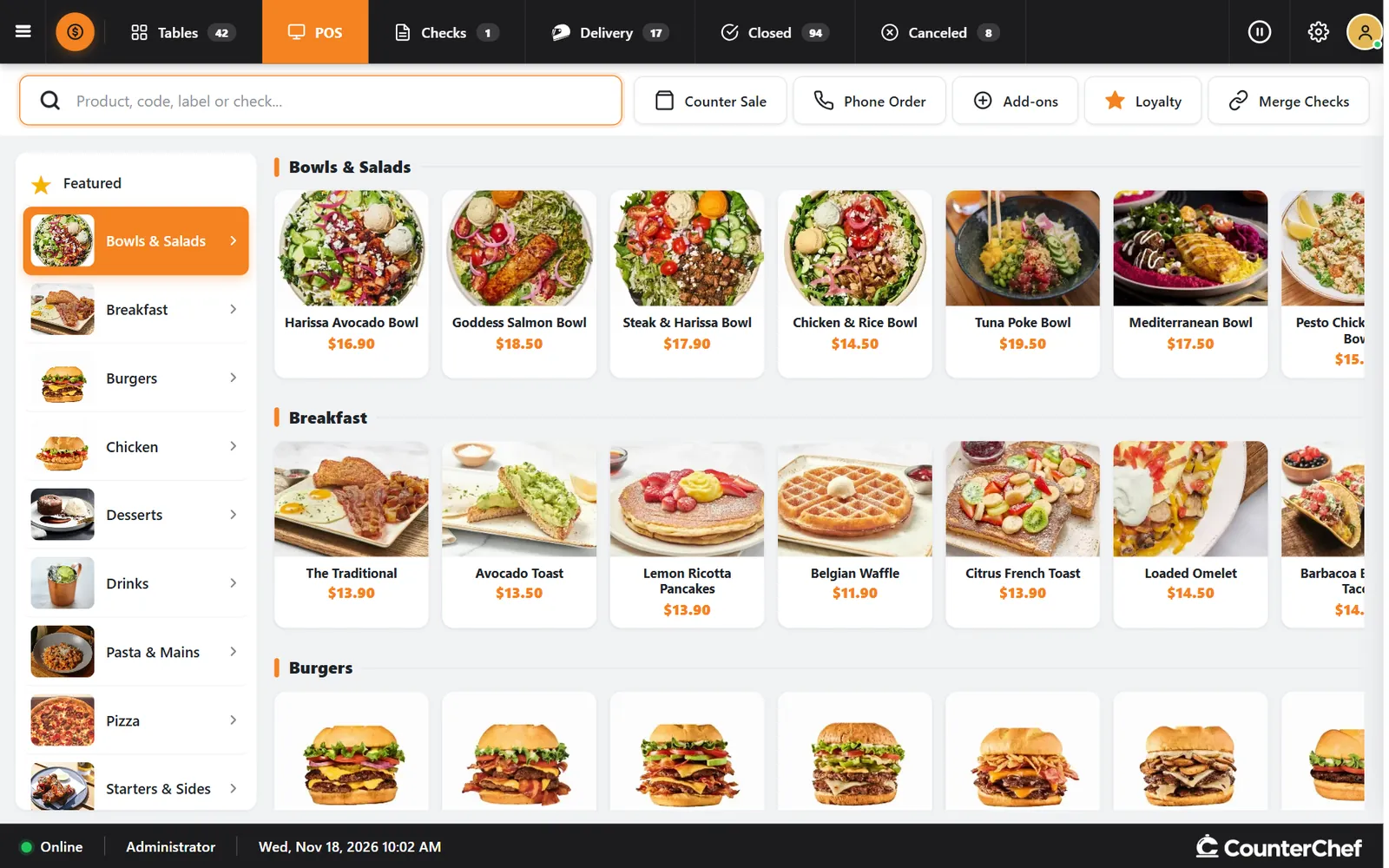
CounterChef's POS handles counter sales and runs on a tablet or phone. Its recipe cards show item cost, and its Reports show which products sell.
These functions can help an owner review sales activity and the cost of menu items when making weekly operating decisions.
Build a repeatable weekly food truck management routine
The biggest improvement in food truck management often comes from making important tasks repeatable.
Instead of solving the same problems every week, create a routine that assigns each task to a specific day.
Use this checklist as a starting point:
| Day | Required task | Completed |
|---|---|---|
| Monday | Review sales, expenses, and location results | ☐ |
| Monday | Identify waste and service problems | ☐ |
| Tuesday | Confirm upcoming stops and permissions | ☐ |
| Tuesday | Compare location performance | ☐ |
| Wednesday | Forecast ingredient requirements | ☐ |
| Wednesday | Complete commissary preparation | ☐ |
| Wednesday | Check critical inventory | ☐ |
| Thursday | Inspect truck and equipment | ☐ |
| Thursday | Rehearse service workflow | ☐ |
| Friday | Confirm bookings and staff schedules | ☐ |
| Friday | Prepare cash and payment records | ☐ |
| Saturday | Monitor service, portions, and inventory | ☐ |
| Sunday | Reconcile sales and cash | ☐ |
| Sunday | Review feedback and assign improvements | ☐ |
You do not need a complicated management system to get started. A shared spreadsheet, printed checklist, and consistent closing routine can provide a useful foundation.
Review the checklist monthly and remove tasks that no longer serve the operation.
The important thing is that responsibilities are clear and records are completed consistently.
Frequently asked questions
How much money do you need to start a food truck business?
Startup costs depend on the truck, equipment, kitchen requirements, permits, insurance, inventory, branding, and working capital. A used truck may require significant repairs, while a fully equipped vehicle may require a larger initial investment. Build a budget that includes several months of operating expenses rather than spending the entire available amount on the vehicle.
How many locations should a food truck visit each week?
There is no universal number. It depends on travel time, service hours, customer demand, event commitments, and the cost of setting up at each location. A smaller number of profitable, repeatable stops may be more manageable than changing locations every day.
Does a food truck need a commissary kitchen?
Requirements vary by city, county, and state. Some jurisdictions require an approved commissary for food preparation, storage, cleaning, or other activities, while others allow different arrangements. Confirm the rules directly with your local health department before starting operations.
How do you know whether a food truck is making a profit?
Track sales and expenses consistently, including ingredients, packaging, labor, fuel, event fees, insurance, maintenance, permits, and other overhead. Review results by location and by menu item. Calculate operating profit after accounting for all business expenses, not just the money remaining in the cash drawer after a busy service.
Related feature: Restaurant POS.