
How to Measure and Improve Sandwich Shop Profit Margin
A sandwich shop can sell a steady stream of sandwiches at lunch and still struggle to make money if portions creep up, combos are poorly priced, or too many employees are scheduled outside the busiest part of the day. To improve your sandwich shop profit margin, start by measuring the actual cost of each sandwich, then connect menu pricing, combo sales, and labor hours to the money left at the end of the month.
Start with the difference between sales and actual profit
A busy counter does not necessarily mean a profitable restaurant. Sales tell you how much money came in, but profit tells you how much remained after paying for the ingredients, employees, occupancy, and other operating expenses.
There are several margins worth tracking in a sandwich shop.
Food cost percentage measures how much you spend on ingredients relative to food sales.
Food cost percentage = Food cost ÷ Food sales × 100
Gross profit margin measures what remains after subtracting the direct cost of the food sold.
Gross profit margin = (Food sales − Food cost) ÷ Food sales × 100
Prime cost combines food and beverage costs with labor costs. It is particularly useful for sandwich shops because both ingredient portions and lunch staffing have a direct effect on profitability.
Prime cost = Cost of goods sold + Labor cost
Net profit margin measures what remains after all operating expenses.
Net profit margin = Net profit ÷ Total revenue × 100
Keep these measurements separate. A sandwich might have an attractive ingredient margin but still contribute little to the business if it requires extensive preparation or slows down the lunch line.
For meaningful comparisons, use consistent accounting periods and make sure sales, discounts, refunds, taxes, and cost categories are handled consistently. Sales tax collected for the government should not be treated as restaurant revenue.
Weigh sandwich ingredients instead of trusting visual estimates
Portion control is one of the most practical ways to protect a sandwich shop's margin.
Consider a sandwich with turkey, cheese, lettuce, tomato, and mayonnaise. The employee preparing it might use a little extra turkey because the customer looks hungry, add another slice of cheese because the first one looks small, and squeeze mayonnaise directly from a bottle.
None of those decisions seems expensive individually. Multiply them across hundreds of sandwiches, however, and the difference becomes meaningful.
Start by creating a recipe specification for every core menu item.
Include:
- Bread type and quantity.
- Meat weight in ounces.
- Cheese weight or slice count.
- Vegetable weight or standardized quantity.
- Sauce and condiment weight.
- Garnishes and finishing ingredients.
- Packaging, including wrappers, boxes, and bags when applicable.
Use a digital portion scale during preparation. Weigh ingredients in the same units used on your purchasing invoices whenever possible.
For example, if turkey arrives in bulk packages priced by the pound, calculate the cost per ounce:
Cost per ounce = Purchase price per pound ÷ 16
Then multiply that amount by the sandwich's required turkey weight.
Do not overlook trim, spoilage, and preparation losses. If a case of tomatoes costs $30 but some weight is lost during trimming, the usable ingredient costs more than the invoice price divided by the original weight.
The same principle applies to sliced meats, cheese, and vegetables.
Make portion standards easy to follow during lunch
A recipe book sitting in the office will not control portions during a busy service.
Put practical instructions where employees assemble sandwiches.
For example:
| Ingredient | Standard portion | Control method |
|---|---|---|
| Turkey | 4 oz | Portion scale |
| Cheddar | 1.5 oz | Pre-weighed portions |
| Lettuce | 0.5 oz | Portion cup |
| Tomato | 2 slices | Standard slicer setting |
| Mayonnaise | 0.5 oz | Measured dispenser |
These are hypothetical operating specifications, not recommended portions for every sandwich shop.
Make the portions visible and easy to repeat. Use labeled containers, portion cups, calibrated dispensers, and pre-weighed ingredients where practical.
One useful idea to try this week is a portion audit at three different times: before lunch, during the lunch rush, and after the rush.
Weigh five examples of the same sandwich at each time. Compare actual portions with the recipe.
You may discover that employees follow the standard in the morning but become less consistent when the line gets busy.
That tells you where training and preparation need attention.
Calculate the actual cost of each sandwich
Once portions are standardized, calculate the ingredient cost of each menu item.
Use current purchase prices rather than estimates based on what ingredients used to cost.
A simple recipe costing sheet should include:
| Ingredient | Portion | Cost per unit | Sandwich cost |
|---|---|---|---|
| Bread | 1 serving | $0.55 | $0.55 |
| Turkey | 4 oz | $0.22/oz | $0.88 |
| Cheddar | 1.5 oz | $0.20/oz | $0.30 |
| Lettuce | 0.5 oz | $0.08/oz | $0.04 |
| Tomato | 2 slices | $0.10/slice | $0.20 |
| Mayonnaise | 0.5 oz | $0.10/oz | $0.05 |
| Total | $2.02 |
All figures in this example are hypothetical.
The ingredient cost is $2.02. If the sandwich sells for $9.00, its theoretical food cost percentage is:
$2.02 ÷ $9.00 × 100 = 22.44%
Its gross profit before labor and other expenses is:
$9.00 − $2.02 = $6.98
That $6.98 is not net profit. It still needs to help pay employees, rent, utilities, insurance, payment processing, repairs, and other expenses.
Also account for packaging. If the sandwich uses a wrapper costing $0.12 and a bag costing $0.08, add another $0.20 to the direct cost.
The revised cost becomes $2.22.
This distinction matters because takeout packaging is part of the cost of fulfilling the order, even when it does not appear in the sandwich recipe.
Use actual inventory to find the cost of waste and overportioning
Theoretical food cost assumes employees use exactly the ingredients specified in the recipes.
Actual food cost reflects what the restaurant really consumed.
Calculate it using:
Beginning inventory + Purchases − Ending inventory = Actual food cost
For example, a sandwich shop starts the month with $4,000 in food inventory, purchases another $12,000, and finishes with $3,500.
Actual food cost is:
$4,000 + $12,000 − $3,500 = $12,500
Compare that figure with the theoretical food cost calculated from recipes and actual item sales.
A difference deserves investigation.
Possible explanations include:
- Employees using larger portions than specified.
- Spoiled vegetables or expired dairy.
- Incorrect inventory counts.
- Unrecorded employee meals.
- Complimentary sandwiches.
- Incorrect recipe costing.
- Unrecorded supplier credits.
- Theft or receiving discrepancies.
One practical idea is to introduce a daily waste ticket.
Every time an ingredient is discarded, record the item, approximate quantity, reason, and employee responsible for recording it.
Keep the process simple. You are not trying to punish employees for unavoidable waste. You are trying to distinguish normal preparation losses from recurring problems.
If the shop throws away tomatoes every afternoon, the issue might be purchasing quantities or preparation timing rather than employee behavior.
Price combos around contribution, not just perceived value
Combos can increase average ticket size, but a higher transaction total does not automatically mean a better profit.
A common mistake is discounting a sandwich, side, and drink without calculating the combined cost.
Consider a hypothetical menu:
| Item | Individual price | Direct cost |
|---|---|---|
| Turkey sandwich | $9.00 | $2.22 |
| Chips | $2.00 | $0.65 |
| Fountain drink | $2.50 | $0.45 |
| Total | $13.50 | $3.32 |
All figures are hypothetical.
Suppose the shop offers the three items as a combo for $11.99.
The combo contribution before labor and other expenses is:
$11.99 − $3.32 = $8.67
The individual items would produce:
$13.50 − $3.32 = $10.18
The discount reduces contribution by $1.51.
That may be acceptable if the combo increases order volume, encourages customers to purchase a drink, or helps move inventory. But you need to know what you are giving up.
Calculate contribution margin for each item and combo:
Contribution = Selling price − Direct variable cost
Then ask whether the combo increases the total contribution per transaction enough to justify the discount.
Build combos around ingredients and service efficiency
Not every side item has the same cost or operational impact.
A combo with chips and a fountain drink may be quicker to assemble than one with a made-to-order side that requires additional preparation.
Think about three factors:
- Ingredient contribution: How much money remains after direct product costs?
- Preparation time: Does the combo add work during the busiest service period?
- Inventory usefulness: Does the combo help sell products that are otherwise likely to remain unused?
Try testing two different combo structures for one week.
For example, compare a sandwich-and-drink offer with a sandwich, chips, and drink offer. Track the number sold, average ticket, direct cost, and contribution per transaction.
Do not judge the test by sales volume alone.
A combo that sells more but requires expensive ingredients and additional labor might be less attractive than a simpler offer.
Measure the lunch rush as a separate labor window
Labor is one of the biggest operating considerations for a sandwich shop.
The lunch rush creates a scheduling challenge: you need enough people to assemble sandwiches, operate the register, prepare sides, replenish ingredients, and handle pickup orders without creating excessive labor hours during quieter periods.
Looking only at total monthly payroll hides these problems.
Break the day into operating windows.
For example:
- Opening and preparation.
- Pre-lunch setup.
- Lunch rush.
- Afternoon slowdown.
- Closing and cleaning.
Record the number of employees working, their hours, and the sales generated during each window.
Then calculate:
Labor cost percentage = Labor cost ÷ Net sales × 100
For a more useful operational view, calculate sales per labor hour:
Sales per labor hour = Net sales ÷ Total labor hours
This helps identify periods when staffing is not aligned with demand.
Schedule around the shape of the lunch rush
Imagine your shop generates most of its lunch sales between 11:30 a.m. and 1:30 p.m.
Scheduling everyone for an identical eight-hour shift may leave the restaurant overstaffed in the morning and understaffed when orders arrive.
Instead, build staggered shifts.
For example:
| Employee | Shift | Main responsibility |
|---|---|---|
| A | 7 a.m.-3 p.m. | Opening and prep |
| B | 9 a.m.-2 p.m. | Sandwich station |
| C | 10:30 a.m.-2:30 p.m. | Register and drinks |
| D | 11 a.m.-3 p.m. | Sandwich assembly and restocking |
This is a hypothetical schedule, not a staffing recommendation.
The goal is to match coverage to the actual workload while maintaining enough preparation and closing coverage.
Do not cut staffing simply because sales per labor hour looks weak during a quiet period. Someone may need to prepare vegetables, receive deliveries, clean equipment, or complete other necessary work.
Instead, ask whether those tasks can be moved to a more productive window.
One idea worth testing this week is a 15-minute labor map.
For five operating days, record how many employees are working every 15 minutes alongside the number of orders received.
You may find that your biggest bottleneck happens at 12:15 p.m., even though the overall lunch period looks adequately staffed.
A small shift in one employee's start time could improve service without adding total labor hours.
Reduce lunch assembly time without reducing quality
A sandwich shop makes money through more than ingredient margins. It also makes money by completing orders efficiently.
Every unnecessary movement adds friction.
Watch how employees prepare a popular sandwich during a busy period.
Do they walk across the kitchen for cheese? Reach around another employee for tomatoes? Open several containers to find the right sauce? Stop assembling sandwiches to refill a dispenser?
These small delays accumulate.
Arrange the assembly line according to the order in which ingredients are used.
Keep frequently used ingredients accessible, but maintain proper food storage and temperature controls.
Use clearly labeled containers and consistent station layouts.
A useful exercise is to film or observe one complete sandwich assembly cycle, following workplace privacy rules. Identify every unnecessary movement and see whether the station can be rearranged.
Another practical idea is to establish a rush-readiness check at 10:45 a.m.
Before the busiest period begins, confirm that:
- Bread is ready for service.
- Meat and cheese are portioned.
- Vegetables are prepared and stocked.
- Sauces and dispensers are filled.
- Packaging is accessible.
- The register and ordering equipment are ready.
- Backup ingredients are available.
This reduces interruptions when the counter fills up.
Do not prepare more perishable ingredients than you can reasonably sell and safely hold. Better organization should reduce both waiting time and waste.
Use a monthly profit calculation to connect the decisions
A complete profit calculation shows whether portion control, combos, and staffing improvements are actually working together.
Consider the following hypothetical monthly example.
All figures below are hypothetical and are provided solely to demonstrate the calculation.
Assume the sandwich shop records:
| Financial item | Monthly amount |
|---|---|
| Sandwich and food sales | $38,000 |
| Drink sales | $7,000 |
| Total net sales | $45,000 |
| Food and beverage cost | $13,500 |
| Gross profit | $31,500 |
| Labor, including applicable payroll costs | $13,500 |
| Occupancy | $4,500 |
| Utilities | $1,000 |
| Payment processing | $900 |
| Insurance | $500 |
| Repairs and maintenance | $400 |
| Other operating expenses | $2,200 |
| Total operating expenses after COGS | $23,000 |
| Operating profit | $8,500 |
The calculations are:
Food and beverage gross profit:
$45,000 − $13,500 = $31,500
Gross profit margin:
$31,500 ÷ $45,000 × 100 = 70%
Prime cost:
$13,500 + $13,500 = $27,000
Prime cost percentage:
$27,000 ÷ $45,000 × 100 = 60%
Operating profit:
$31,500 − $23,000 = $8,500
Operating profit margin:
$8,500 ÷ $45,000 × 100 = 18.89%
This example assumes the listed expenses are complete and consistently classified. It is an illustrative operating calculation, not a claim about typical sandwich shop results.
It also does not automatically represent the final net profit reported for tax purposes. Interest, depreciation, income taxes, and other items may need separate treatment.
Test improvements against the original numbers
Now suppose the shop reduces unnecessary ingredient usage by $500 per month through better portion control.
Assume it also improves scheduling and reduces labor expense by $400 without reducing required coverage.
The hypothetical improvement is:
$500 + $400 = $900
Revised operating profit:
$8,500 + $900 = $9,400
Revised operating profit margin:
$9,400 ÷ $45,000 × 100 = 20.89%
The margin increases from 18.89% to 20.89%, assuming sales and all other expenses remain unchanged.
This illustrates why portion scales and labor scheduling deserve attention before simply raising menu prices.
Use menu performance to decide what deserves attention
Not every sandwich deserves equal attention from management.
Some products sell frequently and produce reliable contribution. Others sell infrequently but have attractive margins. Some are popular but expensive to produce, while others consume preparation time without generating enough contribution.
Track two dimensions:
- Popularity: How many units sell?
- Profitability: How much contribution does each unit generate?
This gives you four useful categories.
High popularity and high profitability: Protect availability and consistency. These are strong menu items.
High popularity and low profitability: Review portion sizes, purchasing costs, and pricing. Avoid making changes that damage a product customers regularly buy.
Low popularity and high profitability: Improve menu placement, staff recommendations, or visibility.
Low popularity and low profitability: Consider changing the recipe, reducing preparation complexity, or removing the item.
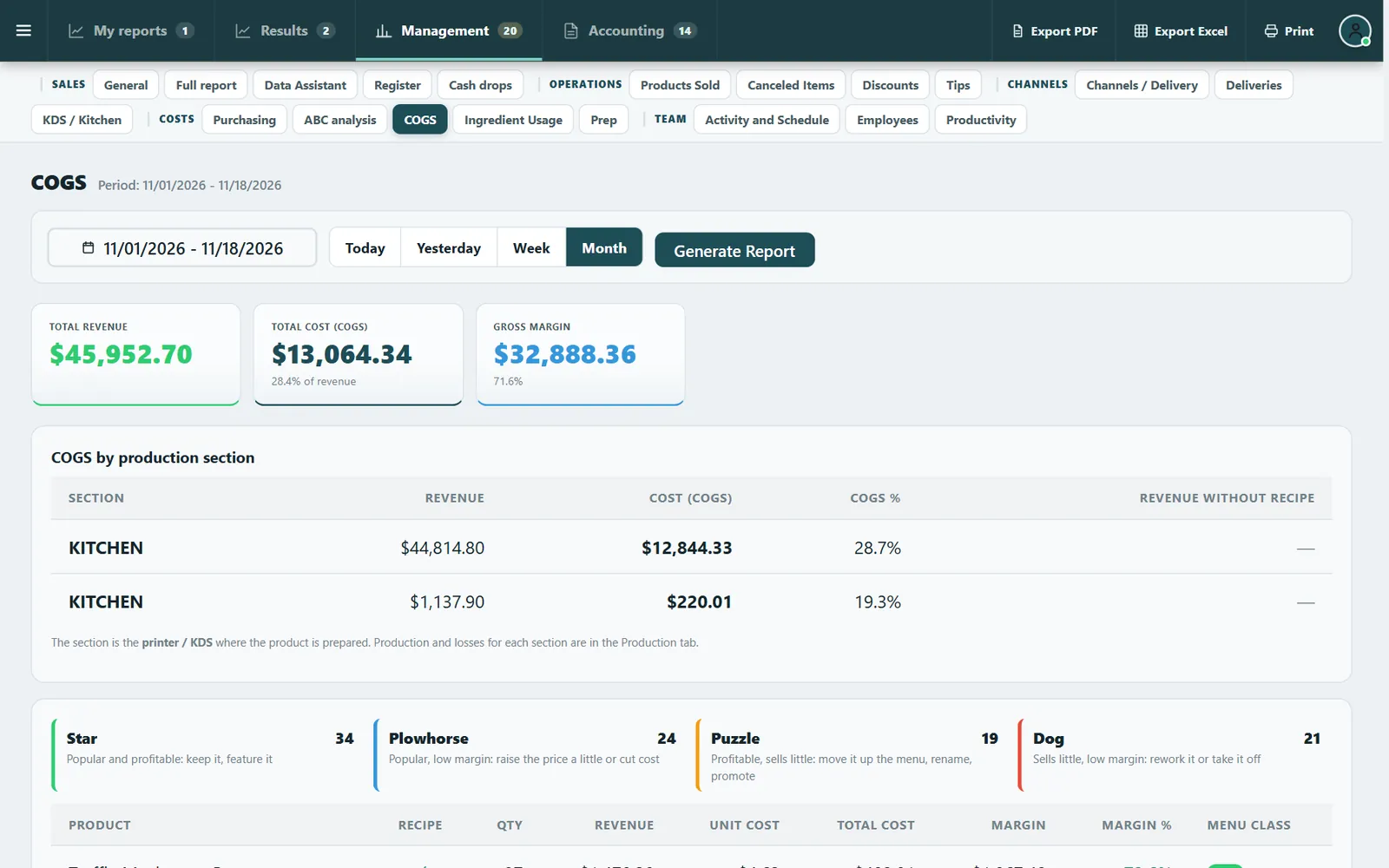
CounterChef's COGS report classifies every item as Star, Plowhorse, Puzzle or Dog using your own sales and recipe costs.
Use this type of analysis to make decisions based on your own menu rather than assumptions about what should sell.
Put these five operating checks into your weekly routine
Improving a sandwich shop profit margin requires regular attention rather than a once-a-year menu review.
Use this ready-to-copy checklist during your weekly management meeting.
Sandwich shop weekly margin checklist
| Check | What to review | Action if something is wrong |
|---|---|---|
| Portion consistency | Weigh five examples of popular sandwiches | Retrain or adjust station setup |
| Ingredient costs | Update prices for major ingredients | Recalculate affected recipes |
| Waste | Review discarded ingredients | Adjust purchasing and prep quantities |
| Combo performance | Compare sales and contribution | Change pricing or composition |
| Lunch staffing | Compare labor hours with 15-minute order volume | Adjust shift start and end times |
| Menu performance | Compare item popularity and contribution | Review pricing, promotion, or removal |
| Inventory | Compare beginning stock, purchases, and ending stock | Investigate unexplained differences |
Assign one person to collect the information and another to review it. This creates accountability without turning every management meeting into a lengthy accounting exercise.
Also compare results against the previous week and the same period in prior months when possible. Holidays, weather, school schedules, and local events can affect sales patterns.
Avoid changing several variables simultaneously. If you change portion sizes, combo pricing, and staffing in the same week, you may struggle to identify which decision produced the result.
Test one or two changes at a time and record what happened.
Frequently asked questions
What is a good sandwich shop profit margin?
There is no single profit margin that applies to every sandwich shop. Results depend on rent, wages, ingredient costs, sales volume, menu complexity, opening hours, and the amount of owner labor involved.
As a rule of thumb, any margin range you use for comparison should be treated cautiously because it varies by concept and location. Your most useful starting point is your own historical performance and a complete monthly profit calculation.
How can a sandwich shop reduce food costs without lowering quality?
Start with portion consistency, purchasing accuracy, and waste tracking.
Weigh meats and cheeses, standardize sauce quantities, monitor vegetable trimming, and prepare ingredients according to actual demand.
Review supplier invoices regularly and update recipe costs when prices change. Avoid reducing portions randomly. If a recipe needs adjustment, make the change deliberately and ensure the finished sandwich still meets your quality standards.
Should a sandwich shop offer meal deals and combos?
Yes, if the numbers support them.
Calculate the individual selling prices, combined ingredient costs, packaging costs, and expected contribution before setting a combo price.
Then measure how many customers purchase the combo and whether it increases average ticket size and total contribution. A discount that increases sales but reduces overall contribution may not be worth keeping.
How often should a sandwich shop review its profit margin?
Review key operating indicators weekly and complete a more thorough profit and loss review monthly.
Weekly checks should cover portion consistency, waste, ingredient prices, combo performance, and lunch labor scheduling. Monthly reviews should connect those operational numbers to actual sales, inventory, payroll, occupancy, and other expenses.
If ingredient prices change significantly or a major menu item is repriced, update its recipe costing immediately rather than waiting for the next monthly review.
Related feature: COGS and menu engineering.