
How to Close a Restaurant Register: The End-of-Day Routine That Keeps Your Numbers Straight
Closing a restaurant register is more than counting the cash drawer and putting the money in a safe. A reliable closing routine accounts for cash, card payments, tips, refunds, paid-outs, and deposits while giving you a clear way to investigate differences without turning a bookkeeping problem into a personnel accusation.
The goal is simple: every dollar collected or paid out should have an explanation, every drawer should have a documented final count, and the next day's opening manager should know exactly what they are starting with.
Start the closing process before the last customer leaves
Do not wait until the restaurant is empty to think about closing the register. A good close starts before the final transaction.
During the last part of service, the closing manager should check that all open tickets are accounted for, no tables have been left with unfinished payments, and employees have completed any required checkout steps.
Start with these checks:
- Confirm that every completed order has been paid, voided, or otherwise properly accounted for.
- Check for open checks that belong to departing employees.
- Review pending refunds and discounts.
- Confirm that cash paid-outs have receipts or written explanations.
- Make sure tip adjustments have been entered according to your restaurant's procedure.
- Identify which employees handled each drawer during the shift.
Keep the register open for legitimate late transactions. Closing early to make the numbers easier to count creates unnecessary problems if a customer needs a correction or another payment must be processed.
One practical idea is to establish a closing cutoff for routine employee purchases, cash exchanges, and nonessential register adjustments. This does not mean refusing legitimate customer transactions. It means reducing avoidable drawer activity while the manager is preparing the close.
Assign one person to control the closing count
The person responsible for closing the register should be clearly identified.
In a small restaurant, that might be the owner or shift manager. In a larger operation, it may be a designated closing supervisor.
Ideally, one employee counts the drawer while another observes or independently verifies the result. If staffing does not allow two people, the manager should still document the count immediately and avoid leaving an unattended drawer.
Use these basic controls:
- Stop normal register activity before beginning the count.
- Record the register number and employee or shift assignment.
- Print or save the register's end-of-shift report.
- Remove the drawer from the active service area.
- Count cash in a designated location away from customers.
- Record the physical count before comparing it with the expected balance.
- Have the manager review and sign the completed count sheet.
Do not count cash while simultaneously handling customer payments, answering service questions, or making change for another employee. Interruptions increase the chance of a simple counting error.
Print the register report before counting the cash
The register report provides the sales information needed to reconcile the drawer.
Depending on the POS configuration, the report may show:
- Gross sales.
- Discounts and promotions.
- Voids.
- Refunds.
- Net sales.
- Cash payments.
- Credit and debit card payments.
- Tips.
- Taxes.
- Cash paid-outs.
- Cash drops.
- Expected cash balance.
Know which figures represent actual cash movement and which are accounting totals.
For example, sales tax collected in cash is part of the cash received, but it is not additional revenue for the restaurant. Similarly, a credit card tip is not money sitting in the cash drawer.
Do not assume that the POS report's total sales figure should equal the drawer count. The drawer contains physical cash, not every payment recorded during the shift.
A useful habit is to save the closing report under a consistent date and register naming convention. For example:
2026-11-18_Register-01_Closing
This makes it easier to locate the report when reviewing a discrepancy several days later.
Count the drawer using denominations rather than estimates
Once the register is closed to normal activity, remove the cash and organize it by denomination.
Count each denomination separately. Do not estimate the total by looking at the size of the cash stack.
A count sheet should include:
- Starting bank.
- Cash received.
- Cash paid out.
- Cash drops.
- Physical ending cash.
- Expected ending cash.
- Over or short amount.
- Employee and manager identification.
The starting bank is the amount of cash placed in the drawer at the beginning of the shift. It is not sales revenue.
For example, if a drawer begins with $200 in change, that $200 must remain distinguishable from the cash generated by sales.
Here is a ready-to-copy count sheet.
Restaurant register closing count sheet
| Field | Entry |
|---|---|
| Business date | __________ |
| Register number | __________ |
| Closing employee | __________ |
| Closing manager | __________ |
| Starting bank | $__________ |
| Cash sales | $__________ |
| Cash refunds | $__________ |
| Cash paid-outs | $__________ |
| Cash drops | $__________ |
| Expected ending cash | $__________ |
| Physical ending cash | $__________ |
| Over / short | $__________ |
| Explanation or follow-up | __________ |
Physical denomination count
| Denomination | Quantity | Total |
|---|---|---|
| $100 bills | ____ | $____ |
| $50 bills | ____ | $____ |
| $20 bills | ____ | $____ |
| $10 bills | ____ | $____ |
| $5 bills | ____ | $____ |
| $1 bills | ____ | $____ |
| Quarters | ____ | $____ |
| Dimes | ____ | $____ |
| Nickels | ____ | $____ |
| Pennies | ____ | $____ |
| Total physical cash | $____ |
Employee signature: ____________________
Manager signature: ____________________
Date and time completed: ____________________
The sheet should be completed for each drawer, not just for the restaurant as a whole. Combining multiple registers too early can hide the source of a discrepancy.
Calculate expected cash before comparing it with the physical count
The basic reconciliation formula is:
Expected ending cash = Starting bank + Cash received − Cash refunds − Cash paid-outs − Cash drops
Use only amounts that represent actual movements of physical cash.
Cash sales increase the drawer. Cash refunds reduce it. A paid-out reduces it. A cash drop also reduces it because the money has been removed from the drawer and secured elsewhere.
Card sales do not increase the drawer. Neither do credit card tips.
Consider a hypothetical closing calculation.
Worked example: Hypothetical restaurant register reconciliation
All figures below are hypothetical and illustrate how an independent restaurant might reconcile one register.
| Item | Hypothetical amount |
|---|---|
| Starting bank | $200.00 |
| Cash sales | $1,480.00 |
| Cash refunds | -$35.00 |
| Cash paid-outs | -$45.00 |
| Cash drops during service | -$800.00 |
| Expected ending cash | $800.00 |
Calculation:
$200.00 + $1,480.00 − $35.00 − $45.00 − $800.00 = $800.00.
The manager now counts the physical drawer.
| Denomination | Quantity | Hypothetical total |
|---|---|---|
| $100 bills | 3 | $300.00 |
| $50 bills | 3 | $150.00 |
| $20 bills | 12 | $240.00 |
| $10 bills | 5 | $50.00 |
| $5 bills | 8 | $40.00 |
| $1 bills | 10 | $10.00 |
| Coins | , | $10.00 |
| Physical ending cash | $800.00 |
The expected ending cash is $800.00, and the physical count is $800.00.
The variance is:
$800.00 − $800.00 = $0.00.
The drawer reconciles.
Now consider another hypothetical scenario. The physical count is $785.00 instead of $800.00.
The variance becomes:
$785.00 − $800.00 = -$15.00.
The drawer is $15.00 short. Record that result accurately. Do not change the expected amount to make the drawer appear balanced.
Reconcile card payments separately from cash
A register close is incomplete if you only count physical money.
Card transactions need their own reconciliation because the POS report, payment processor batch, and eventual bank deposit may show different totals for legitimate reasons.
Compare:
- Card sales recorded in the POS.
- Card refunds.
- Voids and reversals.
- Tips and tip adjustments.
- Payment processor batch totals.
- Any transactions still pending or unsettled.
Be especially careful with tips. A customer may leave a tip on a card, but that amount does not belong in the physical cash count.
Also distinguish between gross card transactions and the amount eventually deposited into the bank. Processing fees and other adjustments can affect the deposit.
Do not automatically classify every difference between card sales and bank deposits as missing money. First identify whether the figures represent the same business date, settlement period, and transaction category.
A practical improvement is to maintain a separate daily card reconciliation line on the closing sheet. This gives the next manager a clear record of what still needs to be checked without mixing card settlement questions into cash accountability.
Investigate a cash variance without accusing anyone
A shortage is a discrepancy, not proof of theft or misconduct.
If a drawer is $15 short, the manager's job is to determine what happened. Starting with an accusation makes employees defensive and can distract everyone from an ordinary operational mistake.
Use a consistent investigation process.
Step 1: Recount the drawer.
Separate the denominations again and repeat the count. Check that coins have not been overlooked and that bills have not stuck together.
Step 2: Verify the starting bank.
Check the opening count sheet. A drawer that started with $185 instead of $200 will appear $15 short if the expected starting bank was entered incorrectly.
Step 3: Review cash drops.
Confirm that each drop was recorded and that the physical deposit matches the documentation.
Step 4: Check refunds and paid-outs.
Look for a cash refund entered incorrectly, a paid-out without a corresponding receipt, or a transaction recorded as cash when another payment method was used.
Step 5: Review transaction timestamps.
Compare the transaction history with the employee schedule and register assignment. Look for duplicate entries, corrections, reopened tickets, and activity near shift changes.
Step 6: Ask neutral questions.
Speak privately with the employees who handled the drawer.
For example:
"I found a $15 difference between the expected and counted cash. I'm checking the transaction records and opening count first. Do you remember any unusual cash exchanges, refunds, or register corrections during your shift?"
This wording communicates the issue without suggesting that someone has done something wrong.
Step 7: Document the outcome.
If you find the cause, record it. If you cannot determine the cause, document that the variance remains unexplained and follow your established escalation procedure.
Avoid making employees personally reimburse shortages or imposing disciplinary action based solely on an unexplained difference. Employment and wage rules vary by state and city. Confirm applicable requirements with your attorney or payroll professional.
Look for patterns instead of treating every shortage as an isolated incident
One of the most useful management habits is to review variances over time.
A single shortage may come from a counting mistake. Repeated differences on the same register, during the same service period, or around the same transaction type may point to a process problem.
Build a simple weekly variance log.
| Date | Register | Expected | Counted | Variance | Follow-up |
|---|---|---|---|---|---|
| Monday | 1 | $500 | $500 | $0 | Reconciled |
| Tuesday | 1 | $600 | $590 | -$10 | Recount completed |
| Wednesday | 2 | $450 | $455 | +$5 | Opening bank checked |
| Thursday | 1 | $525 | $525 | $0 | Reconciled |
All amounts and entries in this sample table are hypothetical.
Three practical ideas are worth trying this week:
1. Track variance by transaction type. Instead of recording only the final shortage, note whether the investigation involved refunds, paid-outs, cash drops, or change exchanges. After several weeks, you may discover that the issue is a poorly documented procedure rather than an individual employee.
2. Introduce a shift-change cash checkpoint. When one cashier hands a register to another, record the drawer balance and both employees' acknowledgment. This creates a clear boundary between shifts and makes later investigations more precise.
3. Photograph deposit bags alongside the written deposit log. Where your security and recordkeeping policies permit, take a dated photograph of the sealed deposit bag and its completed documentation. This gives the owner another way to verify that the recorded deposit was prepared and secured.
A fourth useful practice is to keep a small correction log. Record register errors, mistaken payment selections, duplicate refunds, and corrected transactions. Reviewing these entries during manager meetings can reveal training needs before they become recurring reconciliation problems.
Secure the cash and prepare the next day's opening bank
Once the drawer reconciles, separate the starting bank from the remaining cash.
If the restaurant uses a fixed starting bank, remove that amount and prepare it for the next operating day. The remaining cash should be handled according to your deposit procedure.
A proper deposit process should include:
- Counting the deposit amount.
- Comparing it with the cash reconciliation.
- Completing the deposit record.
- Securing the money in the designated location.
- Recording who prepared and verified the deposit.
- Following the restaurant's bank deposit procedure.
Never leave an unsealed deposit sitting in an unsecured area overnight.
If two people are available, have one prepare the deposit and the other verify the amount. This creates an additional check without making the closing process unnecessarily complicated.
Also record the exact amount of the next day's opening bank. The opening manager should not have to guess how much change is available or reconstruct the previous night's count.
Save the closing paperwork in one consistent location
A completed reconciliation is only useful if someone can find it later.
Keep the following records together by business date:
- Register closing report.
- Physical cash count sheet.
- Card settlement information.
- Refund and paid-out documentation.
- Deposit record.
- Variance explanations.
- Manager sign-off.
Use a consistent naming convention and avoid keeping essential closing records only in someone's personal notebook or email.
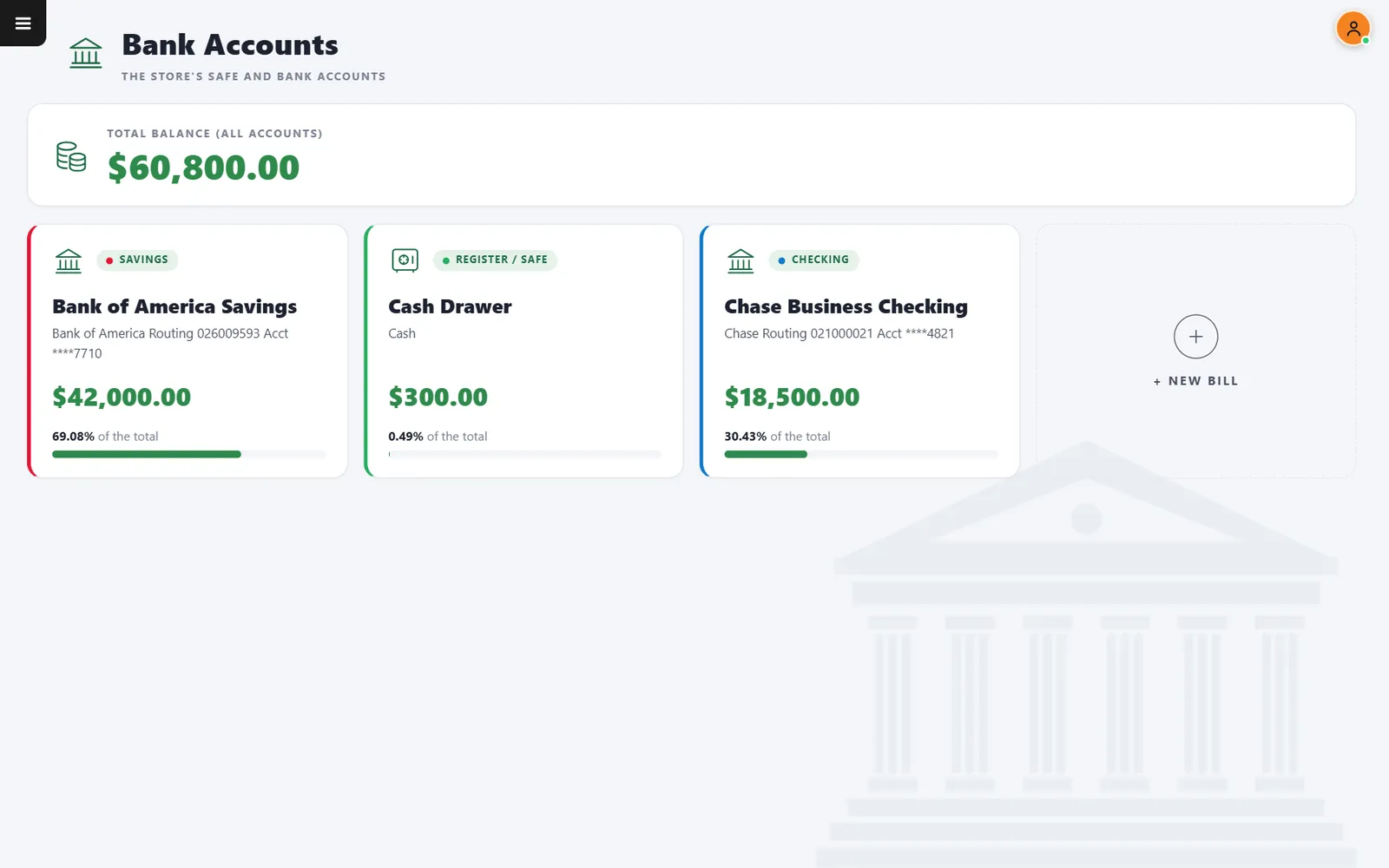
CounterChef includes register reconciliation in Finance, while Reports includes a register report.
Regardless of the system you use, the important management practice is to preserve a clear connection between the register totals, physical cash count, and supporting documentation.
Finish with a manager sign-off checklist
Before leaving, the closing manager should confirm that the register has been reconciled, the cash has been secured, and unresolved questions have been documented.
Here is a practical checklist you can copy into your closing binder.
End-of-day restaurant register checklist
- All completed customer checks accounted for.
- Open tickets reviewed.
- Register closing report saved.
- Starting bank verified.
- Cash counted by denomination.
- Cash refunds checked.
- Paid-outs supported by documentation.
- Cash drops verified.
- Expected cash compared with physical cash.
- Overages or shortages documented.
- Card transactions reconciled separately.
- Deposit counted and secured.
- Next day's opening bank prepared.
- Supporting paperwork saved.
- Closing manager signed and dated the reconciliation.
Do not sign off on a drawer simply because the restaurant needs to close. If something is unresolved, write down what remains outstanding and who will investigate it.
That is better than leaving an unexplained number for the next manager to discover.
Frequently asked questions
How long should it take to close a restaurant register?
It depends on the number of registers, transaction volume, cash handling procedures, and whether discrepancies need investigation. A straightforward drawer may take relatively little time, while multiple drawers and unresolved refunds can extend the process. Focus on completing every control correctly rather than rushing to meet an arbitrary time target.
What should I do if the restaurant register is over?
Record the overage just as carefully as a shortage. Recount the drawer, verify the starting bank, review cash transactions, and check whether a payment was entered incorrectly. An overage is not automatically extra revenue or a reason to ignore the discrepancy.
Should each cashier have a separate cash drawer?
Whenever practical, assigning a separate drawer to each cashier makes accountability easier. If employees share drawers, establish documented handoff counts and clear responsibility for each shift. Your procedure should make it possible to identify who had access to the register during the relevant period.
What happens if the register does not balance after recounting?
Document the exact variance, preserve the closing report and supporting records, and investigate transactions, refunds, paid-outs, starting cash, and deposits. Ask employees neutral questions and record the results. If the cause remains unknown, escalate the issue through your management process rather than assigning blame without evidence.
A restaurant register close should produce three things: an accurate cash count, a documented payment reconciliation, and a clear record of anything that still needs attention. Make the routine consistent, keep the paperwork together, and investigate differences through evidence rather than assumptions. That is how you protect the business while treating the people running it fairly.
Related feature: Finance.