
Restaurant Employee Retention Starts With the Schedule: How to Keep Good People Through Their First 90 Days
Restaurant employee retention is often treated as a hiring problem, but many restaurants lose good employees because the job becomes harder to live with than it looked during the interview. The first 90 days are especially important: what happens with scheduling, pay, training, and manager communication during that period often determines whether a new hire becomes a dependable member of the team or starts looking for another job.
Most turnover starts with a gap between what you promised and what the job actually feels like
Restaurant owners usually notice turnover when somebody quits, stops showing up, or gives notice during a busy week. By then, the decision may have been developing for some time.
A new employee might accept a position expecting consistent shifts, reasonable training, and enough hours to make the job worthwhile. Instead, they discover that the schedule changes every week, nobody knows who is supposed to train them, and their paycheck does not match what they expected.
None of these problems necessarily looks serious on its own. Together, they make the job feel unreliable.
There are several common reasons restaurant employees leave:
- Unpredictable schedules: Employees cannot plan childcare, transportation, school, second jobs, or personal commitments.
- Unclear pay expectations: They do not understand how tips, overtime, deductions, or pay periods work.
- Poor training: They are expected to perform independently before they know the restaurant's procedures.
- Uneven workloads: Reliable employees repeatedly get the difficult shifts because managers know they will show up.
- Weak management: Employees receive criticism when something goes wrong but little feedback when they improve.
- Limited communication: Changes are announced at the last minute, and employees feel they have no say in decisions affecting their work.
Owners sometimes interpret these problems as a lack of commitment. Often, the employee is responding to a workplace that has not made the commitment worthwhile.
The first 90 days need their own retention plan
A new employee should not be treated as a fully established team member after completing a few training shifts.
The first three months are a period of adjustment for both sides. The employee is learning the restaurant, and management is learning how that person works under real operating conditions.
A practical approach is to divide the first 90 days into three stages.
Days 1-30: Make the job predictable
The first month should establish trust.
Before the employee's first shift, explain:
- Their expected position and responsibilities.
- Their starting pay and how tips are handled.
- The normal scheduling process.
- Who approves shift changes and time-off requests.
- Where to find procedures and whom to ask for help.
- What successful performance looks like.
Do not assume that somebody who has restaurant experience already understands your operation.
A server may know how to carry plates but not how your restaurant handles split checks. A line cook may understand the equipment but not your ticket priorities or portion standards.
Give every new employee a named trainer and a clear first-week schedule. Avoid assigning them to whoever happens to be available.
At the end of the first week, have a short conversation. Ask what is clear, what remains confusing, and whether the actual job matches what was discussed during hiring.
Days 31-60: Build confidence without removing support
During the second month, employees should gradually handle more responsibilities.
The mistake is either keeping them dependent on a trainer for too long or expecting them to know everything after a handful of shifts.
Use specific milestones.
For a server, these might include opening a table, entering an order correctly, handling a payment, communicating an allergy request, and closing a section.
For a cook, milestones might include preparing assigned stations, following recipes, managing ticket timing, and completing closing procedures.
Managers should observe actual performance rather than relying exclusively on the trainer's opinion.
Ask the employee which tasks still feel difficult. A person who can explain a procedure but struggles to perform it during a rush may need more practice, not another lecture.
Days 61-90: Confirm that the arrangement works for both sides
By the third month, the employee should understand the position and have a realistic picture of the working conditions.
This is the time to discuss:
- Whether scheduled hours match expectations.
- Whether the employee is comfortable with the responsibilities.
- Whether training gaps remain.
- Whether the pay and tip arrangement are understood.
- Which shifts the employee prefers and which they can reliably work.
- What additional responsibilities they might want to learn.
Do not make this conversation a formality. If someone is considering leaving, there may still be an opportunity to correct a problem.
Also be willing to recognize a genuine mismatch. Retention does not mean keeping every employee regardless of performance or suitability.
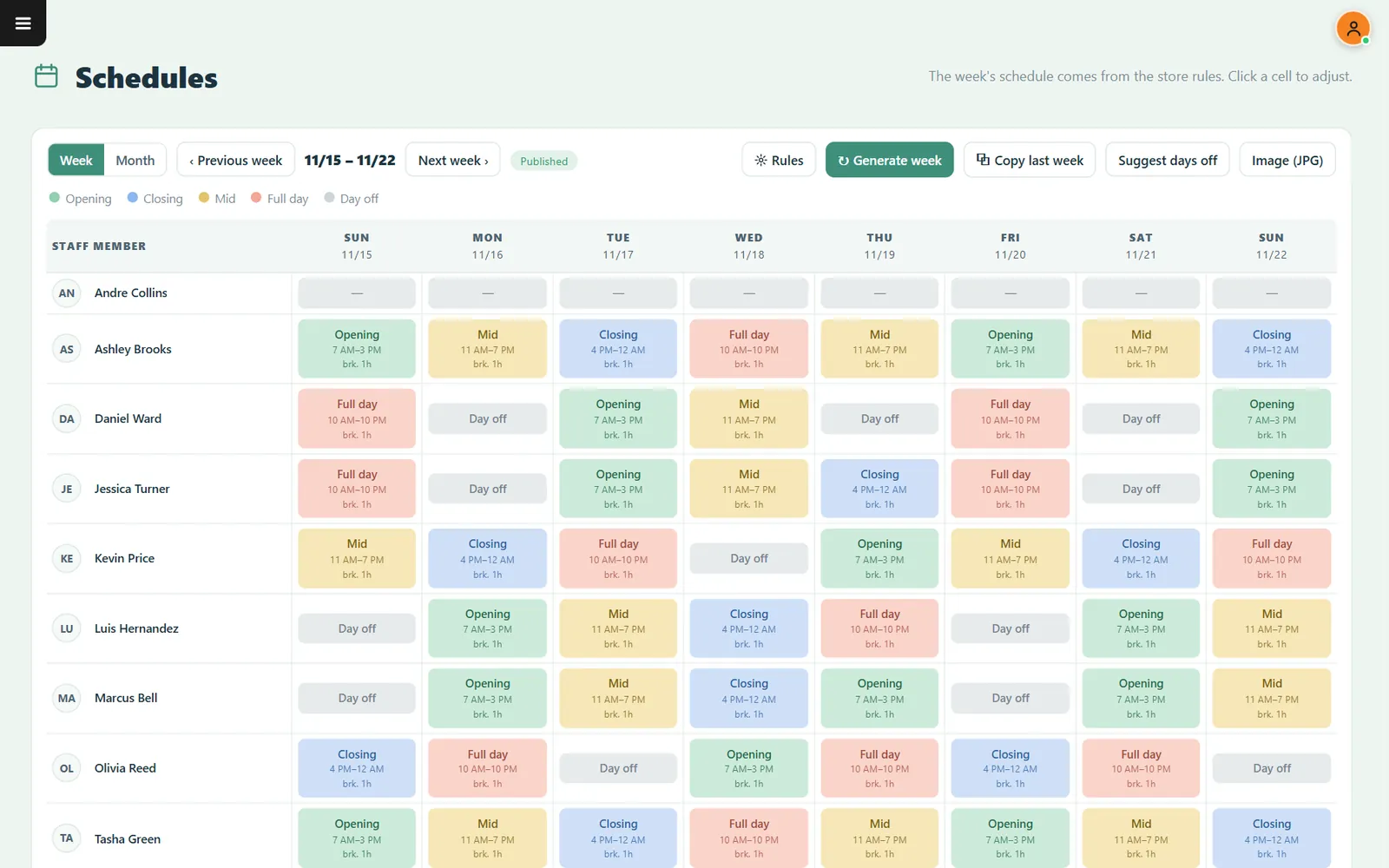
The weekly schedule is the biggest retention tool an owner controls
A schedule is more than a list of names and shifts. It determines how employees organize their lives outside the restaurant.
An employee who cannot predict when they will work has difficulty arranging transportation, childcare, education, another job, or even regular appointments.
That uncertainty has a cost.
Many owners spend considerable time improving job advertisements and interviewing candidates while treating scheduling as an administrative task. This gets the priorities backward.
A better schedule can make an existing position more attractive without changing the job itself.
Start with four habits.
1. Publish schedules consistently
Choose a regular publication day and stick to it. If employees know when the next schedule will be available, they can plan around it.
The exact lead time will depend on the operation, but a week or more of advance notice is a useful starting point where practical.
2. Ask about availability before building the schedule
Do not assume that an employee who worked Friday nights last month can continue doing so indefinitely.
Collect availability and recurring commitments. Review them periodically rather than waiting for a scheduling conflict.
3. Stop rewarding reliability with worse shifts
This is a particularly damaging management habit.
The employee who never complains gradually receives every difficult closing shift, last-minute coverage request, and undesirable assignment.
Meanwhile, less reliable employees may get more favorable schedules because managers are trying to accommodate them.
The dependable employee eventually realizes that being responsible makes their life harder.
Distribute difficult shifts fairly, rotate undesirable assignments where possible, and recognize employees who consistently help the operation.
4. Make schedule changes visible and accountable
A manager should not quietly change someone's shift and assume the employee will notice.
Contact the employee, explain the reason, and obtain confirmation. Keep a record of the agreed change.
Also establish who has authority to approve shift swaps. Employees should not have to guess whether an informal agreement with a coworker is valid.
Scheduling and predictive scheduling requirements vary by location. Confirm applicable rules with your state or city before establishing policies.
A schedule should reflect demand without making employees absorb every business fluctuation
Restaurant demand changes throughout the week. Friday dinner may require a larger team than Tuesday lunch, and seasonal patterns can change staffing needs.
The challenge is balancing labor coverage with employee stability.
Start by examining sales, transaction volume, and staffing needs by day and shift. Look at the actual work required rather than simply repeating last week's schedule.
Then identify your minimum reliable coverage.
For example, a restaurant might need two cooks, one cashier, and one manager during a particular operating period. Additional employees can be scheduled according to expected demand.
Build the schedule around that baseline and add coverage where justified.
Avoid constantly sending employees home early because business is slower than expected. If the restaurant repeatedly schedules people for hours it cannot support, employees will eventually stop trusting the posted schedule.
Likewise, avoid calling the same person every time business becomes unexpectedly busy.
A voluntary coverage list can help. Ask employees whether they want occasional additional shifts and record their preferences. Contact people according to availability and fairness rather than relying on whoever answers first.
One useful practice is to review schedule accuracy every Monday:
- Which shifts were changed after publication?
- Which employees were sent home early?
- Which shifts required emergency coverage?
- Which employees worked beyond their scheduled hours?
- Which staffing assumptions were incorrect?
This turns scheduling problems into operating information.
Pay transparency prevents small misunderstandings from becoming reasons to quit
Employees do not need complicated compensation presentations. They need to understand exactly how their earnings work.
Explain the hourly rate, pay frequency, overtime treatment, tip policies, and any applicable deductions before the employee starts.
For tipped positions, explain how tips are distributed and when they appear in payroll. If tips are pooled, make the rules understandable to everyone involved.
A restaurant should not rely on verbal explanations that change depending on which manager is working.
Write down the policy and make it accessible.
Pay attention to three areas:
Hours worked: Employees should be able to understand how their recorded hours relate to their paycheck. Investigate discrepancies promptly.
Tips: Explain the distribution method, eligibility, and timing. Confirm that the arrangement complies with applicable federal, state, and local requirements.
Overtime and payroll: Maintain accurate time records and review overtime calculations. Wage, break, tip-credit, and payroll rules can vary by jurisdiction, so confirm requirements with a qualified payroll professional or employment attorney.
A useful additional habit is a short payroll review before every pay period closes. Look for missing clock-ins, unusual hour changes, unexplained deductions, and tip discrepancies.
Do not wait for employees to discover payroll errors.
Training should follow the actual flow of a restaurant shift
Training documents often describe individual tasks without explaining how those tasks fit together.
A new cashier may learn how to enter an order but not how to handle a customer who changes an order after payment. A cook may learn recipes but not what to do when several tickets arrive simultaneously.
Good training follows the sequence of work.
For each position, document:
- Opening responsibilities.
- Normal operating procedures.
- Common exceptions and mistakes.
- Communication with other positions.
- Closing responsibilities.
Then train through demonstration, supervised practice, and independent execution.
A trainer should show the task, explain why it matters, observe the employee performing it, and correct mistakes immediately.
Avoid giving a new employee five unrelated tasks and assuming that watching somebody else perform them counts as training.
Give trainers responsibility and time
Training is work. It takes time away from other responsibilities, particularly during busy shifts.
Choose trainers based on their ability to explain procedures, not just their speed or seniority.
Give them a defined training checklist and make it clear that they are responsible for reporting progress.
Do not overload the trainer with a full section or station while also expecting them to provide continuous instruction.
A poorly trained employee can create additional work for the entire team. Proper training reduces repeated corrections, inconsistent service, and unnecessary pressure on experienced employees.
Three retention experiments owners can start this week
Most retention improvements do not require a new employee handbook or a major operational overhaul. They require a few deliberate changes to everyday management.
1. Run a schedule fairness audit
Take the previous four weeks of schedules.
Identify who worked the most closing shifts, weekends, split shifts, and last-minute coverage assignments.
Compare the distribution with employee availability and stated preferences.
You may discover that the same two dependable employees are absorbing most of the difficult assignments.
Change the next schedule to distribute those responsibilities more fairly.
2. Conduct a 10-minute stay interview
Do not wait until somebody resigns to ask what is wrong.
Speak individually with employees, especially those hired within the previous 90 days.
Ask three questions:
- What makes it easiest for you to do your job here?
- What is one thing about your schedule or daily work that you would change?
- Is there anything about the job that turned out differently from what you expected?
Listen without immediately defending the restaurant.
Write down the answers, identify recurring problems, and tell employees which changes you can make.
The important part is following up. Asking for feedback and doing nothing with it can make employees less willing to speak up next time.
3. Introduce a first-90-days buddy system
Assign each new employee an experienced coworker who is not necessarily their formal trainer.
The buddy answers practical questions: where supplies are kept, which manager handles a particular issue, how shift handoffs work, and what to expect during busy periods.
Keep the arrangement simple.
Ask the buddy to check in after the first shift, the first week, and the first month.
This helps new employees build relationships before they feel isolated or overwhelmed.
Measure turnover by hiring group, not just by the total number of employees
If you want to improve restaurant employee retention, you need to understand when people leave.
A single annual turnover figure can hide a serious problem. Your overall workforce might look stable while new hires repeatedly leave before completing their first month.
Track at least five measurements.
1. Employee separations: Count employees who leave during the period. Separate voluntary resignations from dismissals where possible.
2. Average headcount: Calculate the average number of employees during the same period.
3. Turnover rate: Divide separations by average headcount and multiply by 100.
4. First-90-day retention: Track how many people hired in a particular period remain employed after 90 days.
5. Time to departure: Record whether employees leave during their first 30 days, between days 31 and 60, or between days 61 and 90.
Keep the measurements consistent. Define whether your calculations include seasonal employees, temporary workers, transfers, and other categories.
A worked example: calculating restaurant turnover
All figures below are hypothetical and are provided only to demonstrate the calculation.
Suppose a restaurant starts a quarter with 24 employees and ends with 20.
- Starting headcount: 24 employees.
- Ending headcount: 20 employees.
- Average headcount: (24 + 20) ÷ 2 = 22 employees.
- Employees who left during the quarter: 5.
- Quarterly turnover rate: (5 ÷ 22) × 100 = 22.73%.
The restaurant's hypothetical quarterly turnover rate is 22.73%.
Now consider the hiring group.
- New employees hired during the quarter: 8.
- New employees still employed after 90 days: 5.
- First-90-day retention: (5 ÷ 8) × 100 = 62.5%.
- First-90-day departures: 3 employees.
The second calculation reveals something the overall turnover rate does not: three of the eight new employees did not remain through the first 90 days.
These figures describe different things. The first measures workforce departures relative to average headcount. The second measures the experience of a particular hiring group.
Do not treat a quarterly turnover rate as directly comparable to an annual rate. Also, if employees have not yet completed 90 days, do not include them in a completed 90-day retention calculation.
Track the reasons employees leave
Create a simple departure record with consistent categories:
| Departure reason | What to investigate |
|---|---|
| Schedule conflict | Availability, shift changes, advance notice |
| Pay expectations | Actual hours, tips, compensation clarity |
| Training problems | Trainer assignment, training time, supervision |
| Management conflict | Communication, fairness, feedback |
| Better opportunity | Hours, responsibilities, career progression |
| Personal circumstances | Record without making assumptions |
Use employee feedback when available rather than automatically assigning a reason.
Review the results monthly. If most departures involve scheduling, another round of recruitment advertising will not solve the underlying problem.
Calculate the operating cost of replacing an employee
Turnover has costs beyond advertising a vacant position.
Consider the time spent reviewing applications, interviewing, onboarding, training, correcting mistakes, and covering shifts.
There may also be lost productivity while a replacement learns the operation.
A practical way to estimate the cost is to assign a dollar value to each activity.
For example, using hypothetical figures:
| Replacement activity | Hypothetical cost |
|---|---|
| Recruiting and administration | $75 |
| Interview time | $100 |
| Trainer time | $180 |
| Manager onboarding time | $90 |
| Additional coverage | $150 |
| Total estimated replacement cost | $595 |
These are illustrative amounts, not industry averages.
If a restaurant experiences 12 departures in a year and the hypothetical replacement cost is $595 per employee, its estimated annual replacement expense is:
12 × $595 = $7,140.
This calculation does not include every possible indirect cost, such as slower service or increased pressure on existing employees.
It does, however, give owners a way to compare retention improvements against actual operating expenses.
Use restaurant management information to connect staffing with performance
Employee retention becomes easier to manage when staffing information is reviewed alongside daily operations.
Look for patterns between employee departures, shift coverage, sales, labor hours, and service problems.
For example, repeated staffing shortages on particular evenings may indicate that schedules are not aligned with demand. Frequent mistakes during a new employee's first shifts may point to insufficient training.
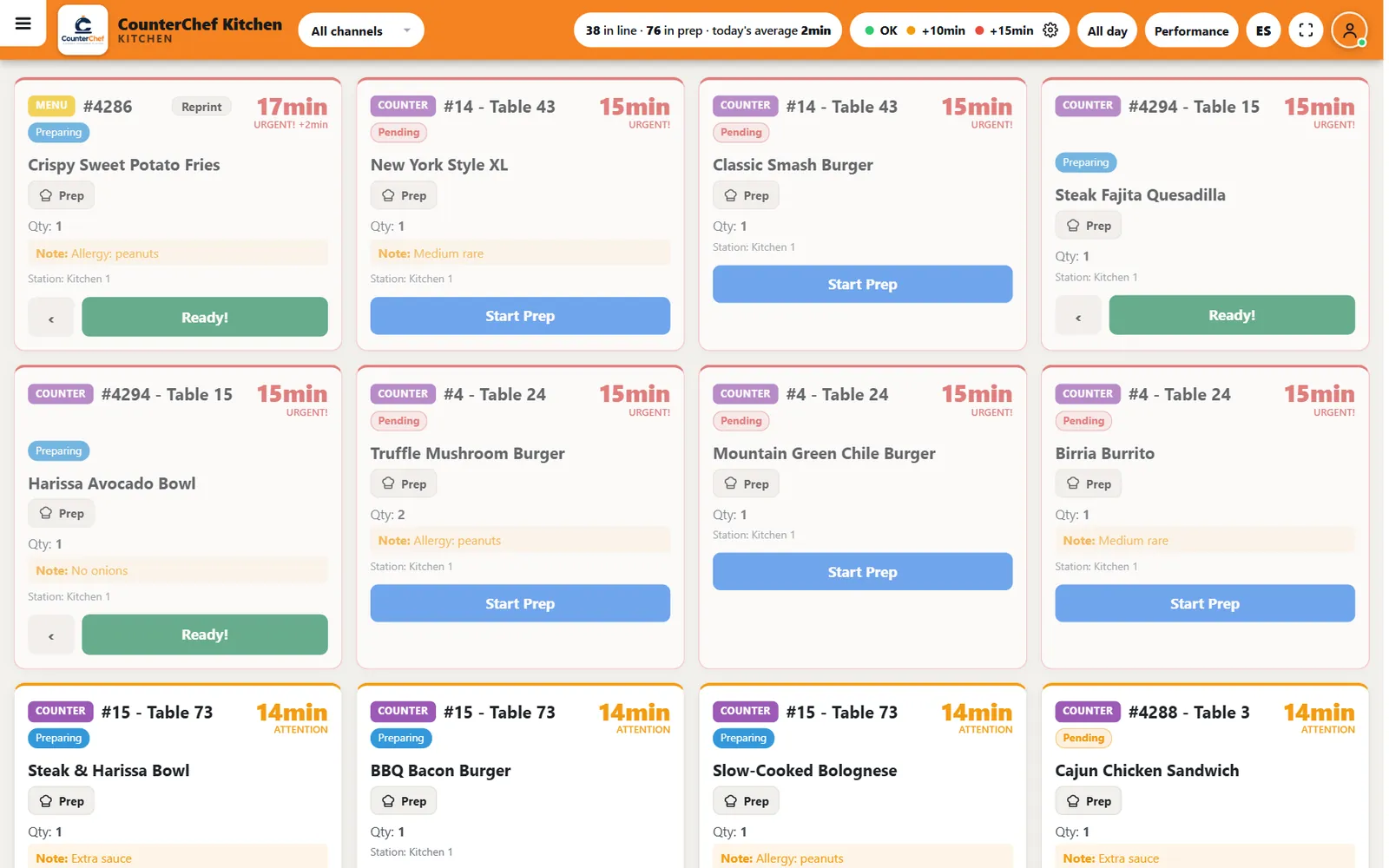
CounterChef runs on iPad, Android tablet, iPhone and computer; it includes employee clock-ins on a tablet or computer and schedules built into the system, alongside reports by day, item and employee. Its other capabilities include tip sharing by percentage or hours worked, inventory and recipe costing, a kitchen display with ticket timers, dine-in table maps and server phones, and an online pickup and delivery menu with ZIP-code delivery areas, individual fees and estimated times; it also supports loyalty points, gift cards, and sales tax rates with up to three decimals and by category.
The important management principle is to use operational information to investigate problems, not to assume that every service issue is an employee performance issue.
A poorly staffed shift can make even a capable team look ineffective.