
How to Split Restaurant Checks Without Slowing Service
Splitting restaurant checks should make payment easier for guests without turning the end of a meal into a second service shift for your staff. The key is to establish a simple process before orders reach the kitchen, handle shared items consistently, and give servers a few clear options for groups that want to pay differently.
Decide how your restaurant will handle split checks before the first request
A guest asking for separate checks should not be a surprise to the server. It is a normal part of restaurant service, especially at tables with friends, coworkers, families, and couples.
The trouble starts when every server handles the request differently. One server splits everything equally, another tries to reconstruct every person's order, and someone else asks the manager to figure it out. The result is inconsistent service and unnecessary time spent at the POS terminal.
Create a house policy with three standard methods:
- By item: Each guest pays for the food and drinks they ordered.
- By seat: Items are assigned to individual seats, making it easier to build separate checks.
- By equal amount: The total is divided into agreed portions, usually when guests are comfortable sharing the cost.
Your policy should also explain how to handle shared appetizers, shared desserts, discounts, tax, and gratuity.
Do not make the policy so rigid that staff cannot accommodate reasonable requests. Instead, give servers a default process and clear limits for unusual situations.
For example, you might allow servers to split a table into a small number of payment groups without manager approval, while complicated requests involving multiple discounts or corrections go to a shift leader.
The exact limit should reflect your menu, POS workflow, and staffing.
Ask about payment arrangements when the order begins
The easiest time to organize a split check is before the food arrives.
When a table sits down, servers can ask a natural question:
"Will you be paying together, separately, or a combination of both?"
This is particularly useful for larger parties.
It does not mean every table needs a detailed payment conversation. Couples who are clearly dining together may prefer one check. A family may have one person paying for everyone. Let the situation guide the question.
For a table of eight, however, asking early can prevent a lengthy discussion after dessert.
Train servers to listen for three things:
- How many people will pay?
- Are any items being shared?
- Is anyone planning to pay with cash?
The third question matters because cash introduces a different calculation. A guest may want to cover their portion with bills while the remaining guests use cards.
Record seat assignments as orders are entered whenever possible. If a guest changes seats, update the assignment rather than relying on memory.
A small amount of organization at the beginning saves time when the check arrives.
Handle a table of eight with shared appetizers using a fixed process
Consider a group of eight guests who order several appetizers for the table, followed by individual entrees and drinks.
This is where splitting restaurant checks becomes more complicated. The entrees are easy to assign, but the shared food needs an agreed approach.
The server should establish whether the appetizers will be divided equally or assigned to particular guests.
Avoid making assumptions. One guest may have skipped the appetizers, while another may have eaten very little. The restaurant does not need to referee how much each person consumed, but it should establish the payment arrangement clearly.
A practical approach is to divide shared appetizers equally among the eight guests unless the group requests something different.
For example, the server can say:
"I'll put the entrees and individual drinks on each person's check and divide the shared appetizers evenly across the group. Does that work for everyone?"
This sentence accomplishes three things:
- It explains the calculation.
- It gives the group an opportunity to correct the arrangement.
- It confirms the plan before the server starts processing payments.
For large parties, assign each guest a seat number. Keep individual items attached to the correct seat and shared items identified separately.
If the POS system cannot automatically distribute shared items, establish a consistent manual procedure. The server should not have to invent a new calculation every time.
Use a different approach when couples want to pay together
Not every guest needs an individual check.
Two couples dining together may want two checks, with each couple paying for its own food and drinks. Splitting the check into four individual portions would create unnecessary work.
Ask whether the couples want their orders grouped together.
For example:
- Couple A pays for its two entrees and drinks.
- Couple B pays for its two entrees and drinks.
- A shared appetizer is divided between the two couples.
This arrangement is straightforward if the server has recorded the original orders by seat.
There is another situation worth training for: couples who share everything but want to divide the final amount equally between two cards.
In that case, splitting by item is not necessary. An equal division between the two payment groups may be faster and more accurate.
The important distinction is that the server should identify the number of payments, not automatically assume the number of guests equals the number of checks.
Let one guest pay cash without delaying everyone else
Cash payments can slow down a table when servers wait until everyone has decided how to pay.
A better approach is to separate the cash portion from the remaining balance as early as possible.
Imagine a table of four. Three guests want to pay by card, while one guest wants to cover their share in cash.
The server should establish the cash guest's portion first. Once that amount is confirmed, the remaining balance can be divided among the other guests.
A useful script is:
"Would you like to cover your own items in cash, or would you prefer to contribute a specific amount toward the table?"
This avoids confusion when guests have shared items.
The server should count the cash according to the restaurant's normal payment procedure and make sure the POS records the transaction correctly. Do not treat cash received as an informal contribution outside the check.
If the cash guest hands over more than their portion, clarify whether the difference is a tip or change before closing the payment.
Never assume that extra cash is automatically a gratuity.
Work through a complete split-check example before training staff
The following example shows how a table of eight could be handled. Every amount and quantity below is hypothetical and is included only to demonstrate the calculation.
Hypothetical table order:
| Item | Quantity | Price each | Total |
|---|---|---|---|
| Shared appetizers | 4 | $12.00 | $48.00 |
| Entrees | 8 | $22.00 | $176.00 |
| Individual drinks | 8 | $4.00 | $32.00 |
| Subtotal | $256.00 |
Assume the eight guests agree to divide the appetizers equally, while each person pays for their own entree and drink.
Hypothetical shared appetizer calculation:
$48.00 ÷ 8 guests = $6.00 per guest.
Hypothetical individual guest check:
- Entree: $22.00
- Drink: $4.00
- Appetizer share: $6.00
- Individual subtotal: $32.00
Hypothetical group calculation:
8 guests × $32.00 = $256.00.
Now assume the restaurant has a hypothetical sales tax rate of 8%.
$256.00 × 8% = $20.48 in sales tax.
$256.00 + $20.48 = $276.48 total.
Each guest's hypothetical tax-inclusive share is:
$32.00 × 1.08 = $34.56.
The eight individual checks total $276.48.
If one guest pays $34.56 in cash and the remaining seven guests pay by card, the server can process the cash payment and then collect the remaining seven payments.
This example excludes discounts, service charges, and gratuities. Actual tax treatment depends on the applicable state and local rules, so confirm your calculations with a qualified professional.
The point is not that every table needs this exact arrangement. It is that the calculation should be agreed upon before payment begins.
Give servers a script instead of making them negotiate
Servers should not have to explain restaurant policy from scratch every time someone requests separate checks.
Create a short set of approved phrases that sound natural.
When a group requests separate checks:
"Absolutely. I'll organize the individual orders by seat. Are any of the appetizers or desserts being shared?"
When guests want equal splits:
"Of course. How many equal payments would you like?"
When guests disagree about a shared item:
"Let me confirm how you'd like that shared item divided before I finalize the checks."
When someone wants to pay cash:
"No problem. Let's confirm your portion first, and I'll organize the remaining balance."
When a request becomes complicated:
"I want to make sure everyone is charged correctly. Give me a moment to review the order."
These scripts prevent unnecessary back-and-forth and give servers a professional way to slow down a conversation when clarification is needed.
Avoid language that makes guests feel they are causing trouble. Splitting checks is a normal service request.
Build a payment workflow that protects the service floor
A common mistake is allowing every server to leave the dining room whenever a group requests multiple payments.
This creates another problem: while one server is working through a complicated check, their other tables may be waiting for drinks, food, or attention.
Set up a consistent workflow:
- Confirm the number of checks and payment methods.
- Verify seat assignments and shared items.
- Review the order before presenting payment options.
- Process payments in a deliberate sequence.
- Confirm that every portion has been settled.
- Return receipts and change promptly.
There are several practical ways to make this faster.
First, designate a check-review point. During busy shifts, have servers review complicated splits at a consistent POS station rather than repeatedly moving between terminals.
Second, use a verbal confirmation before printing. Ask the table to confirm the number of checks and shared-item arrangement. A quick conversation is usually easier than voiding and rebuilding several checks.
Third, establish a manager-assistance threshold. Servers should know when to handle a request independently and when to involve a supervisor. This is especially important when discounts, refunds, or unusual payment corrections are involved.
Fourth, avoid processing payments while the table is still changing its mind. Confirm the arrangement first. Once a payment has been processed, corrections may require additional steps.
Try three operational improvements this week
You do not need to redesign your entire service operation to improve check splitting. Start with a few small experiments.
1. Run a five-minute split-check drill before a shift.
Give each server a hypothetical table with four or eight guests. Include shared appetizers, individual drinks, and two payment methods.
Ask the server to explain how they would organize the checks.
This reveals whether employees understand seat assignments, shared items, and equal splits. Correct misunderstandings before they appear during service.
2. Introduce a shared-item decision card.
Create a small reference card for servers with three options:
- Divide shared items equally.
- Assign shared items to selected guests.
- Put shared items on one agreed payment.
Keep the card near the POS terminal or include it in the server training binder.
This is particularly helpful for new employees who are unsure how to handle a group that orders food for the table.
3. Track split-check corrections separately.
For one week, have managers record every check that needs to be rebuilt or corrected because of a split-payment mistake.
Record the reason, not the employee's name.
Useful categories include:
- Incorrect seat assignment.
- Shared item divided incorrectly.
- Wrong number of payments.
- Cash portion calculated incorrectly.
- Payment processed before the arrangement was confirmed.
Review the results at the end of the week. If most corrections involve shared appetizers, improve that part of the process rather than telling everyone to work faster.
These three experiments turn a vague service complaint into specific operational improvements.
Give managers a ready-to-copy closing checklist
A restaurant should have a simple way to review split-check problems after service.
Use this checklist during shift handoff or manager closing duties.
| Checkpoint | Completed |
|---|---|
| All split checks were reviewed for correct seat assignments | ☐ |
| Shared items were allocated according to guest instructions | ☐ |
| Cash payments were recorded correctly | ☐ |
| All card and cash portions were settled | ☐ |
| Voids and corrections were reviewed | ☐ |
| Unresolved payment questions were documented | ☐ |
| Recurring service problems were noted for training | ☐ |
The manager should also ask one useful question:
"Which split-check situation took the most time tonight, and what would have made it easier?"
Keep the answer specific. A server might report that a group changed its payment arrangement three times or that nobody could agree on who ordered the shared dessert.
Use those examples to improve the next shift's instructions.
Do not turn the review into a search for someone to blame. The purpose is to identify where the process breaks down.
Choose a POS workflow that supports the way your restaurant serves
Your POS system should make common payment arrangements manageable.
When evaluating your current setup or considering a replacement, test the actual scenarios your restaurant encounters.
Can staff assign items to seats? Can they divide shared food without rebuilding the entire order? Can guests use multiple payment methods on the same check? Can a server correct an assignment before finalizing payment?
Run these tests using a realistic table order rather than relying on a product demonstration with a simple two-person check.
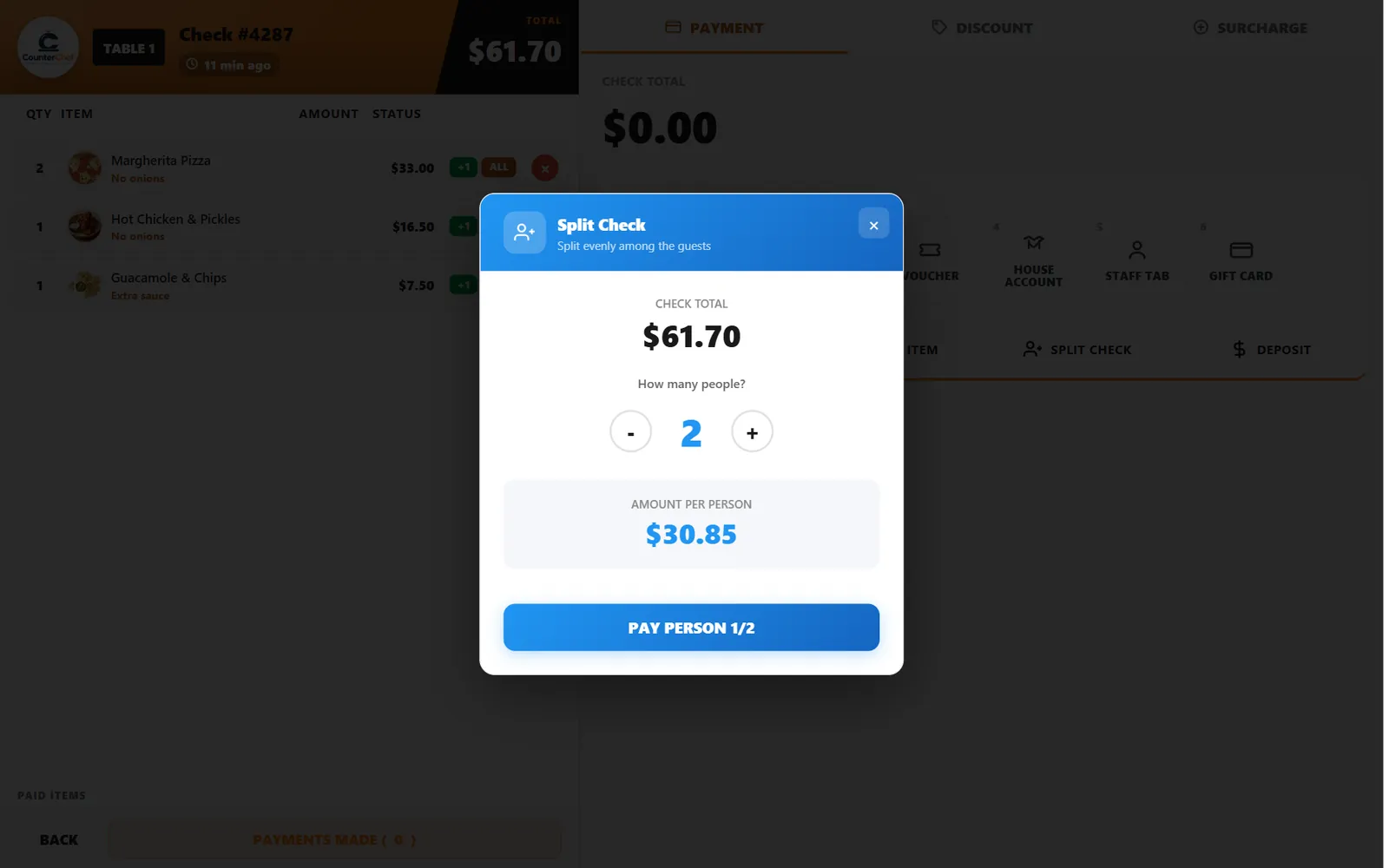
CounterChef supports splitting checks by item, seat, or equal amounts, with several payment methods on the same check. Items can also be assigned to a seat.
The important thing is to evaluate whether the available workflow matches your restaurant's actual service routine.
Frequently asked questions
Should restaurants allow customers to split checks?
Yes, restaurants can establish a policy that accommodates reasonable split-check requests. The policy should explain how shared items, discounts, and multiple payment methods are handled. Make sure servers communicate any limitations politely and consistently.
Is it better to split restaurant checks by item or by person?
It depends on how the guests ordered. Splitting by item works well when everyone has individual orders. Splitting by person or seat is useful when guests share food or want to group their purchases. Equal splits are often simpler when everyone agrees to divide the total.
How should servers handle shared appetizers on separate checks?
Ask the guests how they want the appetizers divided before finalizing payment. Equal division is a practical default when everyone agrees, but guests may prefer to assign the cost to selected people or put the shared items on one check.
What should a restaurant do when guests disagree about splitting the bill?
Pause payment processing and ask the group to agree on an arrangement. Explain the available options without taking sides. If the disagreement cannot be resolved, involve a manager and follow the restaurant's payment policy.
Splitting restaurant checks is ultimately a service procedure, not just a POS task. When servers confirm payment arrangements early, assign orders carefully, and follow the same process every shift, guests spend less time sorting out the bill and employees spend more time taking care of the dining room.
Related feature: Split checks.