
Table Turnover Rate: How to Make Your Tables Available Sooner Without Rushing Guests
Table turnover rate measures how often a restaurant's tables are occupied and then made available for another party during a service period, but the number alone doesn't tell you whether your dining room is running well. The real opportunity is to separate the time guests naturally spend enjoying their meal from the time your operation wastes on waiting, missed communication, slow payment, clearing, and resetting, and fix the second category without making hospitality feel like a stopwatch.
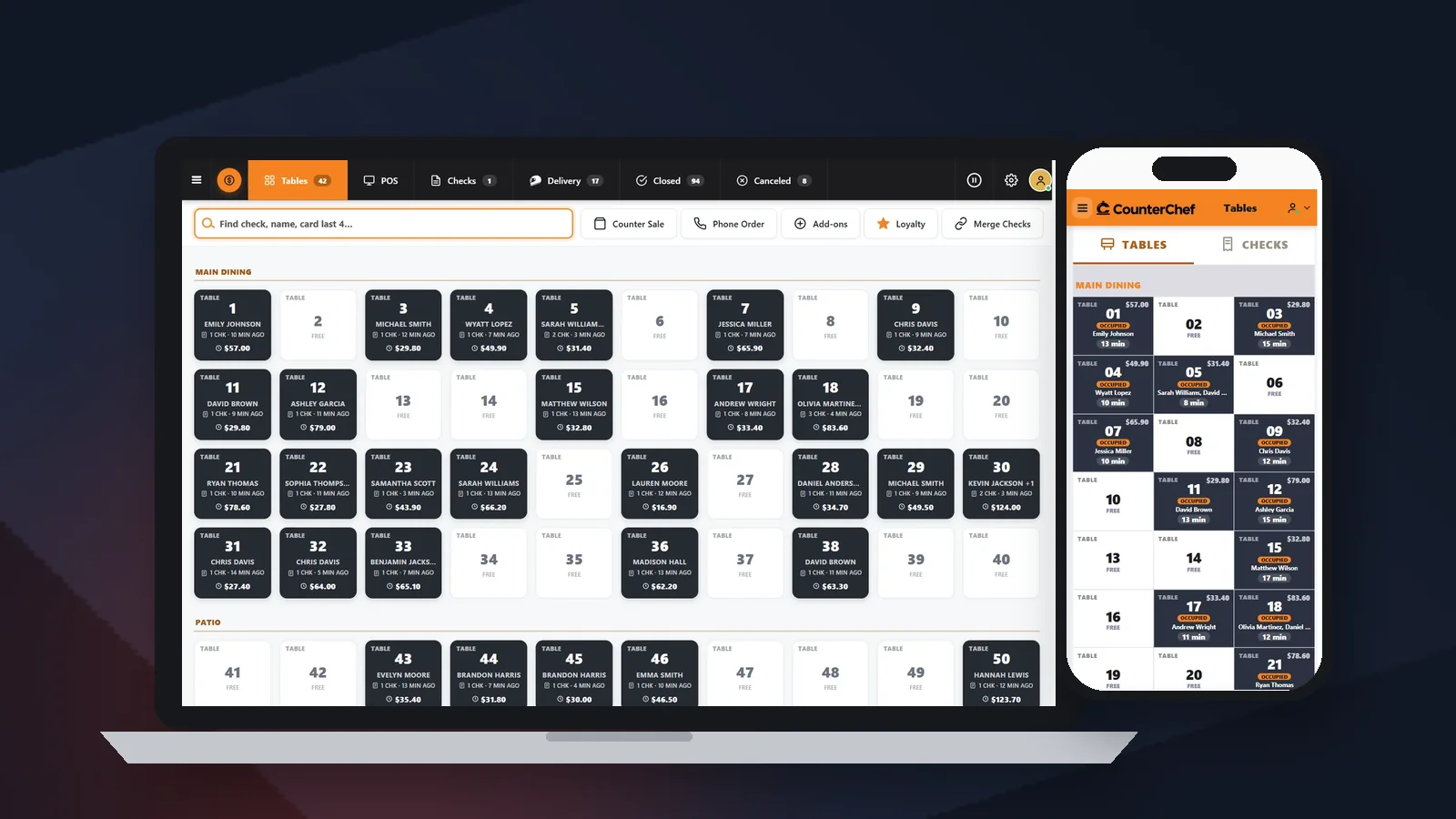
Table turnover is a measure of capacity, not a hospitality score
Operators use the phrase table turnover in a few different ways. Before comparing your dining room with another restaurant, make sure you're measuring the same thing.
Three useful measures are:
- Table turns: How many parties occupy a particular table during a defined service period.
- Seat turnover: How many guests occupy each seat during that period.
- Table turnover rate: The number of times tables are occupied and released relative to the available tables or time period, depending on the formula being used.
For day-to-day management, I recommend tracking completed parties per table per service, alongside average dining duration and covers per available seat.
A table that serves several small parties in a lunch period may turn more frequently than a table serving large family groups. Neither is automatically better. A family restaurant, neighborhood bistro, tasting-menu restaurant, coffee shop, and casual lunch counter have different service promises and different natural dining patterns.
Your target should be built around your concept, menu, staffing, reservation pattern, and guest expectations, not someone else's number.
Calculate table turnover rate using a consistent formula
A simple formula for a service period is:
Table turnover = Total parties seated ÷ Number of available tables
If you want to calculate turns for a particular table, count the parties seated at that table during the period. If you're measuring your entire dining room, use the number of tables that were actually available for service, not tables being used for storage, permanently blocked, or held out of rotation.
For a broader capacity measure, calculate:
Seat turnover = Total guests served ÷ Available seats
This is useful when party sizes vary considerably. A dining room may serve fewer parties but more guests because larger groups occupy its tables.
Use both measures. Table turns help you understand the pace of the dining room; seat turnover helps you understand how efficiently you are using seating capacity.
Don't mix a lunch-only calculation with an entire-day calculation, or compare a Saturday dinner with a Tuesday lunch without accounting for differences in demand.
Set a turn-time target that fits the experience you sell
A reasonable turn-time range varies by concept and is only a rule of thumb. The point is to establish an operating expectation, not a countdown that servers use to push guests out.
| Restaurant concept | What the dining pace generally needs to support |
|---|---|
| Counter-service or fast casual | Quick ordering, short waits for food, and minimal time spent completing payment |
| Casual lunch restaurant | A predictable meal break, timely food delivery, and efficient checkout |
| Neighborhood full-service restaurant | A comfortable meal with attentive service and smooth transitions between courses |
| Upscale dining | Deliberate pacing, course coordination, and room for conversation |
| Tasting-menu restaurant | A planned sequence of courses; turnover is usually less important than timing and execution |
| Coffee shop or café | A mix of short visits, takeaway, and guests who may stay longer |
A restaurant can have a slow table turn and still be profitable. A restaurant can have a fast table turn and still lose money if guests are unhappy, orders are wrong, the kitchen is overloaded, or staff are spending too much time recovering mistakes.
Choose a target that fits your actual operating model.
Break dining time into guest-controlled and restaurant-controlled minutes
This is the most important distinction when trying to improve table turnover rate.
The total time a party occupies a table can be divided into two categories.
Guest-controlled time includes:
- Deciding what to order
- Eating at a comfortable pace
- Talking with companions
- Enjoying another drink
- Deciding whether to order dessert
- Choosing when to leave after the meal
Restaurant-controlled time includes:
- Waiting to be greeted
- Waiting for menus or water
- Waiting for a server to take the order
- Waiting for drinks that could have been prepared sooner
- Waiting for food that is ready but not delivered
- Waiting for a check
- Waiting for payment to be processed
- Waiting for the table to be cleared and reset
Guests are not the bottleneck simply because they are still sitting at the table. Your operation may be the bottleneck while guests are waiting for something they already requested.
The best improvement is often to remove the pauses between guest decisions rather than shorten the decisions themselves.
Map the full visit to find where minutes disappear
Track the visit in stages instead of relying on the vague impression that service was slow.
| Stage | Start and end point | What to investigate |
|---|---|---|
| Arrival | Arrival to greeting or seating | Host coverage, waitlist accuracy, table readiness |
| Ordering | Seating to order entry | Menu clarity, server availability, unanswered questions |
| Drinks | Order to delivery | Bar workload, batching, ticket communication |
| Food | Order to first food delivery | Kitchen capacity, preparation time, ticket prioritization |
| Meal | First food to last food finished | Guest pace, missing items, follow-up, course timing |
| Checkout | Check request to payment completion | Server availability, payment process, split checks |
| Reset | Guest departure to next seating | Clearing, sanitizing, restocking, table readiness |
You don't need to record every timestamp for every guest forever. Start with a sample during a busy shift and look for patterns.
If guests are ready to order but servers are occupied, that's a service bottleneck. If entrees are ready but the expo station is crowded, that's a delivery bottleneck. If guests have finished and asked for the check but are still waiting, that's a checkout bottleneck.
Fixing these is fundamentally different from asking guests to eat faster.
Work backward from the next reservation instead of forward from the current party
Reservation spacing is often a more effective tool than trying to speed up everyone already in the dining room.
If you know that a particular table type usually needs a longer meal, don't book another party into the same table at an unrealistic interval. Consider party size, course structure, day of week, and the actual history of that table.
A two-top may have different pacing from a six-top, even when both are seated in the same section. A party ordering appetizers and cocktails may need a different expectation from a party ordering entrees only.
Use your reservation pattern to protect the guest experience:
- Avoid seating several large parties in the same section at the same time.
- Stagger arrivals when your kitchen or bar has a limited capacity.
- Keep a realistic buffer for cleaning and resetting.
- Don't promise a table at a specific time unless your team has a reasonable basis for delivering it.
- Give hosts discretion to hold a table briefly if the prior party is still comfortably enjoying the meal.
The dining room should not be scheduled like a machine with no variation.
Reduce the time between guest decisions and staff actions
The guest may decide to order, ask for another drink, request dessert, or ask for the check. Your team controls how long it takes to respond.
A few small operating changes can make a meaningful difference.
Give servers a clear section and backup coverage. If a server has too many tables to acknowledge new arrivals promptly, adding more pressure won't solve the problem. Define who covers greetings, drinks, check requests, and food running when the assigned server is busy.
Use a visible service cue. A guest who closes a menu, looks around, or puts a card near the edge of the table may be signaling that they're ready. Train staff to notice cues without interrupting conversation unnecessarily.
Make the check easy to request. Guests shouldn't have to repeatedly catch a server's eye. Make it natural to ask, and train servers to respond promptly when requested.
Run food when it's ready. Don't let completed plates wait because the person who entered the order is busy. Clear responsibility for food running reduces unnecessary delays.
Prepare for predictable demand. Restock service stations before the rush, keep common items accessible, and check that payment devices are ready. A missing roll of receipt paper or an empty water pitcher can create a delay that repeats throughout the shift.
Fix the kitchen bottleneck before trying to accelerate the dining room
A faster dining room can create a slower kitchen if you seat guests faster than the kitchen can fulfill their orders.
Look at order volume by time, item, station, and modifier. Identify dishes that consistently delay tickets or create a bottleneck at one station.
A dish might be popular but require a finishing step that ties up a station during peak periods. Another might be quick to prepare but difficult to plate when several orders arrive simultaneously.
Before removing dishes, try:
- Preparing components earlier where food safety and quality allow.
- Simplifying unnecessary finishing steps.
- Standardizing plating and garnish placement.
- Reviewing whether menu items compete for the same equipment.
- Identifying modifications that create disproportionate work.
- Training staff to communicate sold-out items and delays immediately.
A menu with fewer operational conflicts can produce a better guest experience without making the menu feel smaller.
Measure the minutes you can actually change
Create a small set of service measurements that help managers identify operational delays rather than pressure guests.
Useful metrics include:
- Average time from seating to greeting
- Average time from order entry to first drink
- Average time from order entry to food delivery
- Average time from check request to payment completion
- Average time from departure to table readiness
- Average dining duration by party size and daypart
- Number of tables waiting for a reset
- Number of orders delayed by a specific station
Avoid treating an average as the complete story. Averages can hide the fact that most guests receive food quickly while a small number experience very long waits.
Review the unusually long visits separately. Was the delay caused by a kitchen problem, an incorrect order, a missing item, a payment issue, or a guest who wanted to stay longer? These causes require different responses.
Worked example: Calculate the opportunity without rushing guests
The following example is entirely hypothetical. All figures are illustrative, not industry benchmarks.
A neighborhood restaurant has 20 tables and operates a dinner service lasting 4 hours.
During the service, it seats 40 parties.
Its table-turn calculation is:
40 parties ÷ 20 tables = 2.0 turns per table
Assume the restaurant serves 100 guests during the same service.
Its seat turnover calculation is:
100 guests ÷ 60 available seats = 1.67 seat turns
Now the owner reviews sampled visits and finds the following hypothetical breakdown:
| Activity | Hypothetical average time |
|---|---|
| Greeting and menu delivery | 5 minutes |
| Order-taking delay | 8 minutes |
| Drink preparation and delivery | 10 minutes |
| Food preparation and delivery | 25 minutes |
| Guest eating and conversation | 55 minutes |
| Check request and payment | 12 minutes |
| Clearing and reset | 10 minutes |
| Total | 125 minutes |
The restaurant does not need to shorten the hypothetical 55 minutes of guest eating and conversation.
Instead, it tests improvements to the controllable stages:
| Activity | Original hypothetical time | Improved hypothetical time |
|---|---|---|
| Greeting and menu delivery | 5 minutes | 3 minutes |
| Order-taking delay | 8 minutes | 4 minutes |
| Drink preparation and delivery | 10 minutes | 7 minutes |
| Food preparation and delivery | 25 minutes | 22 minutes |
| Guest eating and conversation | 55 minutes | 55 minutes |
| Check request and payment | 12 minutes | 6 minutes |
| Clearing and reset | 10 minutes | 7 minutes |
| Total | 125 minutes | 104 minutes |
The hypothetical improvement is 21 minutes per visit, entirely outside the guest's eating and conversation time.
That does not mean the restaurant should automatically book more parties into every table. First, it should confirm that the improvements are sustainable, food quality remains consistent, and the guest experience is unchanged.
Then it can decide whether the extra capacity is useful for its reservation pattern, walk-in demand, staffing, and profitability.
Try three operational experiments this week
These are practical tests that don't require redesigning your dining room.
Experiment 1: The check-request audit
For one busy service, have a manager quietly record every check request and when payment is completed.
Look for recurring causes of delay: servers not noticing the request, payment devices being unavailable, split checks taking too long, or a manager needed to resolve an issue.
Fix the most common cause first. Don't tell servers to "be faster" without identifying what is slowing them down.
Experiment 2: The ready-table relay
Assign one person during the busiest period to monitor tables that have become available. Their responsibility is to coordinate clearing, sanitation, restocking, and communicating that the table is ready.
The host should know which tables are genuinely available, not which tables merely appear empty.
This is especially useful when servers are responsible for clearing their own sections and the host cannot tell whether an empty table is ready for seating.
Experiment 3: The bottleneck menu test
Choose the busiest service and identify the menu item or station that causes the most delays.
For a week, record how often it delays other tickets, what preparation step causes the delay, and whether the delay can be reduced through prep, station organization, or plating changes.
Don't immediately remove a profitable dish because it takes longer. Determine whether the problem is the recipe, the workflow, or a staffing mismatch.
Use a shift checklist that managers can actually complete
Copy this into a manager's pre-shift and service notes.
| Check | Action |
|---|---|
| Before service | Confirm table map matches the actual dining room |
| Before service | Check table settings, water, condiments, and service stations |
| Before service | Review reservations and expected large parties |
| Before service | Identify kitchen and bar bottlenecks |
| During service | Track greeting, food, and check delays |
| During service | Assign backup coverage for busy sections |
| During service | Communicate unavailable items immediately |
| During service | Monitor tables ready to be reset |
| After service | Record the biggest controllable delay |
| After service | Choose one process to test next shift |
The manager's job is to turn observations into an operating change. If the checklist reveals the same problem repeatedly, assign an owner and a specific corrective action rather than adding another reminder.
Use operating systems that make delays visible
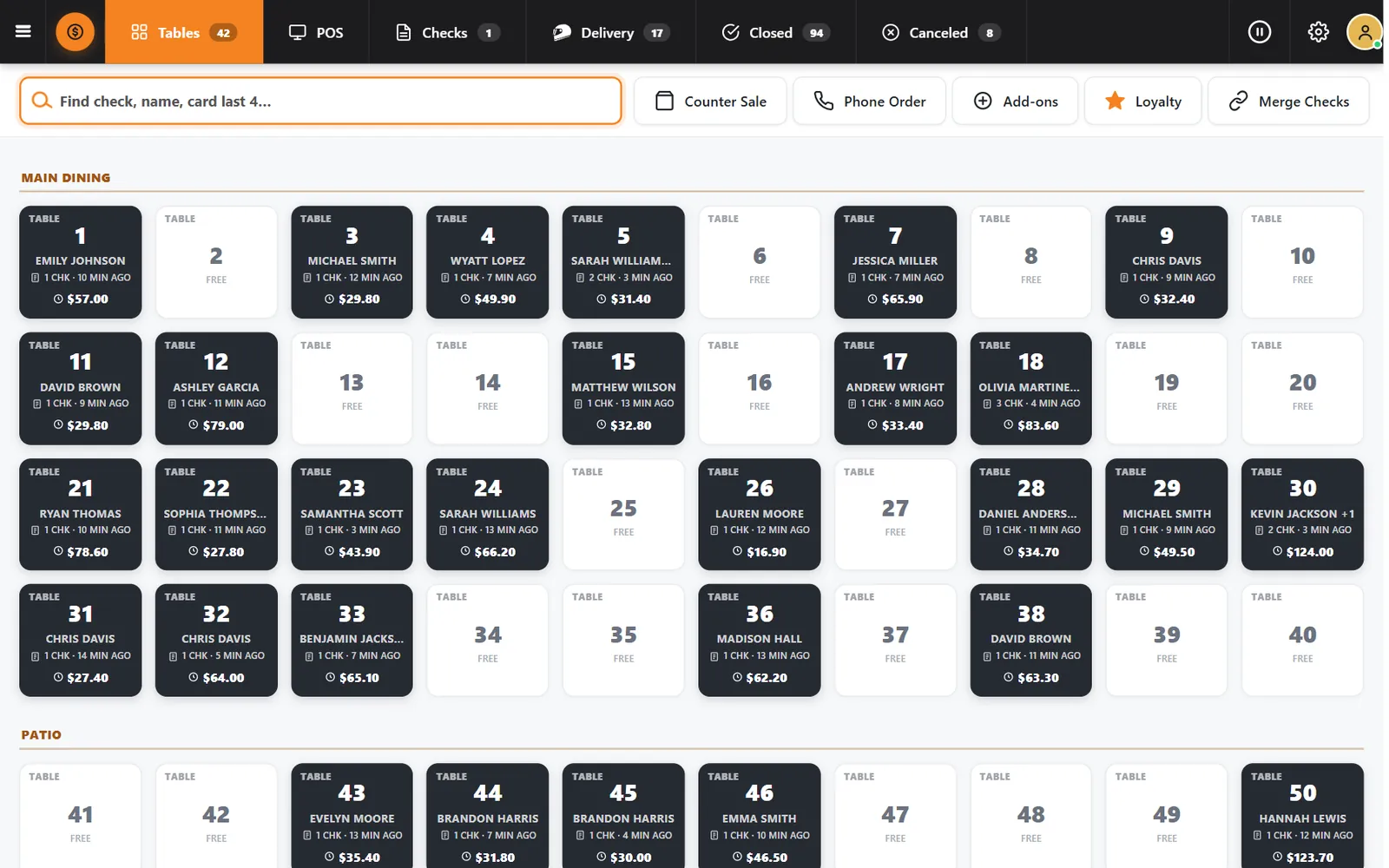
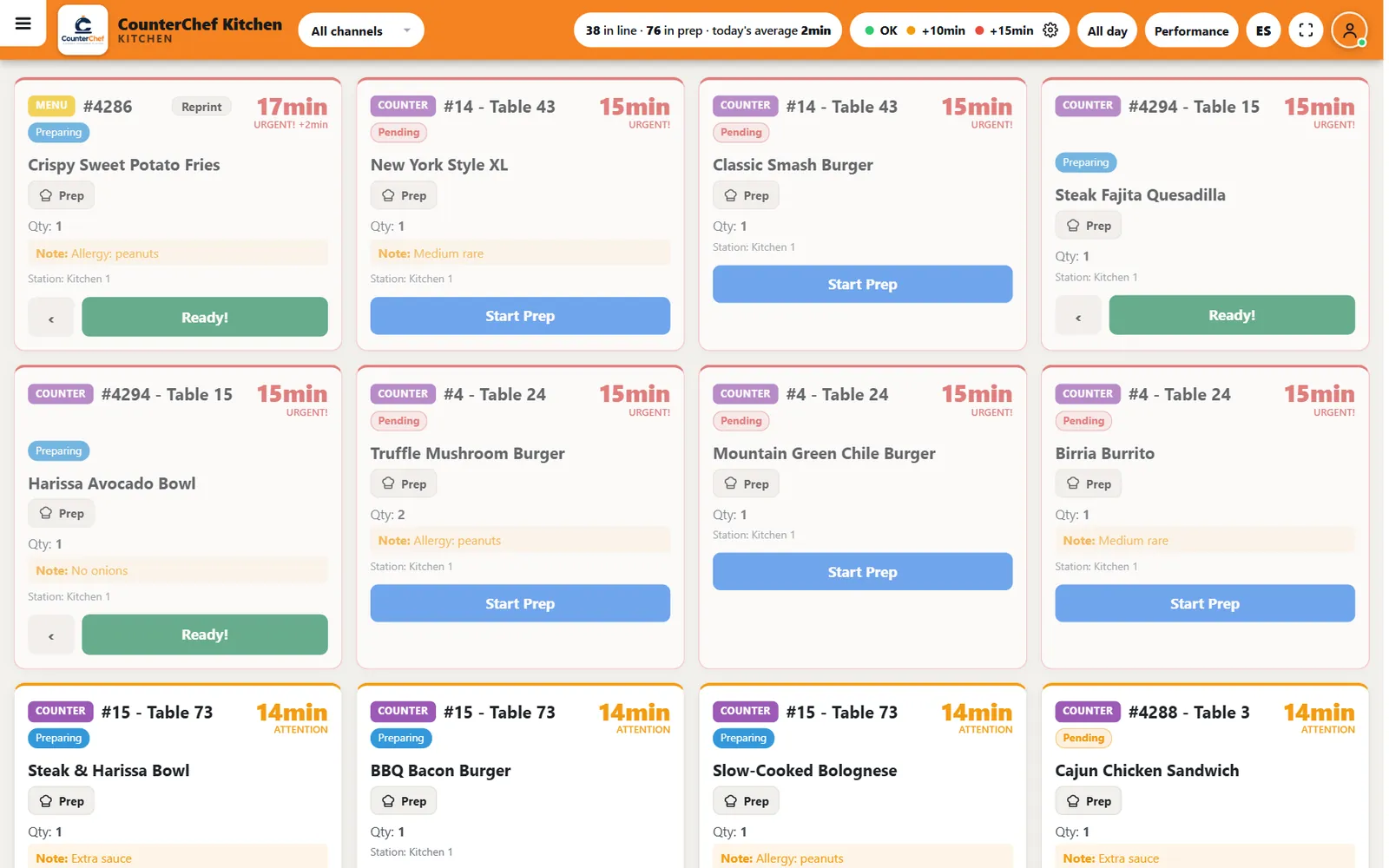
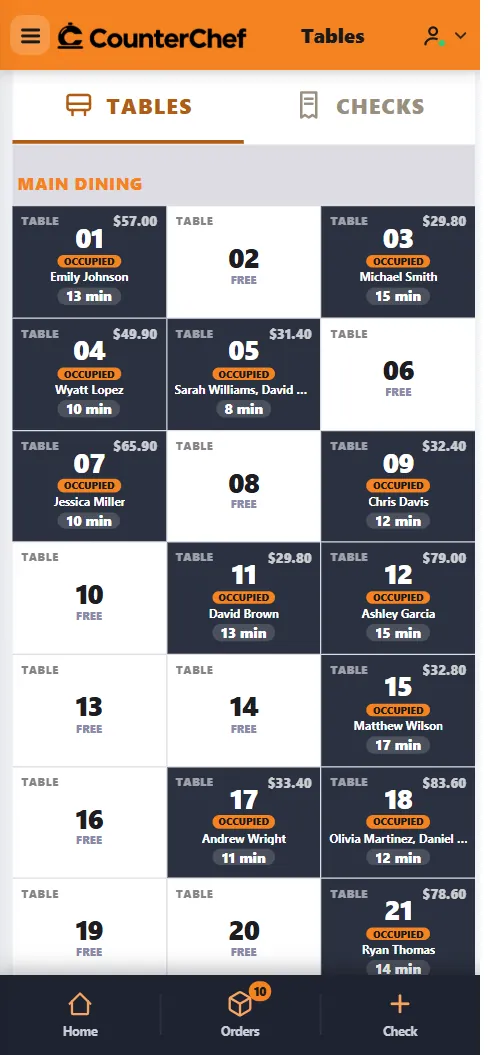
A manager can't fix what the team can't see. Useful operating tools should help staff understand which tables are seated, which orders are waiting, which items are delayed, and which tables are ready for the next party.
CounterChef runs on iPad, Android tablet, iPhone and computer; it includes your own online menu for pickup and delivery, with delivery areas by ZIP code, each with its own fee and estimated time; a kitchen display with ticket timers; a table map and server phones for dine-in; employee clock-in on a tablet or computer and schedules built in the system; tip sharing by percentage or by hours worked; inventory and recipe costing that show the cost of each dish; loyalty points and gift cards; sales tax rates with up to three decimals and by category; and reports by day, item and employee.
Whatever systems you use, the goal is to make operational information easier to act on, not to turn every guest into a timed transaction.