
Restaurant Business Plan: The Questions Lenders Ask and the Answers Owners Need
A restaurant business plan is more than a document used to secure financing. It's the operating blueprint that connects your concept, location, menu, staffing, and cash flow into a business that can survive a slow Tuesday, not just a busy Saturday. The strongest plan answers the questions a lender, investor, landlord, or business partner will ask before committing money, while forcing you to confront the assumptions that can break the restaurant before it opens.

What business are you actually building, and why will customers choose it?
A lender wants to understand whether the concept is specific enough to operate consistently and whether it fills a real customer need. "A neighborhood restaurant serving great food" is not a business concept. It describes almost every restaurant that fails to explain its differentiation.
Define the concept in practical terms:
- Cuisine and service style
- Price positioning
- Target customer
- Occasion customers visit for
- What makes the restaurant different
- What the restaurant deliberately will not offer
A concept that tries to serve breakfast, lunch, dinner, cocktails, catering, and every dietary preference from day one creates complexity before it has established demand.
Hypothetical sample answer:
Maple Street Kitchen will be a 48-seat neighborhood bistro serving seasonal American comfort food, weekday lunch, and dinner. Its primary customers are nearby residents, professionals, and small groups looking for approachable meals in a casual setting. The menu will emphasize recognizable dishes, consistent execution, and a small rotating seasonal selection. The restaurant will initially operate six days per week, with no breakfast service or full-scale catering during its first operating phase.
Make your concept specific enough that someone could picture the customer, the menu, the dining room, and the service experience.
Who lives, works, eats, and spends money around your proposed location?
The market section should establish demand without relying on broad claims about how much people love restaurants.
Your research should answer:
- Who is within your practical customer radius?
- What are the area's residential and employment patterns?
- What happens during weekdays versus weekends?
- Are nearby customers looking for lunch, dinner, takeout, or social dining?
- What competing restaurants serve similar occasions?
- What price points do customers already accept?
- What would make customers change their existing habits?
Visit the area during the actual hours you intend to operate. Observe parking, pedestrian traffic, office activity, neighboring businesses, and restaurant turnover.
Don't mistake foot traffic for restaurant demand. A busy street at 8 a.m. may be nearly empty at dinner. A location near offices may look attractive but become quiet on weekends.
Hypothetical sample answer:
Maple Street Kitchen is proposed for a mixed residential and office neighborhood. Our research will focus on weekday lunch demand from nearby employees, dinner demand from residents, and weekend evening traffic. We identified several restaurants serving burgers, pizza, and fast-casual meals. Our opportunity is a compact bistro menu with table service, accessible pricing, and a dining experience suitable for both casual meals and small gatherings.
Include a competitor comparison with real restaurants you have researched. Record their menu prices, opening hours, service format, busy periods, strengths, weaknesses, and customer feedback.
A useful field exercise: visit competitors three times, one weekday lunch, one weekday dinner, and one weekend period. Your observations are more useful than a single visit.
What will the menu sell, and can the kitchen execute it profitably?
The menu is where the concept becomes operational. It determines purchasing, equipment, preparation time, labor requirements, storage, waste, and sales mix.
Lenders and partners want to know whether the menu makes sense for your kitchen, your staff, and your customers, not simply whether the chef likes it.
Explain:
- The opening menu size and categories
- Signature dishes and expected customer appeal
- Ingredient overlap between recipes
- Recipe costing and portion standards
- Pricing methodology
- Preparation complexity
- Seasonal changes
- Dietary accommodations
- Expected beverage sales, if applicable
Cost every recipe before finalizing selling prices. Include ingredients, yield loss, trim, garnishes, sauces, sides, and portion sizes. A dish that looks inexpensive on paper can become costly when the actual preparation is measured.
Hypothetical sample answer:
Maple Street Kitchen will launch with 12 food items: four starters, six entrees, and two desserts. Five core ingredients will be shared across multiple recipes to reduce purchasing complexity and spoilage. The grilled chicken entree will use a standardized portion, house sauce, and one seasonal side. Recipes will be documented by weight, and selling prices will be reviewed when supplier costs change.
One practical idea: create a "menu stress test" before opening. Ask the kitchen to produce the five most complicated dishes simultaneously during a simulated rush. Record bottlenecks, equipment conflicts, plating time, and ingredients that run out first.
A menu is not ready because each dish tastes good individually. It is ready when the entire menu can be produced together during service.
How will the restaurant operate when 30 orders arrive at once?
This section is often too vague in business plans. Owners describe the customer experience but fail to explain the systems that deliver it.
Describe the operating model from opening preparation through closing:
- Hours and days of operation
- Seating capacity and expected table turns
- Reservation and walk-in handling
- Order flow from server to kitchen
- Food preparation and station responsibilities
- Purchasing and receiving
- Inventory counts
- Food safety and cleaning procedures
- Cash handling and closing reconciliation
- Maintenance and equipment contingency plans
Explain what happens when the restaurant is busy, short-staffed, or dealing with a broken piece of equipment.
Hypothetical sample answer:
Maple Street Kitchen will operate Tuesday through Sunday, with lunch service Tuesday through Friday and dinner service daily except Monday. The kitchen will use defined stations for cold preparation, grill, and finishing. Prep lists will be based on expected sales and recorded inventory. Managers will review ticket times, voids, waste, and product shortages after each service. Closing staff will complete cleaning, temperature logs, cash reconciliation, and next-day prep assignments.
Three operational ideas owners can test this week
1. Build a "sold-out decision" sheet. For each high-risk ingredient, specify who can mark an item unavailable, what substitutes are approved, and how servers communicate it. This prevents five people from making five different decisions.
2. Track the 10-minute window before a rush. Observe what the kitchen and front of house are doing immediately before peak service. Identify unfinished prep, missing tools, unclear assignments, and unnecessary movement. Fixing this window often improves the whole shift.
3. Create a recovery plan for one broken station. What if the fryer stops working, the dishwasher is down, or the only trained grill cook calls out? List the menu items affected, alternative equipment, staffing adjustments, and customer communication. Practice the plan before you need it.
These details demonstrate that you understand restaurant operations as a system, not simply a collection of recipes and employees.
How many employees do you need, and who is responsible for each decision?
Your staffing plan should show how the restaurant will cover service without building an unnecessarily expensive payroll.
Include positions, responsibilities, working hours, management coverage, training, hiring timelines, and contingency coverage.
Avoid using a single monthly labor percentage to explain the entire staffing plan. Show the actual shifts required to operate.
Hypothetical sample answer:
Maple Street Kitchen will be managed by one owner-operator responsible for purchasing, scheduling, financial review, and vendor relationships. The opening kitchen team will include a head cook, two line cooks, and part-time prep support. Front-of-house coverage will include servers, a host during peak periods, and a designated shift lead. Staffing will increase or decrease according to reservations, historical sales patterns, and actual workload.
Prepare a schedule for each daypart. Identify who opens, who closes, who handles deliveries, who approves refunds, who counts inventory, and who is responsible when the owner is absent.
Calculate wages, payroll taxes, workers' compensation, applicable benefits, training hours, overtime exposure, and other employer costs. Labor requirements vary by state and city; confirm applicable wage, scheduling, tip, and employment rules with qualified local professionals.
A useful staffing exercise: schedule the restaurant assuming the owner is unavailable for an entire week. If every purchasing, scheduling, payroll, and service decision stops, you have identified a management dependency that should be addressed.
How much money is required before opening, and where will it go?
Your startup budget should separate one-time opening costs from recurring operating expenses.
Typical categories include:
| Startup category | What to include |
|---|---|
| Lease and occupancy | Deposit, rent during construction, utility deposits |
| Construction | Plumbing, electrical, flooring, ventilation, accessibility work |
| Equipment | Cooking equipment, refrigeration, dishwashing, smallwares |
| Furniture and fixtures | Tables, chairs, shelving, lighting |
| Permits and professional fees | Licensing, architectural work, legal, accounting |
| Technology | Hardware, setup, internet, operational systems |
| Opening inventory | Food, beverage, cleaning supplies, packaging |
| Hiring and training | Recruiting, onboarding, pre-opening payroll |
| Marketing | Signage, photography, opening promotions |
| Working capital | Cash for expenses before operations stabilize |
| Contingency | Unexpected repairs, delays, scope changes |
Don't underestimate expenses that begin before revenue: rent, utilities, insurance, management payroll, contractor changes, training, and deposits.
Hypothetical sample answer:
Maple Street Kitchen estimates total project funding of $285,000. This includes $165,000 for buildout and equipment, $35,000 for furniture and setup, $20,000 for professional fees and permits, $15,000 for opening inventory and training, $10,000 for initial marketing, and $40,000 in working capital and contingency. All figures are preliminary hypothetical estimates pending contractor bids, lease review, and supplier quotes.
The important part isn't the precision of an early estimate. It's whether the estimate is supported by quotes, assumptions, and an explicit allowance for uncertainty.
How will the restaurant make money, and what sales assumptions support the projections?
Financial projections should explain how revenue is generated rather than simply display an optimistic monthly sales number.
Break sales into operational drivers:
- Seats available
- Operating days
- Expected guests per day
- Average check
- Revenue by lunch, dinner, and other channels
- Sales mix
- Seasonality
- Ramp-up period
Avoid assuming full capacity from the first month. New restaurants take time to build repeat business, refine operations, and establish customer awareness.
Worked example: Monthly sales projection
All figures below are hypothetical and illustrative.
| Assumption | Hypothetical value |
|---|---|
| Seats | 48 |
| Operating days per month | 26 |
| Average guests per day | 72 |
| Average check per guest | $28 |
| Monthly guest count | 1,872 |
| Projected monthly sales | $52,416 |
Calculation:
- 72 guests × 26 operating days = 1,872 guests per month
- 1,872 guests × $28 average check = $52,416 monthly sales
This is a sales assumption, not proof of demand. Explain how you expect to reach 72 guests per day: seating capacity, service periods, reservations, walk-ins, repeat customers, and realistic throughput.
Build three scenarios:
- Conservative: Lower guest counts, slower opening ramp, weaker average check.
- Base case: Your best-supported operating assumptions.
- Upside: Higher sales that the restaurant can actually serve without exceeding capacity.
The upside scenario should not be your financing request's justification.
What are the monthly expenses, and when does the restaurant break even?
Your projections need a monthly income statement showing revenue, cost of goods sold, labor, occupancy, utilities, insurance, marketing, repairs, administrative expenses, and other operating costs.
Separate fixed costs from variable costs. Rent may remain constant while food costs increase with sales. Labor may contain both scheduled fixed coverage and additional hours tied to volume.
Hypothetical monthly expense example
Using the hypothetical $52,416 sales projection above:
| Expense | Hypothetical monthly amount |
|---|---|
| Food and beverage cost | $16,000 |
| Labor and employer costs | $19,000 |
| Rent and occupancy | $5,500 |
| Utilities | $1,500 |
| Insurance | $700 |
| Marketing | $800 |
| Repairs and supplies | $1,000 |
| Administrative and other costs | $1,200 |
| Total expenses | $45,700 |
| Operating remainder before debt, taxes, and other excluded items | $6,716 |
This is not a forecast of a typical restaurant. It is a hypothetical worksheet illustrating how assumptions interact. Your categories and accounting treatment should be adjusted with your accountant.
The operating remainder is not automatically the amount available to owners. Debt payments, taxes, capital replacements, owner compensation, and other excluded costs may reduce cash available.
A lender may ask for monthly projections for the first year, followed by annual projections for additional years. Show the assumptions behind every line rather than hiding them in a spreadsheet.
Can the restaurant repay financing and survive a cash-flow shortage?
Profit and cash flow are different. A restaurant can show a profit on paper and still struggle to pay bills because of timing, loan repayments, deposits, equipment purchases, or slow sales.
Your business plan should include a cash-flow forecast showing:
- Opening cash balance
- Cash sales and payment timing
- Payroll dates
- Supplier payment terms
- Rent and other recurring bills
- Loan payments
- Capital purchases
- Taxes and other obligations
- Ending cash balance
Identify the lowest projected cash balance during the first year. That is often more important to an owner than the projected annual profit.
Hypothetical sample answer:
Maple Street Kitchen will maintain a dedicated operating reserve to cover payroll, occupancy, and supplier obligations during slower periods. The cash-flow forecast will be reviewed weekly during the opening months. Management will compare actual cash balances against the forecast and postpone discretionary purchases if the reserve falls below the planned minimum.
A useful practice is to prepare a 13-week cash forecast alongside the annual financial projections. Update it every week using actual bank balances, expected deposits, invoices, payroll, and upcoming obligations.
What could prevent the restaurant from succeeding, and how will you respond?
A credible business plan acknowledges risks. Pretending everything will go according to plan makes the document less convincing.
Consider risks such as:
- Construction delays or unexpected costs
- Lower-than-expected customer traffic
- Food price increases
- Difficulty hiring or retaining employees
- Equipment failures
- Dependence on a single chef or owner
- Lease restrictions or unexpected occupancy obligations
- Seasonal changes
- Cash shortages
- Changes in customer preferences
For each major risk, identify a prevention measure and a response.
| Risk | Prevention | Response |
|---|---|---|
| Opening delayed | Confirm permits, contractors, and milestones | Reduce pre-opening spending and revise launch date |
| Sales below plan | Validate demand and monitor daily sales | Adjust hours, menu, and staffing |
| Ingredient cost increase | Track supplier quotes and recipe costs | Reprice, substitute, or redesign dishes |
| Staff shortage | Cross-train and maintain hiring pipeline | Simplify service and reduce menu temporarily |
| Equipment failure | Maintenance and backup procedures | Activate contingency menu and repair plan |
Hypothetical sample answer:
The primary risks are construction delays, lower initial sales, and staffing instability. The owners will maintain a contingency reserve, use a staged hiring plan, and avoid adding operating hours until customer demand and staffing capacity support the expansion. Weekly cash-flow reviews will trigger corrective action before cash reserves become critical.
Who owns the business, who contributes capital, and how will decisions be made?
If you're opening with partners, clearly explain the ownership structure and responsibilities.
Include:
- Legal business entity
- Ownership percentages
- Initial capital contributions
- Additional funding obligations
- Management responsibilities
- Decision-making authority
- Compensation arrangements
- Distribution policy
- Exit provisions
- Dispute resolution
Don't assume that contributing money and working in the restaurant are equivalent contributions. Document how owners are compensated for labor separately from their ownership interests where appropriate.
Hypothetical sample answer:
Maple Street Kitchen will be owned by two partners. Partner A will contribute $180,000 and oversee operations, hiring, purchasing, and financial reporting. Partner B will contribute $105,000 and oversee facilities, marketing, and administrative coordination. Ownership percentages, compensation, distributions, and decision-making authority will be documented in a formal operating agreement prepared with legal and accounting professionals.
When will the restaurant open, and what must happen before each milestone?
A timeline helps lenders understand how their money will be used and whether the project is realistic.
A useful timeline includes:
| Milestone | Target | Dependency |
|---|---|---|
| Lease execution | Month 1 | Lease review and financing |
| Plans and permits | Months 1-2 | Architect and local approvals |
| Construction | Months 2-4 | Contractor and permits |
| Equipment installation | Month 4 | Construction completion |
| Hiring and training | Month 4-5 | Equipment and operating procedures |
| Soft opening | Month 5 | Inspections and staff readiness |
| Full opening | Month 5 | Successful soft opening |
All dates are hypothetical. Actual timelines depend on local approvals, site conditions, construction, and vendors.
Set a readiness checklist for opening day. The restaurant should not open simply because the calendar says it should.
What systems will help you control operations and report results?
Explain how you'll keep track of sales, employees, inventory, menu profitability, service performance, and customer retention. A lender or partner wants to know that management can identify problems and respond using actual operating information.
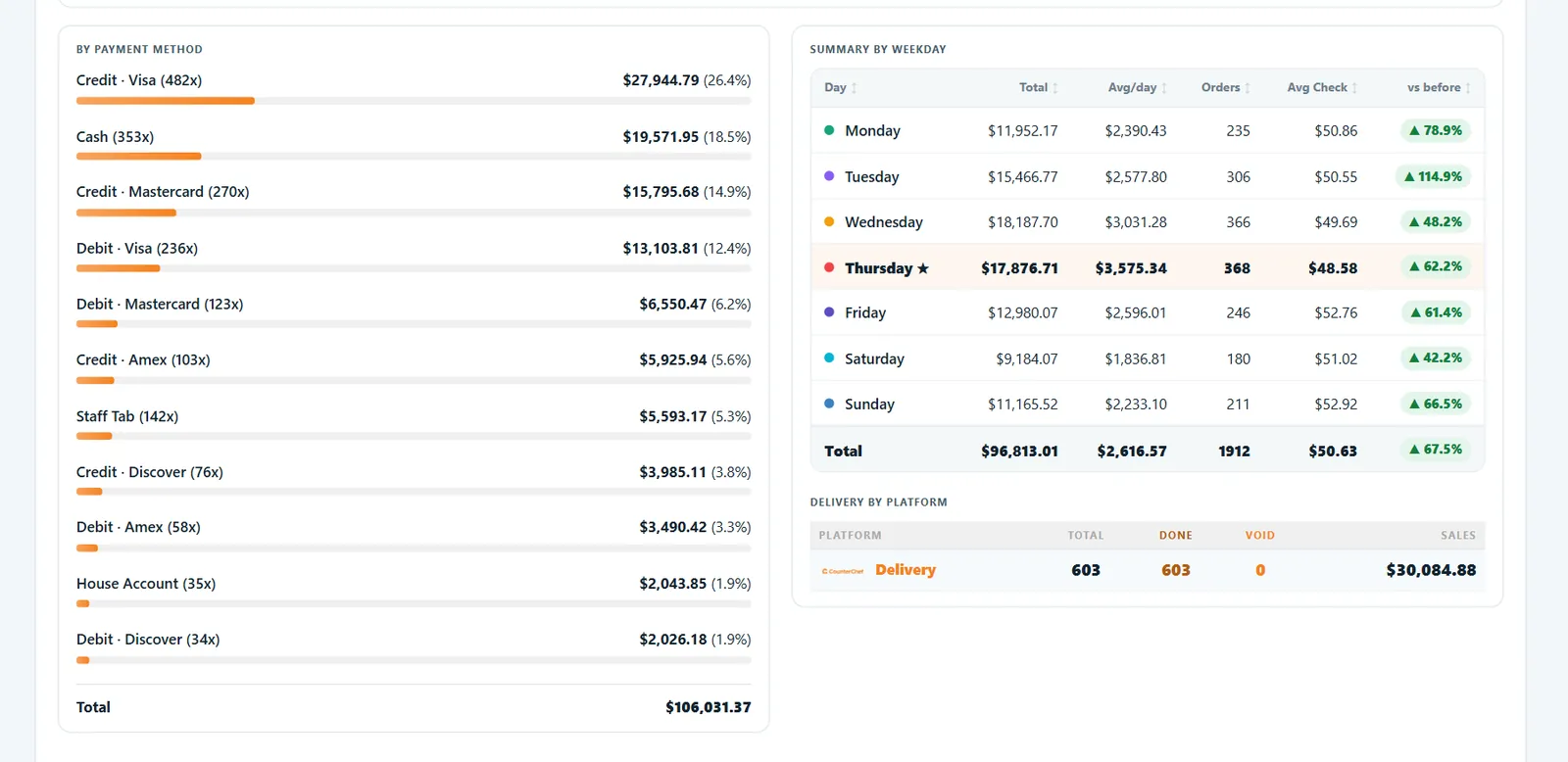
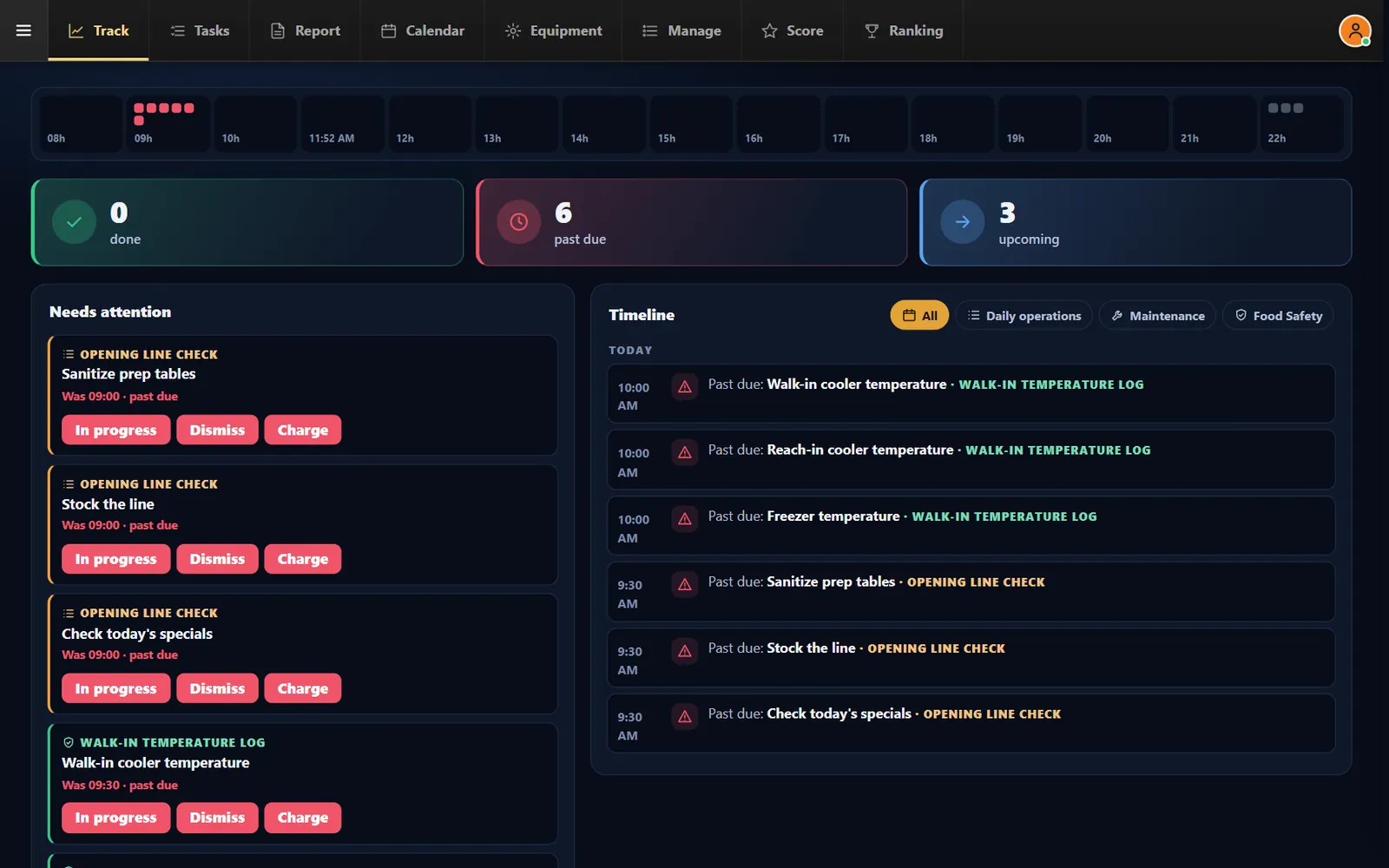
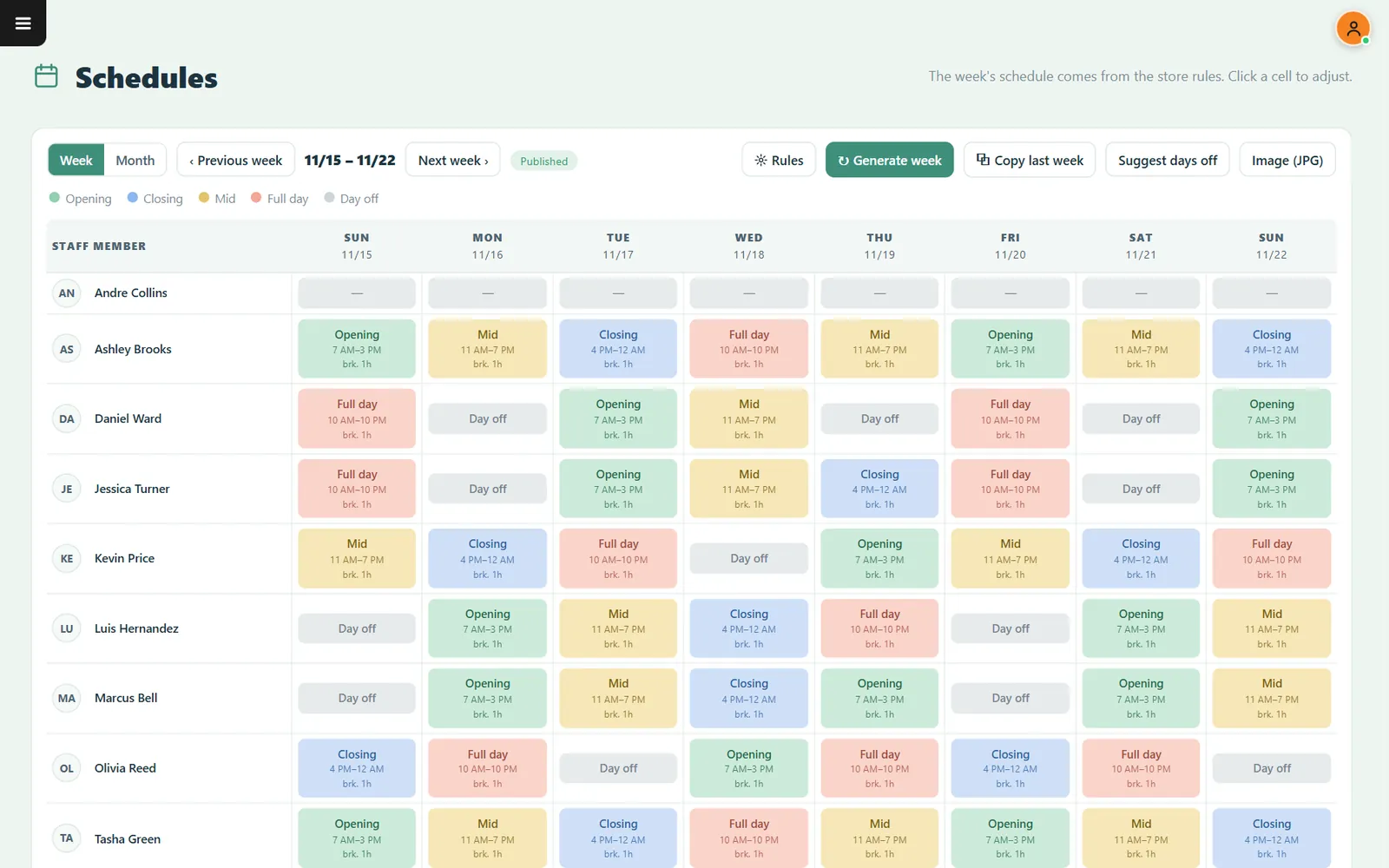
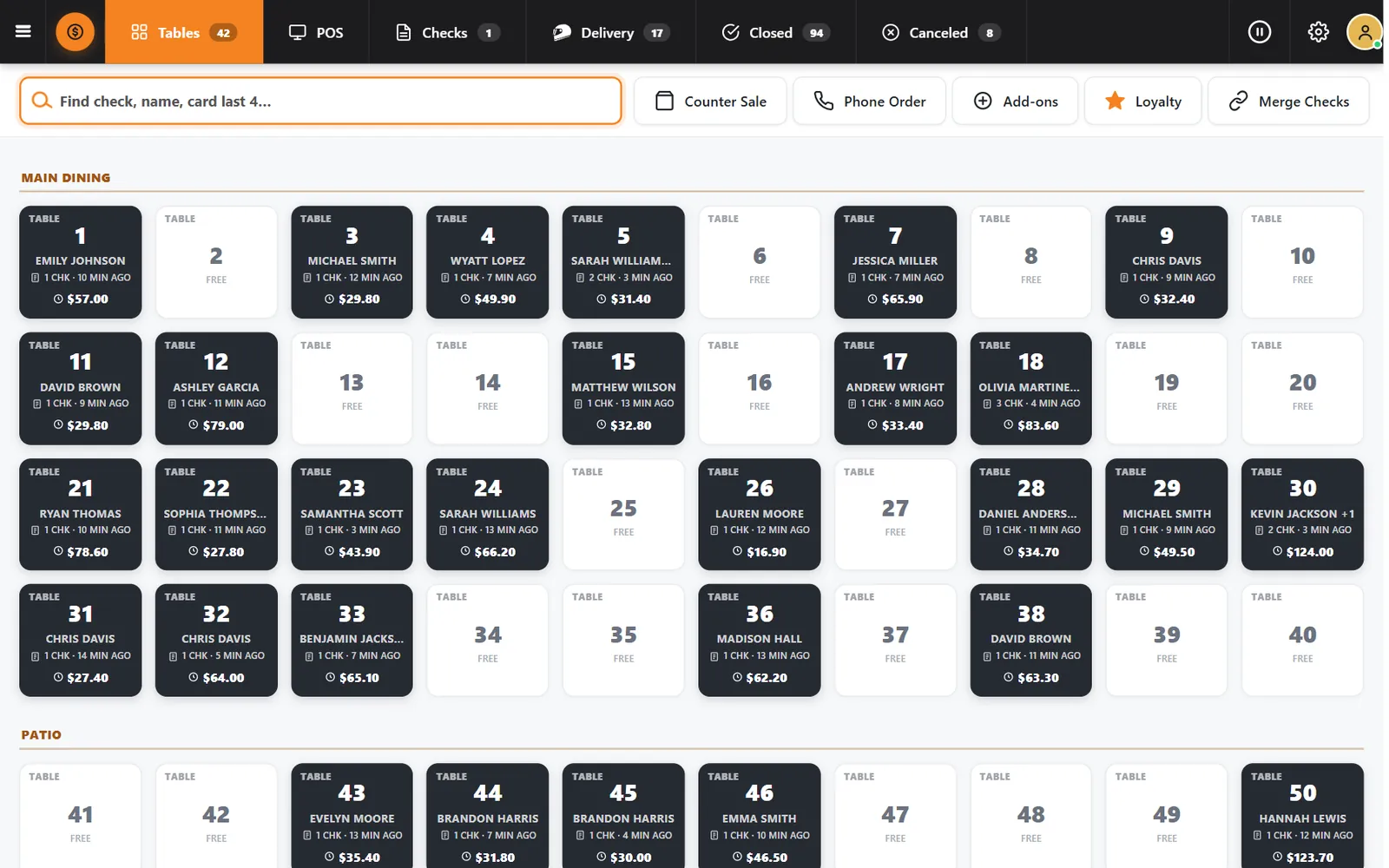
For example, CounterChef runs on iPad, Android tablet, iPhone and computer; provides your own online menu for pickup and delivery, with delivery areas by ZIP code, each with its own fee and estimated time; a kitchen display with ticket timers; a table map and server phones for dine-in; employees clock in on a tablet or computer and schedules are built in the system; tips can be shared by percentage or by hours worked; inventory and recipe costing show the cost of each dish; loyalty points and gift cards; sales tax rates with up to three decimals and by category; and reports by day, item and employee.
The business plan should explain how management will use its operating information, not just list tools.
For example, the owner can review sales by day, compare actual ingredient usage against recipe expectations, identify slow-moving items, and investigate shifts where labor or service times changed.
What should you verify before sending the business plan to a lender?
Use this checklist before sharing the plan with a lender, investor, landlord, or potential partner.
Restaurant business plan review checklist
- The concept is specific and commercially understandable.
- The target customer is clearly defined.
- Market research includes actual site visits and competitor observations.
- Menu items have preliminary recipe costs and pricing assumptions.
- Kitchen equipment matches the menu and service model.
- Staffing plans cover every operating day and daypart.
- Startup costs are supported by quotes or clearly labeled estimates.
- Working capital and contingency are included.
- Sales projections explain guest counts and average checks.
- Conservative, base, and upside scenarios are prepared.
- Monthly expenses and break-even assumptions are documented.
- Cash flow includes loan payments and timing of bills.
- Ownership contributions and responsibilities are documented.
- Risks have practical mitigation plans.
- Opening milestones have dependencies and realistic timing.
- Financial assumptions have been reviewed with an accountant.
- Local permits, licensing, tax, and employment requirements have been checked.