
Restaurant Cash Flow Management: How to Build and Use a 13-Week Cash Flow Forecast
A restaurant can show a profit on its monthly income statement and still struggle to make payroll, pay suppliers, or cover rent. The reason is simple: profit measures what the business earns, while cash flow management tracks when money actually enters and leaves the bank account. For independent restaurant owners, a rolling 13-week cash flow forecast turns that timing problem into something you can see, plan for, and manage before it becomes an emergency.
A profitable restaurant can still run out of cash
Start with a distinction that every owner needs to understand: profit and cash are not the same thing.
Your profit and loss statement records revenue and expenses according to accounting rules. Your bank account reflects actual cash movements. Those two views are connected, but they rarely move in perfect alignment.
Consider a restaurant that has a strong month. Sales are up, food costs are controlled, labor is reasonable, and the income statement shows a healthy operating profit. The owner might reasonably assume there is plenty of money available.
Then several payments hit at once:
- A large food and beverage invoice comes due.
- Payroll includes an extra pay period or a larger-than-usual amount of overtime.
- Monthly rent is withdrawn.
- Sales tax collected during the previous period must be remitted.
- An equipment repair requires immediate payment.
- A quarterly insurance installment becomes due.
The restaurant may have earned enough to cover all these expenses on paper. But if the cash from its sales has not arrived before those payments are due, the bank balance can fall below the amount needed to operate.
This is a timing problem, not necessarily a profitability problem.
Other situations create the same disconnect.
Inventory purchases consume cash before the inventory becomes an expense. Buying a large quantity of food or beverages increases inventory on hand. The money leaves the bank immediately, but the corresponding cost is generally recognized as the products are used or sold.
Loan principal payments reduce cash without reducing operating profit. The interest portion is an expense, but principal repayment reduces the loan balance rather than appearing as an operating expense on the income statement.
Capital purchases use cash differently from ordinary expenses. A new refrigerator, oven, or point-of-sale terminal may require a substantial payment. Its accounting treatment can spread the expense over time, but the bank account takes the hit when the purchase is paid.
Credit sales create a delay between revenue and cash collection. Catering, private events, corporate accounts, and other arrangements may generate sales before the customer actually pays.
Owner distributions reduce available cash. A restaurant can be profitable while the owner withdraws more money than the business can comfortably support.
The lesson is straightforward: a monthly profit report cannot tell you exactly how much cash will be available next Thursday.
That is why restaurant cash flow management needs its own operating routine.
A 13-week forecast gives you enough time to make useful decisions
A 13-week cash flow forecast projects cash entering and leaving the business over the next three months.
Thirteen weeks is a practical planning window because it is long enough to capture recurring expenses, payroll cycles, supplier payment patterns, rent, taxes, debt payments, and upcoming seasonal changes. It is also short enough that you can estimate many of the numbers using information you already have.
A yearly cash flow forecast can help with long-term planning, but it often relies on assumptions that become less reliable as the forecast moves further into the future.
A 13-week view gives you a better balance between visibility and accuracy.
The basic structure is simple:
- Start with the actual available cash in your bank accounts.
- Estimate the cash you expect to receive during each week.
- List the payments you expect to make during each week.
- Calculate the projected ending cash balance.
- Carry that ending balance into the following week.
- Replace estimates with actual numbers as transactions happen.
- Extend the forecast by one week as each week closes.
The important detail is that this should be a rolling forecast, not a document you prepare once and forget.
Every week, the forecast should move forward. Week 1 becomes actual history, Week 2 becomes the current operating week, and a new Week 13 is added at the end.
This gives you a constantly updated view of the next three months.
Build the forecast around cash dates, not accounting dates
One of the most common forecasting mistakes is organizing the schedule around when expenses are recorded rather than when money actually leaves the bank.
For cash flow purposes, payment dates matter.
If a supplier delivers food on Monday but payment is due the following Friday, the cash forecast should show the expected payment on Friday.
If payroll covers two weeks but the money is withdrawn every other Thursday, record the cash outflow on Thursday.
If rent is due on the first of the month, put it in the week containing that date.
The same principle applies to incoming money.
A restaurant might record sales on Saturday night, but some payment processing deposits may not arrive until the next business day or later. Forecast the expected deposit date, not simply the date of the sale.
For each transaction, ask:
- When will the money actually arrive?
- When will the money actually leave?
- Is the amount confirmed or estimated?
- What happens if the date changes?
This approach prevents a misleading forecast in which the restaurant appears to have money available simply because an incoming payment and an outgoing payment were recorded in the same accounting period.
A weekly forecast does not need to predict every individual transaction perfectly. It needs to place the major cash movements in the correct week.
Separate available cash from money that already has a purpose
Your bank balance is not automatically your operating cash balance.
Some of the money sitting in your accounts may already be committed to specific obligations.
Examples include:
- Sales tax collected from customers.
- Payroll taxes and other required withholdings.
- Tips held for distribution to employees.
- Deposits for future private events.
- Money reserved for upcoming insurance or tax payments.
- Cash set aside for a planned equipment purchase.
These amounts may appear in your bank balance, but treating all of them as freely available operating cash can create problems.
A useful practice is to calculate two figures every week:
Total bank cash: The actual combined balance of the business bank accounts.
Uncommitted operating cash: Total bank cash minus amounts already reserved for specific obligations.
For example, suppose the restaurant has $48,000 in its operating accounts. Of that amount, $6,000 is reserved for sales tax, $4,000 for payroll-related obligations, and $3,000 for a future event deposit that must be applied to the event.
The business has $48,000 in bank cash, but only $35,000 is uncommitted.
These are hypothetical figures.
This distinction makes the forecast more useful because it prevents an owner from treating money that belongs to another obligation as available for supplier payments or discretionary spending.
Be careful not to subtract the same obligation twice. If a reserved tax payment is already included as an upcoming cash outflow in the forecast, the reserve should be used consistently rather than deducted again from the projected balance.
Build the 13-week forecast in six practical steps
You do not need a complicated financial model to get started. A spreadsheet with weekly columns and clearly labeled cash categories is enough.
Start with the actual bank balance
Use the latest reconciled bank balance, not a balance remembered from a previous statement.
Include the business accounts that will actually fund operations. If you have separate operating, payroll, or reserve accounts, decide which balances belong in the forecast and how transfers between accounts will be handled.
Internal transfers are not new income or expenses. Counting a transfer as both an inflow and an outflow can distort the forecast.
Also identify outstanding payments, deposits in transit, and checks or electronic payments that have not cleared.
The starting number should represent the cash the restaurant can realistically use.
Forecast incoming cash by source
Do not simply multiply average daily sales by seven and call that your weekly cash inflow.
Separate expected receipts into useful categories:
- Credit and debit card deposits.
- Cash deposits.
- Catering and private-event payments.
- House-account collections.
- Other business income.
- Owner contributions or financing, when applicable.
For regular restaurant sales, use recent sales patterns, reservations, scheduled events, and seasonal information.
Then adjust for the actual deposit schedule.
For example, if a large private event is scheduled for Week 4 and the customer owes the final balance in Week 5, do not put that money in Week 4 simply because the event happens then.
A deposit expected in Week 5 belongs in Week 5.
It is also helpful to distinguish confirmed receipts from uncertain ones. An invoice that has been approved for payment is different from a customer who has not yet confirmed a payment date.
List outgoing payments by their expected dates
This is where many restaurant forecasts become useful.
Break expenses into categories that reflect how the restaurant actually operates:
Payroll and employee-related payments
- Regular wages.
- Overtime.
- Payroll taxes and required contributions.
- Employee benefits.
- Tip distributions, where applicable.
Food and beverage purchasing
- Produce and perishables.
- Meat and seafood.
- Dry goods.
- Alcohol and nonalcoholic beverages.
- Packaging and disposables.
Occupancy and utilities
- Rent.
- Electricity.
- Gas.
- Water.
- Waste collection.
- Property-related charges.
Operating expenses
- Cleaning supplies.
- Repairs and maintenance.
- Small equipment.
- Linen and laundry.
- Insurance.
- Marketing.
- Administrative expenses.
Financing and taxes
- Loan principal and interest.
- Sales tax remittances.
- Income tax payments, when applicable.
- Other scheduled obligations.
Capital spending
- Equipment purchases.
- Furniture.
- Renovations.
- Technology replacements.
Use actual due dates whenever possible.
For recurring payments, check the contract, invoice, or bank history instead of relying on memory.
Calculate the projected ending cash balance
The core calculation is:
Beginning cash + Cash inflows - Cash outflows = Ending cash
The ending balance becomes the next week's beginning balance.
For example:
| Cash movement | Hypothetical amount |
|---|---|
| Beginning cash | $35,000 |
| Customer receipts | $42,000 |
| Other cash inflows | $1,000 |
| Total cash available | $78,000 |
| Payroll | -$18,000 |
| Food and beverage suppliers | -$16,000 |
| Rent | -$7,000 |
| Utilities and operating expenses | -$4,000 |
| Taxes and loan payments | -$5,000 |
| Total cash outflows | -$50,000 |
| Ending cash | $28,000 |
All figures in this example are hypothetical.
The restaurant begins with $35,000, receives $43,000, and pays $50,000. It finishes the week with $28,000.
That $28,000 becomes the starting balance for the next week's forecast.
Repeat the calculation for all 13 weeks.
Add a minimum operating cash target
A positive projected balance does not automatically mean the restaurant is financially comfortable.
The owner should establish a minimum operating cash target based on the business's actual obligations and risks.
Consider:
- Upcoming payroll.
- Rent and utilities.
- Supplier payment requirements.
- Tax obligations.
- Debt payments.
- Expected repairs.
- Seasonal fluctuations.
- The time needed to arrange financing or adjust spending.
There is no universal cash reserve that works for every restaurant. A small counter-service operation with predictable sales and limited fixed costs has a different cash requirement from a full-service restaurant with substantial payroll, seasonal revenue, and expensive equipment.
Set a target that reflects your own operation.
Then add a row to the forecast showing the difference between projected ending cash and that target.
A forecast can show positive cash while still warning that the business is approaching an uncomfortable position.
Update actual results and roll the forecast forward
At the end of each week, replace estimates with actual cash receipts and payments.
Do not overwrite the original forecast without keeping track of what changed. The difference between the original estimate and the actual result contains valuable information.
If food supplier payments were consistently higher than expected, investigate whether purchasing volume, invoice timing, or payment terms caused the difference.
If cash receipts arrived later than expected, adjust the deposit assumptions.
If payroll repeatedly exceeds the estimate, review staffing schedules and overtime.
Then add a new Week 13.
Over time, the forecast becomes more accurate because it reflects how your particular restaurant actually moves money.
A worked 13-week example shows how profit can hide a cash shortage
Consider a hypothetical independent restaurant that is profitable on its monthly income statement but has several large cash obligations coming due.
The following simplified example uses hypothetical numbers throughout.
The restaurant starts Week 1 with $35,000 in available cash.
Its projected weekly cash movements are:
| Week | Beginning cash | Cash inflows | Cash outflows | Ending cash |
|---|---|---|---|---|
| 1 | $35,000 | $43,000 | $50,000 | $28,000 |
| 2 | $28,000 | $45,000 | $39,000 | $34,000 |
| 3 | $34,000 | $42,000 | $41,000 | $35,000 |
| 4 | $35,000 | $44,000 | $58,000 | $21,000 |
| 5 | $21,000 | $46,000 | $40,000 | $27,000 |
| 6 | $27,000 | $43,000 | $42,000 | $28,000 |
| 7 | $28,000 | $45,000 | $40,000 | $33,000 |
| 8 | $33,000 | $42,000 | $57,000 | $18,000 |
| 9 | $18,000 | $44,000 | $41,000 | $21,000 |
| 10 | $21,000 | $46,000 | $40,000 | $27,000 |
| 11 | $27,000 | $43,000 | $42,000 | $28,000 |
| 12 | $28,000 | $45,000 | $56,000 | $17,000 |
| 13 | $17,000 | $44,000 | $41,000 | $20,000 |
All amounts in the table are hypothetical US dollars.
The restaurant receives a total of $562,000 in cash inflows during the 13 weeks and makes $547,000 in cash payments.
The net cash increase is $15,000.
However, the ending cash balance falls from $35,000 to $20,000 at various points in the forecast, reaching a low of $17,000 in Week 12.
The large outflows in Weeks 4, 8, and 12 are hypothetical examples of weeks containing rent, payroll, supplier settlements, taxes, and other scheduled obligations.
Now consider a separate hypothetical monthly profit and loss statement:
| Income statement item | Hypothetical amount |
|---|---|
| Sales revenue | $240,000 |
| Cost of goods sold | -$72,000 |
| Labor expense | -$84,000 |
| Occupancy expense | -$18,000 |
| Other operating expenses | -$42,000 |
| Depreciation and interest | -$4,000 |
| Net profit | $20,000 |
All figures are hypothetical.
The restaurant reports $20,000 in net profit for the month. That does not mean the bank account increased by $20,000.
Some revenue may not have been collected yet. Inventory purchases may have been paid for in a different period. Loan principal payments may have reduced cash without reducing profit. Capital purchases may have consumed money without appearing as an immediate operating expense.
The income statement and the cash forecast are answering different questions.
The income statement asks whether the restaurant earned a profit.
The forecast asks whether the restaurant can meet its obligations on the dates they are due.
In this example, the owner should not wait until Week 12 to react to the projected $17,000 balance.
If the restaurant's hypothetical minimum operating cash target is $25,000, the forecast already shows a problem in Week 4.
That gives the owner time to take action.
Possible responses include negotiating a more suitable supplier payment schedule, delaying a nonessential equipment purchase, collecting outstanding catering balances earlier, or adjusting purchasing to match actual sales needs.
The owner can also investigate whether the restaurant is holding too much slow-moving inventory.
The right response depends on the cause of the cash shortage. The forecast tells you when and where to investigate.
Read the forecast every week and make a decision from it
A 13-week forecast is only useful when it changes how you run the restaurant.
A weekly review should be a short management meeting, not a long accounting exercise.
Use the same questions every week:
- What was our actual ending cash balance?
- Where did actual receipts differ from the forecast?
- Which payments are coming due in the next two weeks?
- When will projected cash fall below our minimum target?
- What decision needs to happen this week?
Pay particular attention to the next two weeks. Those numbers should be more reliable because invoices, payroll, and scheduled payments are easier to confirm.
The later weeks are still useful, but they should be treated as planning estimates rather than guaranteed outcomes.
A practical response depends on the size and timing of the projected gap.
If the shortage is caused by delayed collections: Contact customers with outstanding balances, confirm payment dates, and tighten the process for collecting event deposits and final balances.
If the shortage is caused by excessive inventory purchases: Review what is already in storage, identify slow-moving products, and reduce orders where doing so will not compromise service.
If the shortage is caused by payment timing: Contact suppliers before the due date to discuss a realistic payment schedule. Do not simply stop paying invoices without communication.
If the shortage is caused by weak sales: Revisit staffing, purchasing, opening hours, and discretionary spending. Do not assume that cutting every expense will improve the business. Protect the operating capacity needed to generate revenue.
If the shortage is structural: If the restaurant repeatedly cannot cover its normal operating obligations, a temporary payment delay will not solve the underlying problem. Review pricing, margins, labor, occupancy costs, debt, and the overall operating model with an accountant or financial adviser.
Three practical cash flow improvements owners can try this week
A forecast helps you identify problems. The next step is to change the operating habits that create them.
Here are three practical ideas that go beyond simply reviewing the bank balance.
Give every large purchase a cash date before approving it
Restaurants often evaluate purchases by asking whether the item is necessary and whether the price is reasonable.
Add another question: What will this purchase do to our cash position during the week it is paid?
Create a simple purchase approval rule for larger or nonroutine expenses.
Before approving the purchase, write down:
- What the restaurant is buying.
- The total expected cost.
- The expected payment date.
- Whether the purchase is essential now.
- Which week of the forecast will contain the payment.
- What the projected ending cash balance will be after payment.
For example, a hypothetical $4,500 equipment purchase may be affordable in the accounting sense but could push the restaurant below its minimum cash target during a week with payroll and rent.
The owner might decide to postpone it, arrange a payment schedule, or find an alternative that meets the operational need without creating the same immediate cash pressure.
This does not mean avoiding necessary investments. It means understanding their timing before committing.
Create a 30-day supplier payment calendar
Most owners know their major suppliers, but not every owner has a clear view of when all supplier payments will hit the bank.
Build a calendar showing every expected supplier payment over the next 30 days.
Include the supplier, invoice amount, due date, payment method, and whether the invoice has been approved.
Then look for clusters.
You may discover that several large food invoices, beverage payments, and equipment service bills all fall in the same week.
That concentration is often more important than the total monthly purchasing amount.
Once you identify the problem, you can discuss payment arrangements with suppliers before the invoices become overdue.
You may also be able to coordinate orders more carefully without compromising product quality or food safety.
The objective is not to delay every payment. It is to avoid unnecessary concentration of cash outflows.
Run a cash-neutral purchasing review before every major order
A purchasing decision can look reasonable when each individual item is considered separately.
A produce order increases a little. A beverage order increases a little. A backup supply of packaging seems sensible. A few extra cases are added because the restaurant expects a busy weekend.
Together, those decisions can tie up substantial cash.
Before placing a major order, compare the proposed purchase against:
- Current inventory.
- Expected sales until the next order.
- Confirmed events and reservations.
- Product shelf life.
- Existing supplier commitments.
- The projected cash balance after payment.
One useful question is: If sales come in below our estimate, how much of this order will still be sitting in storage?
This encourages managers to distinguish between inventory needed to protect service and inventory purchased because it is convenient to have.
A cash-neutral purchasing review does not require cutting the order by a fixed percentage. It requires making the order fit both the restaurant's operating needs and its available cash.
Use a simple weekly checklist to keep the forecast current
The following checklist can become part of the restaurant's Monday management routine.
Copy it into your operating notes or spreadsheet and assign one person to complete it.
| Weekly task | What to check | Complete |
|---|---|---|
| Confirm opening cash | Reconcile business bank balances | ☐ |
| Check pending deposits | Verify expected customer and card receipts | ☐ |
| Review receivables | Contact customers with overdue balances | ☐ |
| Review supplier bills | Confirm amounts and payment dates | ☐ |
| Check payroll | Include wages, overtime, and related obligations | ☐ |
| Review taxes | Confirm upcoming remittance dates and amounts | ☐ |
| Check fixed expenses | Confirm rent, insurance, utilities, and debt payments | ☐ |
| Review inventory commitments | Match major orders to expected sales | ☐ |
| Update the 13-week forecast | Replace last week's estimates with actuals | ☐ |
| Identify the lowest projected balance | Compare it with the minimum cash target | ☐ |
| Assign corrective actions | Give each action an owner and deadline | ☐ |
| Add a new Week 13 | Extend the forecast by one week | ☐ |
The checklist is intentionally simple.
The point is to make cash flow management a repeatable management responsibility rather than something the owner remembers to do when the bank balance looks uncomfortable.
Track a few warning signs before cash becomes a crisis
A 13-week forecast is your main planning tool, but a few supporting indicators can help you spot trouble earlier.
Receivables are getting older. If customers are taking longer to pay catering or event invoices, future cash inflows may be less reliable.
Supplier balances are increasing. If unpaid invoices are accumulating even though sales are steady, the restaurant may be using supplier credit to cover an operating shortfall.
Inventory is increasing faster than sales. More cash is being tied up in products that may take longer to sell.
Payroll is creating unexpected cash pressure. Frequent overtime, staffing inefficiencies, or poorly planned schedules can make weekly outflows less predictable.
The restaurant is relying on transfers or borrowing to cover normal expenses. Occasional financing may be part of a reasonable plan, but repeated borrowing to cover ordinary operating costs deserves a closer review.
The minimum cash target is being breached repeatedly. This may indicate that the target is too low, the business needs more working capital, or its operating economics need attention.
Do not treat any single indicator as proof that the restaurant is in financial trouble. Look at the pattern and investigate the underlying cause.
Keep cash flow responsibilities connected to daily restaurant operations
Cash flow should not be left entirely to the bookkeeper or accountant.
The owner may be responsible for the overall forecast, but managers can influence the numbers every day.
The kitchen manager affects purchasing, waste, inventory levels, and production planning.
The front-of-house manager influences staffing, overtime, service consistency, and the handling of event deposits or customer accounts.
The general manager can coordinate purchase approvals, review upcoming obligations, and make sure invoices reach the person responsible for payment.
The owner or financial manager should maintain the forecast, review bank activity, and decide how much cash can be committed to discretionary expenses.
Give each manager a practical responsibility rather than asking everyone to understand the entire financial picture.
For example, the kitchen manager does not need to calculate the restaurant's 13-week ending cash balance. That manager does need to understand that an unnecessary inventory purchase can create a cash problem during payroll week.
This connection between operating decisions and financial consequences makes the forecast much more useful.
CounterChef can help organize financial administration
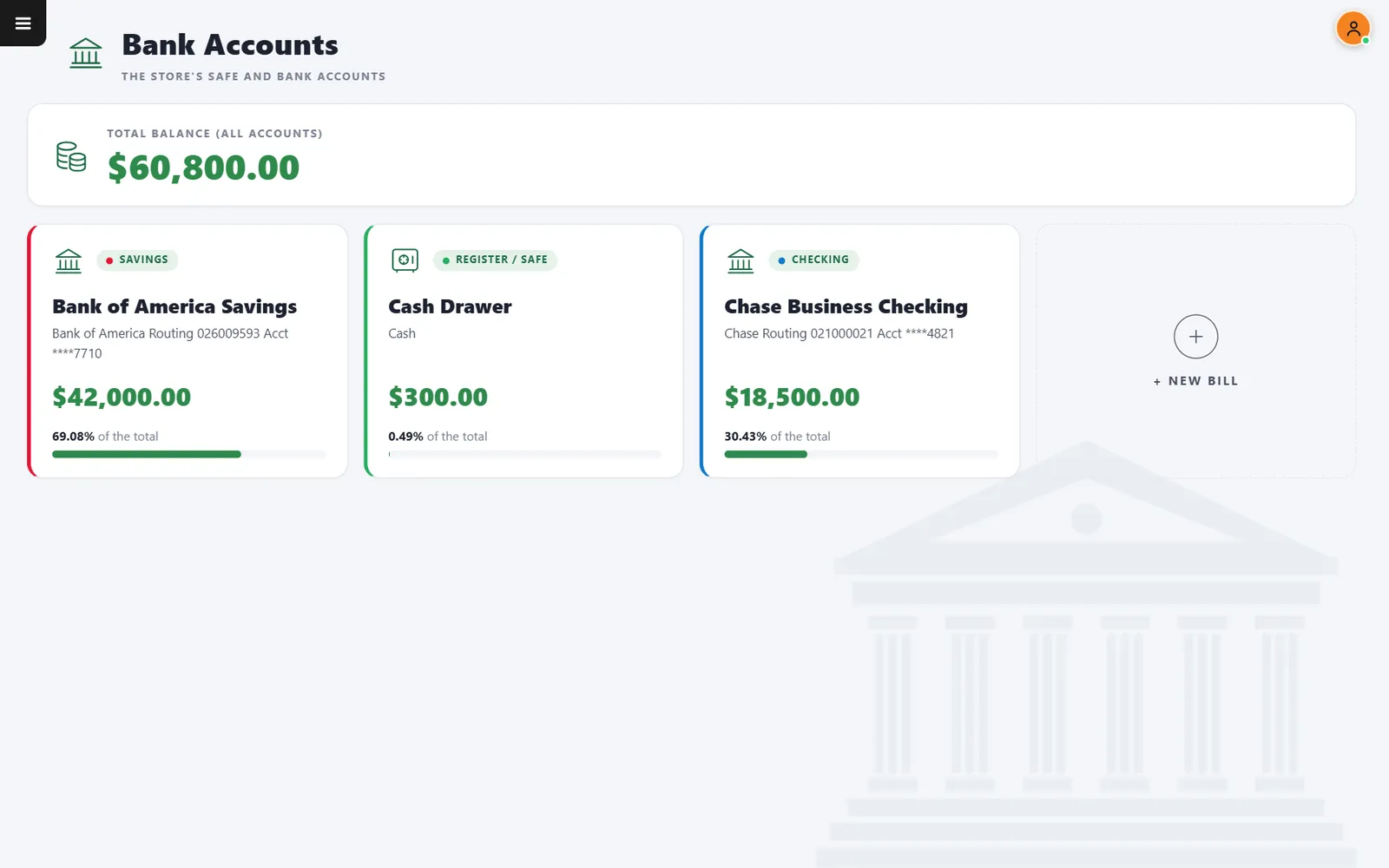
For restaurants using CounterChef, Finance manages bills, receivables, bank accounts, register reconciliation, and recurring expenses. Accounts payable shows open and overdue bills and can be filtered by supplier, date, or bank.
Those functions relate to the administrative work that supports a cash flow routine. The owner still needs to review expected payment dates, estimate future receipts, and make decisions based on the restaurant's projected cash position.
Avoid these common mistakes when forecasting restaurant cash
Even a well-designed spreadsheet can produce misleading results if the assumptions are poor.
Using sales instead of cash deposits. Revenue recorded during the week is not necessarily cash received during that week. Account for deposit timing and outstanding balances.
Assuming every supplier invoice will be paid on its due date without checking. Confirm actual payment terms, scheduled withdrawals, and any outstanding arrangements.
Forgetting less frequent expenses. Annual insurance payments, equipment maintenance, licensing costs, and seasonal repairs can create significant cash demands.
Counting internal bank transfers as income. A transfer between two business accounts changes the location of cash, not the total amount of cash owned by the restaurant.
Ignoring loan principal. Debt repayment schedules need to include both principal and interest because both affect available cash.
Treating future sales as guaranteed. Reservations, events, and seasonal expectations can change. Use conservative assumptions when the receipts are not confirmed.
Updating only when something goes wrong. A forecast that is reviewed only during a cash shortage is a reporting document, not an operating tool.
Confusing cash reserves with profit. Money in the bank can include taxes, deposits, and other obligations. A high balance does not automatically mean the owner can safely withdraw funds.
Finally, do not use a cash forecast as a substitute for accounting records, tax planning, or professional financial advice. Tax payment requirements, payroll obligations, and other legal requirements vary by state and city. Confirm applicable obligations with the relevant authorities and qualified professionals.
Frequently asked questions
How far ahead should a restaurant forecast its cash flow?
A rolling 13-week forecast is a useful starting point for most independent restaurants. It provides enough visibility to plan for payroll, supplier payments, rent, taxes, debt payments, and other recurring obligations.
You can also maintain a longer-term annual forecast for seasonal planning and major investments. The 13-week version should receive more frequent updates because its assumptions are closer to actual operating conditions.
How often should restaurant owners update their cash flow forecast?
Update it at least once a week.
A Monday review is a practical routine because it allows the owner to compare the previous week's actual results with the forecast and prepare for upcoming obligations.
During periods of tight cash, rapid growth, seasonal changes, or unexpected financial pressure, reviewing bank activity and the next few days of payments more frequently can be appropriate.
What is the difference between restaurant cash flow and restaurant profit?
Profit measures the financial result of revenue minus expenses under accounting rules. Cash flow measures the actual movement of money into and out of the business.
A restaurant can report a profit while experiencing a cash shortage because customers have not paid yet, inventory purchases have consumed cash, loan principal is due, or several large bills fall in the same week.
Both measurements matter. Profit tells you whether the business is economically successful, while cash flow tells you whether it can meet its financial obligations when they come due.
How much cash should a restaurant keep in reserve?
There is no single reserve amount that works for every restaurant.
The appropriate amount depends on payroll, rent, supplier terms, debt obligations, seasonality, repair risks, and the reliability of incoming cash.
Start by identifying the restaurant's unavoidable near-term expenses and the timing of its largest cash obligations. Then establish a minimum operating cash target that provides enough room to handle normal fluctuations and unexpected expenses.
Review that target as the business changes. A restaurant opening a second location, entering a slower season, or taking on additional debt may need a different reserve than it did previously.
The most important step is to stop treating the bank balance as a surprise. A rolling 13-week forecast gives you a chance to see cash shortages coming, understand what is causing them, and make operating decisions while you still have time to act.
Related feature: Finance.