
Restaurant Opening Closing Checklist: Ready-to-Use Lists for Managers, Line Cooks, Servers, and Bartenders
A restaurant opening and closing checklist gives every employee a clear picture of what must be ready before service and what must be finished before going home. The most useful system assigns tasks by position, identifies who verifies completion, and makes it difficult for important work to disappear between shifts.
Build the checklist around positions, not just opening and closing times
A single master checklist is useful for management, but it is not the best working document for everyone. A line cook needs to know which equipment to check, a server needs to know which tables and stations to prepare, and a bartender needs to know what must be stocked and secured.
Give each position its own opening and closing list. Keep a separate manager checklist for inspections, staffing, cash controls, safety and final approval.
Every task should have three characteristics:
- A clear action: "Check walk-in temperatures" is better than "Check kitchen."
- An assigned owner: One person is responsible for completing it.
- A verification point: Someone confirms the work when the task affects safety, cash, security or another employee's station.
Health code requirements vary by state, county and city. Confirm food handling, temperature records, sanitation, handwashing, employee health, equipment and other requirements with your local health department. Treat the lists below as operating templates, not substitutes for local regulations.
The manager should open the building before the team starts service preparation
The opening manager is responsible for making sure the restaurant is safe, staffed and ready to serve. Arriving before the rest of the team gives the manager time to identify problems before employees are working around them.
Manager opening checklist
- Unlock the building and disarm the alarm according to security procedures.
- Check entrances, exits, windows and visible signs of damage or forced entry.
- Turn on approved lighting and inspect customer and employee areas.
- Check that emergency exits and walkways are unobstructed.
- Confirm refrigeration and freezer temperatures are within the restaurant's established limits.
- Review required temperature and food safety logs.
- Check hot water, handwashing stations and restroom supplies.
- Confirm cleaning chemicals are properly labeled and stored away from food.
- Inspect the kitchen, dining room, bar and storage areas for overnight problems.
- Review reservations, expected covers, special events and large-party requirements.
- Confirm attendance and identify staffing gaps.
- Assign stations, breaks and opening responsibilities.
- Review unavailable menu items, specials and ingredient substitutions.
- Confirm the POS system, printers and payment terminals are working.
- Verify the opening cash bank according to cash-handling procedures.
- Conduct a short pre-shift meeting.
- Confirm that each department has completed its opening checklist.
One useful addition is a five-minute equipment review. Ask each department lead to identify one piece of equipment that could interrupt service if it failed. A refrigerator making unusual noise, a weak ice machine or a printer that intermittently disconnects deserves attention before the first order arrives.
Manager closing checklist
- Confirm all guests have left and remaining checks are settled.
- Verify that employees have completed their assigned closing tasks.
- Review voids, discounts, refunds and unusual transactions.
- Reconcile cash drawers according to established procedures.
- Confirm credit card batches and required sales reports are complete.
- Secure cash and sensitive documents.
- Review labor records and outstanding timekeeping issues.
- Check waste, spoilage and food safety records.
- Confirm refrigeration and freezer doors are closed.
- Verify that required equipment is switched off or left operating according to manufacturer and food safety instructions.
- Confirm cleaning chemicals and hazardous materials are secured.
- Check restrooms, dining areas, kitchen and employee spaces.
- Confirm trash and recycling have been handled.
- Check that exterior doors, windows and storage areas are secured.
- Set the alarm and lock the building.
- Record maintenance problems and unfinished tasks for the next shift.
The manager should not simply sign every department's sheet without checking. Spot-check important items, particularly food storage, cash handling and security.
Line cooks should prepare stations and leave food safe for the next shift
The kitchen opening checklist should focus on equipment, ingredients, preparation and sanitation. A station that looks organized but has improperly stored food is not ready.
Line opening checklist
- Wash hands and follow the restaurant's required hygiene procedures.
- Put on clean, appropriate work clothing and protective equipment.
- Check station cleanliness and sanitation.
- Confirm refrigeration and hot-holding equipment are operating correctly.
- Check and document food temperatures as required.
- Inspect deliveries and stored ingredients for quality and proper labeling.
- Rotate stock using the restaurant's established system.
- Check preparation lists and expected service volume.
- Prepare assigned ingredients and recipes.
- Label and date prepared food according to house procedures.
- Set up cutting boards, knives, utensils and sanitation supplies.
- Check that thermometers are available and functioning.
- Stock sauces, garnishes, proteins and other station ingredients.
- Confirm backup ingredients are accessible.
- Check equipment settings and preheat ovens, grills or fryers as needed.
- Review menu changes, allergies and unavailable items with the kitchen lead.
A practical improvement is to organize prep quantities around actual service requirements rather than automatically preparing the same amount every morning. Review recent sales, reservations, weather-related demand and scheduled events before assigning production.
Line closing checklist
- Stop new preparation according to the kitchen closing schedule.
- Identify usable leftover ingredients and items that must be discarded.
- Cool and store food using approved procedures.
- Label, date and organize retained ingredients.
- Record waste and spoilage.
- Clean and sanitize food-contact surfaces.
- Wash, rinse and sanitize utensils and equipment as required.
- Clean grills, fryers, ovens and other equipment according to manufacturer instructions.
- Empty and clean approved waste containers.
- Sweep and mop floors.
- Clean drains and surrounding areas according to the sanitation schedule.
- Store knives and equipment safely.
- Check refrigeration doors and storage containers.
- Restock essential supplies for the next shift.
- Report broken equipment and low inventory.
- Complete required food safety records.
- Have the kitchen lead inspect the station before departure.
One detail worth emphasizing: closing employees should not guess how to cool, store or reheat food. Establish written procedures that comply with local health requirements, train employees on them and verify that they are followed.
Front-of-house employees should prepare the guest experience before the doors open
Front-of-house preparation is more than wiping tables and arranging chairs. Servers and hosts need to know what is happening during the shift, where supplies are located and which problems should be escalated.
Front-of-house opening checklist
- Unlock or prepare the assigned service areas when authorized.
- Turn on appropriate lighting and music.
- Check dining room cleanliness.
- Clean and arrange tables, chairs and booths.
- Confirm table numbers and seating arrangements.
- Set tables according to restaurant standards.
- Stock napkins, silverware, menus and other service supplies.
- Clean and organize server stations.
- Check POS terminals and receipt printers.
- Confirm payment terminals are charged or connected.
- Prepare water stations and beverage supplies.
- Check restrooms and replenish supplies.
- Review reservations, waitlist expectations and large parties.
- Identify accessibility or seating arrangements that need attention.
- Review specials, unavailable items and allergen information.
- Attend the pre-shift meeting.
- Confirm assigned sections and side work.
Front-of-house closing checklist
- Complete all assigned guest checks.
- Clear and sanitize tables.
- Reset tables for the next service period.
- Clean chairs, booths and high-touch surfaces.
- Restock napkins, menus and service supplies.
- Clean and organize server stations.
- Remove abandoned items and report lost property.
- Complete required POS and payment procedures.
- Clean beverage and water stations.
- Check restrooms and replenish supplies.
- Sweep and mop assigned areas.
- Remove trash and recycling.
- Return menus and equipment to designated locations.
- Report maintenance problems and guest complaints requiring follow-up.
- Turn off designated equipment and lighting.
- Confirm the dining room is ready for the next shift.
A useful practice is to assign one employee to inspect the dining room from the guest's perspective before leaving. Have that person walk from the entrance to the restroom and then to the dining area. This often catches details missed by employees who have been working in the same section for hours.
Bartenders should control inventory, sanitation and cash throughout the shift
Bar opening and closing procedures deserve their own checklist because beverage inventory, garnishes, glassware, ice and cash all require attention.
Bar opening checklist
- Check bar cleanliness and sanitation.
- Inspect refrigeration and beverage storage.
- Check ice machine condition and ice storage procedures.
- Stock beer, wine, spirits and nonalcoholic beverages.
- Check mixers, juices, syrups and garnishes.
- Prepare garnishes using approved food handling procedures.
- Inspect glassware for cleanliness and damage.
- Stock bar tools, napkins, straws and other supplies.
- Check taps, beverage dispensers and equipment.
- Verify the bar POS terminal and payment equipment.
- Count and verify the opening cash bank.
- Review specials, unavailable beverages and menu changes.
- Confirm applicable age-verification procedures.
- Organize backup stock for anticipated demand.
Bar closing checklist
- Complete outstanding guest checks.
- Reconcile the assigned cash bank.
- Secure beverage sales records as required.
- Store open beverages according to house procedures.
- Label and refrigerate approved juices, mixers and garnishes.
- Discard items that cannot safely be retained.
- Clean and sanitize bar surfaces.
- Wash and store glassware and bar tools.
- Clean beverage dispensers and equipment according to instructions.
- Clean and secure ice storage equipment as required.
- Restock frequently used supplies.
- Record low inventory and products needing replacement.
- Remove trash and recycling.
- Sweep and mop behind the bar.
- Secure alcoholic beverages and other controlled inventory.
- Turn off designated equipment.
- Report leaks, equipment failures and maintenance needs.
Alcohol service laws vary by jurisdiction. Confirm local requirements for service hours, age verification, employee responsibilities and alcohol storage with the appropriate state or local authorities.
Use one shared handoff sheet to prevent opening and closing tasks from getting lost
Separate checklists establish responsibility, but they do not automatically communicate problems between shifts. A handoff sheet should capture anything the next employee needs to know.
Here is a ready-to-copy example:
| Department | Issue or task | Responsible person | Due time | Status |
|---|---|---|---|---|
| Kitchen | Walk-in temperature needs manager review | Manager | Before prep | Open |
| Line | Low stock of prepared sauce | Kitchen lead | Before lunch | Open |
| Front of house | Replace damaged table menu | FOH lead | Before opening | Open |
| Bar | Order additional glassware | Bar lead | Next order | Open |
| Maintenance | Investigate leaking sink | Manager | Before next shift | Open |
Use three simple status options: Open, In Progress and Complete.
Do not let an employee mark a task complete merely because it has been reported. For example, reporting a leaking sink is not the same as fixing it. The manager should distinguish between completed work and an outstanding issue that has been assigned for follow-up.
A second useful improvement is to give every unfinished task a named owner and deadline. "Fix the sink" is not a useful handoff if nobody knows who is responsible.
Work through an example to see how checklists protect operating time
Consider a hypothetical independent restaurant preparing for a dinner service.
All figures below are hypothetical and are not industry benchmarks.
The restaurant has:
- 1 opening manager.
- 2 line cooks.
- 2 front-of-house employees.
- 1 bartender.
- 1 expected dinner service period of 5 hours.
- 1 manager-assigned opening preparation window of 45 minutes.
The manager assigns opening responsibilities as follows:
| Position | Assigned opening time | Main responsibility |
|---|---|---|
| Manager | 45 minutes | Safety, staffing, cash and inspection |
| Line cooks | 40 minutes | Equipment, food preparation and station setup |
| Front of house | 30 minutes | Dining room and service stations |
| Bartender | 35 minutes | Beverage stock, ice and bar setup |
These times overlap because employees work simultaneously. They are hypothetical planning estimates, not a recommended staffing standard.
Suppose the manager discovers that a refrigerator requires attention before service. The issue is recorded, the affected food is handled according to food safety procedures, and the manager arranges the appropriate corrective action.
Without an assigned verification step, a cook might assume the manager has handled the problem while the manager assumes the kitchen has checked it. A checklist makes responsibility visible.
Now consider a hypothetical closing situation:
- 1 server has not finished restocking the service station.
- 1 bartender has left an inventory discrepancy unexplained.
- 1 line cook has reported a cleaning equipment problem.
- The manager has 20 minutes available for the final inspection.
The manager does not simply check every box. The manager prioritizes food safety, cash security, equipment problems and building security, assigns follow-up responsibility and records anything that cannot be completed.
That is the real purpose of the system: not to produce a perfect-looking sheet, but to make sure important work is completed or explicitly handed over.
Try three practical improvements this week to make checklists more useful
Most restaurants already know they should use opening and closing lists. The harder problem is making employees complete them consistently without turning the process into paperwork.
Try these three changes.
1. Create a two-minute exception report.
At the bottom of each position's checklist, add three questions:
- What was missing?
- What was broken or unsafe?
- What could delay the next shift?
Employees only need to write something when an exception exists. This makes the checklist useful as an operating report rather than just a record of completed duties.
2. Introduce a first-five-minutes inspection.
Ask each department lead to inspect the five items most likely to interrupt service immediately after clocking in. For a line cook, this might mean refrigeration, grill operation, ingredient availability, sanitation supplies and the prep list.
The point is to identify problems while there is still time to respond. Do not wait until the first ticket exposes a missing ingredient or equipment failure.
3. Rotate one closing verification task each week.
Have a different trained employee verify one non-routine detail each week, such as the organization of the walk-in, the condition of storage labels or the completeness of the bar cleaning process.
The manager remains accountable, but rotating the inspection helps employees understand how their work affects the next shift. It also reduces the tendency to treat checklist completion as an automatic exercise.
You can introduce all three ideas without changing the entire restaurant's operating system.
Keep the checklist short enough to complete and detailed enough to verify
A checklist should not become a complete description of every job. If employees need to scroll through several pages to find their responsibilities, the document is probably too complicated.
Organize tasks into four groups:
- Must complete: Essential before opening or leaving.
- Must verify: Tasks with food safety, cash or security implications.
- As needed: Tasks triggered by inventory, equipment or service conditions.
- Handoff: Tasks that remain unfinished and need another person's attention.
Review the document whenever the menu, equipment, layout, operating hours or staffing structure changes.
It is also worth testing each list during an actual shift. Ask an employee to use it without additional verbal instructions. Watch where they hesitate, misunderstand a task or discover that an item is missing. Rewrite those sections in plain language.
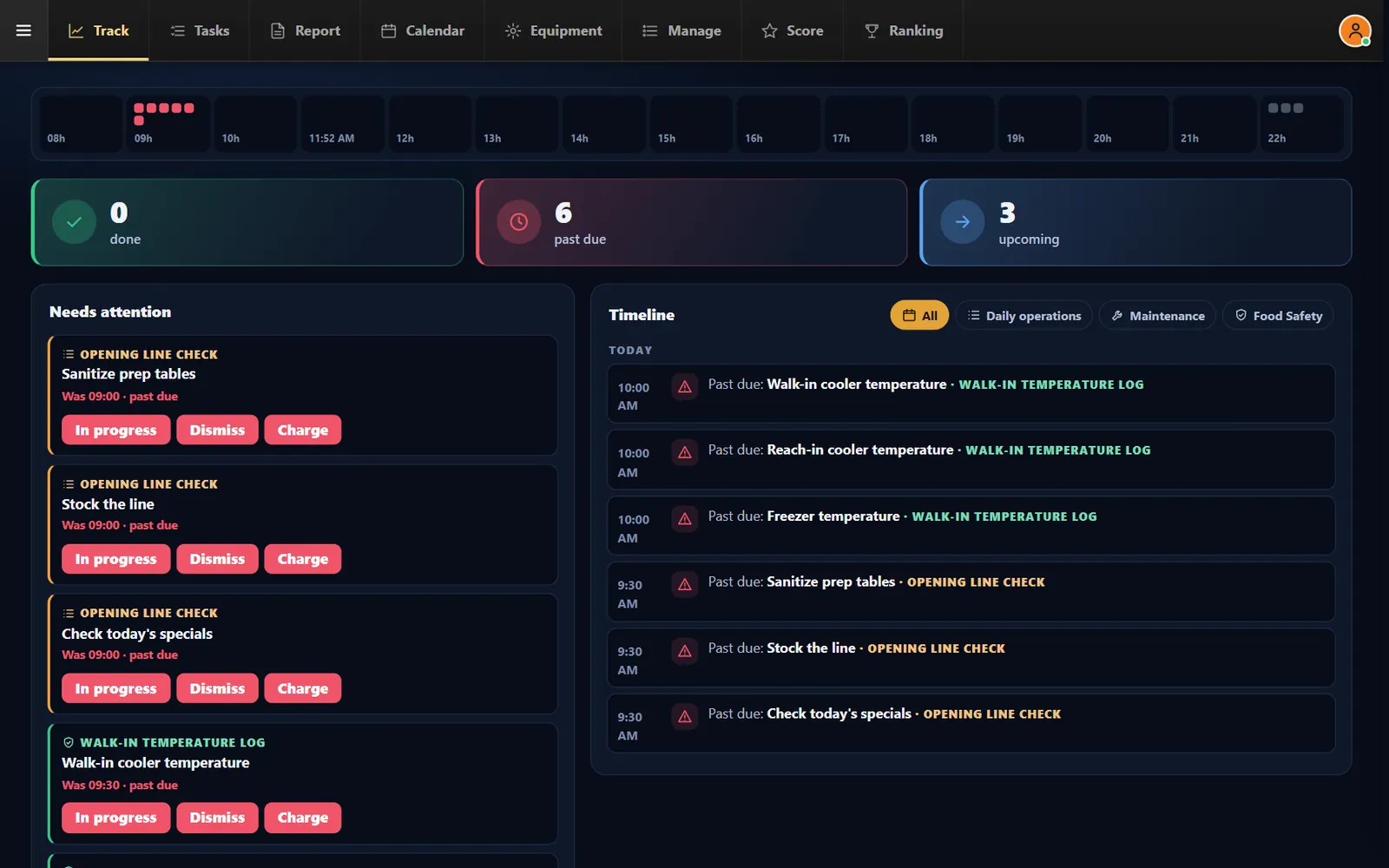
CounterChef offers checklists covering opening, closing and food safety, tracks what is late and shows the team score.
Frequently asked questions
What should be included in a restaurant opening checklist?
Include building safety, equipment inspections, food storage temperatures, sanitation, staffing, inventory, preparation, dining room setup, POS readiness and pre-shift communication. Assign responsibilities by position so employees know exactly what they must complete.
What should be included in a restaurant closing checklist?
Include food storage, cleaning, sanitation, waste recording, inventory notes, cash reconciliation, equipment shutdown, trash removal and building security. Make sure unfinished tasks are documented and assigned to someone responsible for follow-up.
Who should be responsible for completing restaurant opening and closing checklists?
Each employee should complete the checklist for their assigned position. Department leads should verify important tasks, while the manager remains responsible for the overall opening and closing process.
How often should restaurant opening and closing checklists be updated?
Review them whenever operating procedures, equipment, menu items, staffing responsibilities or local requirements change. A scheduled monthly review is also a useful management practice, particularly for identifying repetitive problems and removing tasks that no longer apply.
The best restaurant opening closing checklist is one employees can actually use during a working shift. Give every position clear responsibilities, verify the tasks that matter most and make sure unfinished work has an owner before anyone leaves.
Related feature: Checklists.