
Restaurant Marketing Budget: Work Backward From the Guests You Need
A restaurant marketing budget should be built around a business outcome, not a collection of advertising ideas or a percentage pulled from someone else's spreadsheet. Start with the guests you need to attract, the guests you need to bring back, the profit those visits can generate, and then decide how much each marketing channel is allowed to spend to produce them.

Start with the sales goal, not the marketing percentage
Many restaurant owners begin budgeting by asking, "How much should I spend on marketing each month?" A percentage of sales can be useful for planning, but it doesn't tell you whether your restaurant needs more first-time guests, more weekday traffic, more repeat visits, or higher spending per table.
A restaurant with a full dining room Friday and Saturday but empty seats Tuesday through Thursday has a different marketing problem from a new restaurant that needs people to discover it.
Before assigning dollars, identify the specific gap.
Write down:
- Current average monthly sales.
- Sales target for the next month or quarter.
- The days and shifts that are underperforming.
- Whether the problem is new customer acquisition, repeat visits, average check, or capacity.
- Which customers are most likely to fill the available seats profitably.
If your kitchen is already at capacity during peak hours, spending money to attract more guests during those hours may create longer waits and poorer service. Marketing should fill available capacity, not create a problem your operation cannot handle.
Calculate how many additional visits the budget must generate
Turn the sales gap into a guest target.
Use this formula:
Additional guest visits needed = Sales gap ÷ Average revenue per guest
If you are trying to generate an extra $6,000 in monthly sales and your average guest spends $30, you need 200 additional guest visits.
That doesn't automatically mean 200 new customers. Some may be returning customers who visit more often, some may be new guests, and some may come in groups.
Separate those targets.
| Guest type | What you want | How you measure it |
|---|---|---|
| New guests | Discover and try the restaurant | First-time visits attributed to a campaign |
| Returning guests | Come back sooner or more often | Repeat visits within a defined period |
| Lapsed guests | Return after a long absence | Visits from previously inactive customers |
| Existing guests | Spend more or add an item | Average check, add-ons, dessert or beverage attachment |
| Group guests | Bring friends or family | Group bookings, party size, event attendance |
Don't count the same person as both a new guest and a returning guest in the same campaign report. Define the categories before measuring results.
Set a maximum marketing spend based on contribution
Sales aren't profit. A campaign can produce plenty of revenue and still lose money.
Calculate what remains from an additional visit after variable costs such as food, packaging, payment processing, and other visit-related expenses. Use your own cost structure rather than assuming every restaurant has the same margin.
A simple planning formula:
Contribution per incremental guest = Average check per guest − Variable costs per guest
Then:
Break-even acquisition cost = Contribution per incremental guest
Break-even is the maximum theoretical cost to acquire a guest if that guest visits only once and produces no additional contribution. Your actual allowable marketing cost should be lower if you need to cover rent, fixed payroll, utilities, debt, and profit.
For repeat guests, calculate the expected contribution from additional visits within a realistic time window. Don't assume a guest will return indefinitely because they redeemed a coupon once.
A useful rule: calculate the campaign's break-even point first, then choose a lower target that leaves room for error.
Build the budget from the guest target backward
Instead of allocating money to "social media," "advertising," and "promotions" because those are familiar categories, assign money to the outcomes you need.
A budget might include:
- New guest discovery.
- Repeat-visit campaigns.
- Slow-day promotions.
- Local partnerships.
- Content production.
- Printed materials.
- Customer feedback and measurement.
- A small reserve for testing.
Each line needs a reason to exist, a target, and a stop-or-continue decision.
For example, if you need 100 first-time visits, you could divide that target among a local campaign, a neighborhood partnership, and a referral offer. The channel allocation should reflect your actual audience and previous results, not an arbitrary percentage.
Choose channels according to the restaurant's real problem
Match the channel to the job
| Channel | Best use | What to track |
|---|---|---|
| Local paid advertising | Reach nearby people who haven't visited | Cost per attributable first visit |
| Email or text | Encourage existing guests to return | Incremental visits, redemptions, opt-outs |
| Social content | Show food, atmosphere, specials, and reasons to visit | Profile actions, inquiries, tracked visits |
| Referral offer | Turn satisfied guests into introductions | New guests per referral, offer cost |
| Neighborhood partnerships | Reach nearby workers, residents, and groups | Visits and sales tied to partner |
| Events | Create a specific reason to visit | Attendance, contribution, repeat attendance |
| Printed materials | Reach guests or nearby audiences at a physical touchpoint | Unique codes, tracked offers |
| Reputation and guest experience | Remove friction that prevents bookings or visits | Feedback themes, conversion, repeat visits |
A channel's job matters more than its popularity.
If guests already know your restaurant but don't return, broad awareness advertising may not solve the problem. If your location is difficult to discover, a retention campaign won't create enough first-time visits.
Set a spending cap for every channel
A marketing budget needs limits, especially when the results are uncertain.
For each channel, set:
- A test budget.
- A minimum result you want to see.
- A period to collect enough evidence.
- A maximum cost per acquired guest or incremental visit.
- A decision date.
For a paid campaign, don't keep increasing the budget simply because impressions, clicks, or followers are rising. Those are intermediate signals, not restaurant sales.
If an ad generates clicks but no visits, investigate the offer, location, menu, booking process, landing page, hours, and timing before spending more.
For a partnership, agree on what success looks like before printing materials or offering discounts. A partner saying that they distributed your flyers is not the same as customers arriving.
Worked example: Build a monthly budget from a sales target
The following is a hypothetical example. Every number is illustrative, not a benchmark or recommendation for every restaurant.
Imagine a neighborhood restaurant wants to add $6,000 in monthly sales during slower shifts.
Hypothetical assumptions:
- Average guest check: $30.
- Variable cost per guest: $12.
- Contribution per guest: $18.
- Required incremental guest visits: 200.
- Monthly marketing budget: $1,500.
- Target: 120 new guests and 80 incremental returning guest visits.
The restaurant assigns its hypothetical budget as follows:
| Channel | Budget | Target visits | Cost per target visit |
|---|---|---|---|
| Local discovery campaign | $600 | 60 new | $10 |
| Referral offer | $300 | 30 new | $10 |
| Neighborhood partnership | $250 | 30 new | $8.33 |
| Return-visit campaign | $200 | 80 incremental returning | $2.50 |
| Creative and printed materials | $100 | Supports all channels | Not directly attributed |
| Total | $1,450 | 200 | , |
The remaining hypothetical $50 is unallocated, for a total budget ceiling of $1,500.
If all 200 visits are truly incremental, the hypothetical contribution is:
200 visits × $18 contribution = $3,600.
Subtract the hypothetical $1,450 marketing spend:
$3,600 − $1,450 = $2,150 in contribution after marketing, before fixed expenses.
The hypothetical campaign has produced $6,000 in sales, but the more useful number for decision-making is the contribution after marketing.
Now consider a different outcome: the restaurant reports 200 redemptions, but 70 of those guests would have visited anyway. The campaign generated only 130 incremental visits.
130 × $18 = $2,340 contribution.
$2,340 − $1,450 = $890 contribution after marketing.
The campaign still appears positive, but its performance is considerably weaker. That distinction is why redemptions and incremental visits should not be treated as interchangeable.
Measure new guests without relying on guesswork
A restaurant often has no perfect customer tracking system, especially for walk-in traffic. That doesn't mean measurement is impossible.
Create a consistent method that staff can use without slowing service.
Examples:
- Assign a distinct offer code to each campaign.
- Ask new guests a simple question at checkout: "How did you hear about us?"
- Use a short optional field on online orders.
- Record the referring partner's name.
- Track event registrations separately from walk-ins.
- Use a campaign-specific menu item or offer where appropriate.
Avoid asking staff to remember a long list of marketing sources during a rush. Make the question short, provide a few common choices, and allow "other."
If your answers are inconsistent, your report will be inconsistent. Train the team on the exact wording and when to ask.
Track repeat visits with a defined time window
A repeat visit is only meaningful when you define when it happens.
For example, measure whether a guest returns within 30 days of their first visit. You could also use a longer period for a concept where visits naturally occur less frequently.
Use a consistent definition:
- First visit: The guest's earliest identifiable transaction.
- Repeat visit: Another transaction after the first visit.
- Lapsed guest: Someone who has not visited within your chosen inactivity period.
- Incremental return: A visit that likely would not have occurred without the campaign.
The last category is difficult to prove. A loyalty redemption, for example, may reward a guest who was already planning to come in.
One practical approach is to test a campaign on a portion of your eligible customer list and leave another comparable portion untouched for the same period. Compare the return rates. The untouched group helps estimate what would have happened without the offer.
Keep the test simple and large enough to be useful. If the groups are tiny, treat the result as directional rather than conclusive.
Avoid discounting guests who would have paid full price
Discounts are easy to measure and easy to misuse.
A coupon can increase visits while reducing the contribution from guests who were already coming. It can also train customers to wait for a promotion.
Before offering a discount, consider alternatives:
- A complimentary item with a purchase.
- A limited menu available on a slow shift.
- A reservation perk.
- A small reward after a second visit.
- A seasonal dish that creates a reason to return.
- A group experience with a fixed menu.
The right incentive depends on the food cost, labor requirements, capacity, and guest behavior.
Test one offer at a time. If you change the discount, message, timing, and audience simultaneously, you won't know which change mattered.
Protect the restaurant from marketing that creates operational problems
Marketing can produce an unintended result: more orders than the kitchen can handle, too many guests arriving at the same time, or a promotion that sells your least profitable items.
Before launching, review:
- Ingredient availability.
- Prep requirements.
- Station capacity.
- Staffing for the targeted shift.
- Dining room availability.
- Takeout packaging.
- Expected order mix.
- Whether the offer can be explained clearly at the point of sale.
An offer for a popular dish may be attractive but unwise if that dish requires a bottlenecked station. A slow-day promotion should be designed around what your team can execute without damaging the guest experience.
The best marketing campaign is not the one that creates the most traffic. It is the one that creates profitable traffic your restaurant can serve well.
Try three practical marketing experiments this week
These are small operator-led tests that can reveal useful information without committing to a large campaign.
1. Map the empty seats by hour before buying ads
Print or export your sales by day and hour. Mark the hours when you have unused capacity, then identify which guest type could realistically fill those seats.
Build one offer around that specific window.
For example, if Wednesday from 5 to 7 p.m. is consistently quiet, test an early dinner offer that doesn't interfere with the busier dinner period. Track the visits during that window, not the entire day's sales.
2. Ask departing guests what would bring them back
For a few shifts, ask a small number of guests a simple question:
"Is there anything you'd like us to offer that would make you come back sooner?"
Record the answers verbatim in a notebook, without trying to sell them anything.
Look for repeated themes: lunch speed, family options, a dish they want, a quieter time, a special occasion, or a convenient pickup option. Choose one recurring request and test it. This is a low-cost way to develop campaigns from actual guest friction instead of guessing.
3. Track the second visit separately from the first
Give new guests a reason to return, but don't judge the offer by the first redemption.
Record the original visit date, the return date, and whether the second visit occurred within your defined window. Review the results weekly.
A campaign that brings guests once at a low cost may still be less valuable than a slightly more expensive campaign that attracts guests who return without another discount.
Use this ready-to-copy monthly marketing worksheet
Copy this into a spreadsheet or print it for your monthly planning meeting.
| Item | Your plan |
|---|---|
| Monthly sales target | $________ |
| Current forecast sales | $________ |
| Sales gap | $________ |
| Target shift or day | ________ |
| Average check per guest | $________ |
| Contribution per guest | $________ |
| Additional guest visits required | ________ |
| New guest target | ________ |
| Returning guest target | ________ |
| Total budget ceiling | $________ |
| Campaign start date | ________ |
| Campaign review date | ________ |
For each campaign:
| Campaign | Spend cap | Guest target | Actual visits | Incremental visits | Cost per incremental visit | Decision |
|---|---|---|---|---|---|---|
| ________ | $_____ | _____ | _____ | _____ | $_____ | Continue / Change / Stop |
| ________ | $_____ | _____ | _____ | _____ | $_____ | Continue / Change / Stop |
| ________ | $_____ | _____ | _____ | _____ | $_____ | Continue / Change / Stop |
Use the same worksheet every month. Consistency makes the results more useful than an elaborate report that changes its definitions every time.
Review the budget weekly and reallocate monthly
A weekly review should take only a few minutes.
Check:
- How much money has been spent?
- Which campaigns have generated identifiable visits?
- Are the visits happening on the shifts you targeted?
- Are staff recording campaign sources consistently?
- Is the offer causing operational strain?
- Are guests returning?
Don't make a major decision based on a single slow day. But don't wait three months to discover that a campaign is producing clicks without visits.
At the end of the month, decide which campaigns deserve more money, which need a change, and which should stop. Move dollars toward demonstrated results, while keeping a small amount available for testing something new.
Use restaurant systems to support marketing measurement and operations
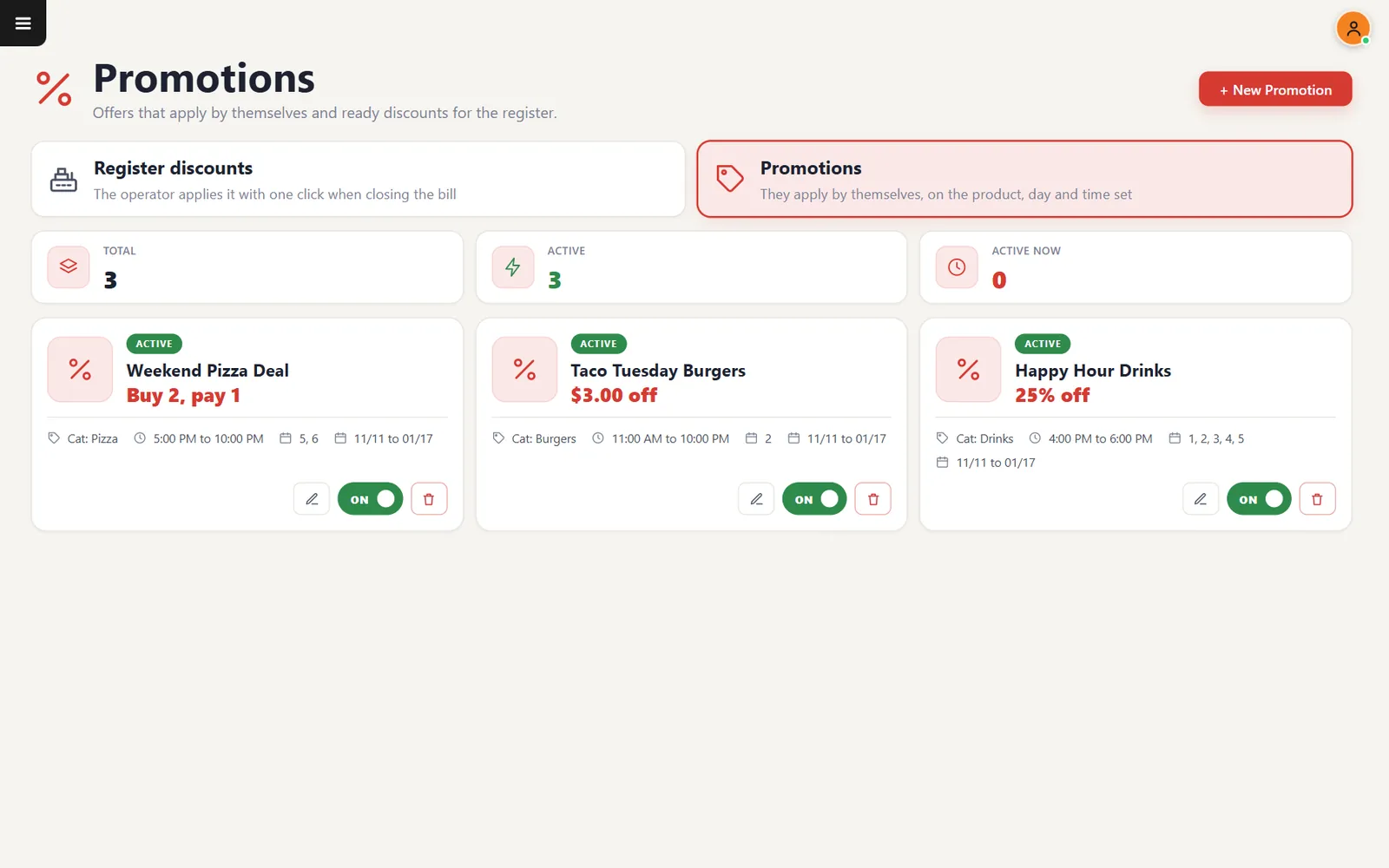
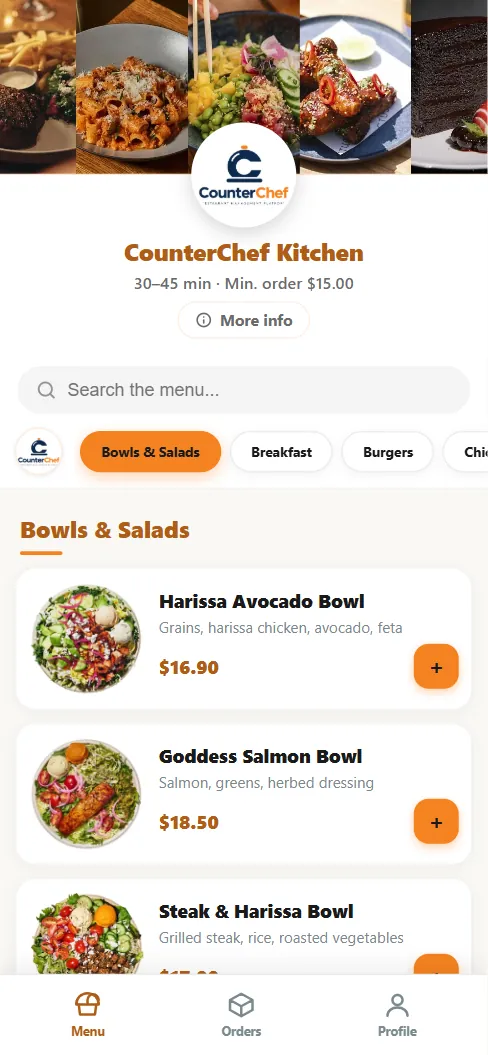
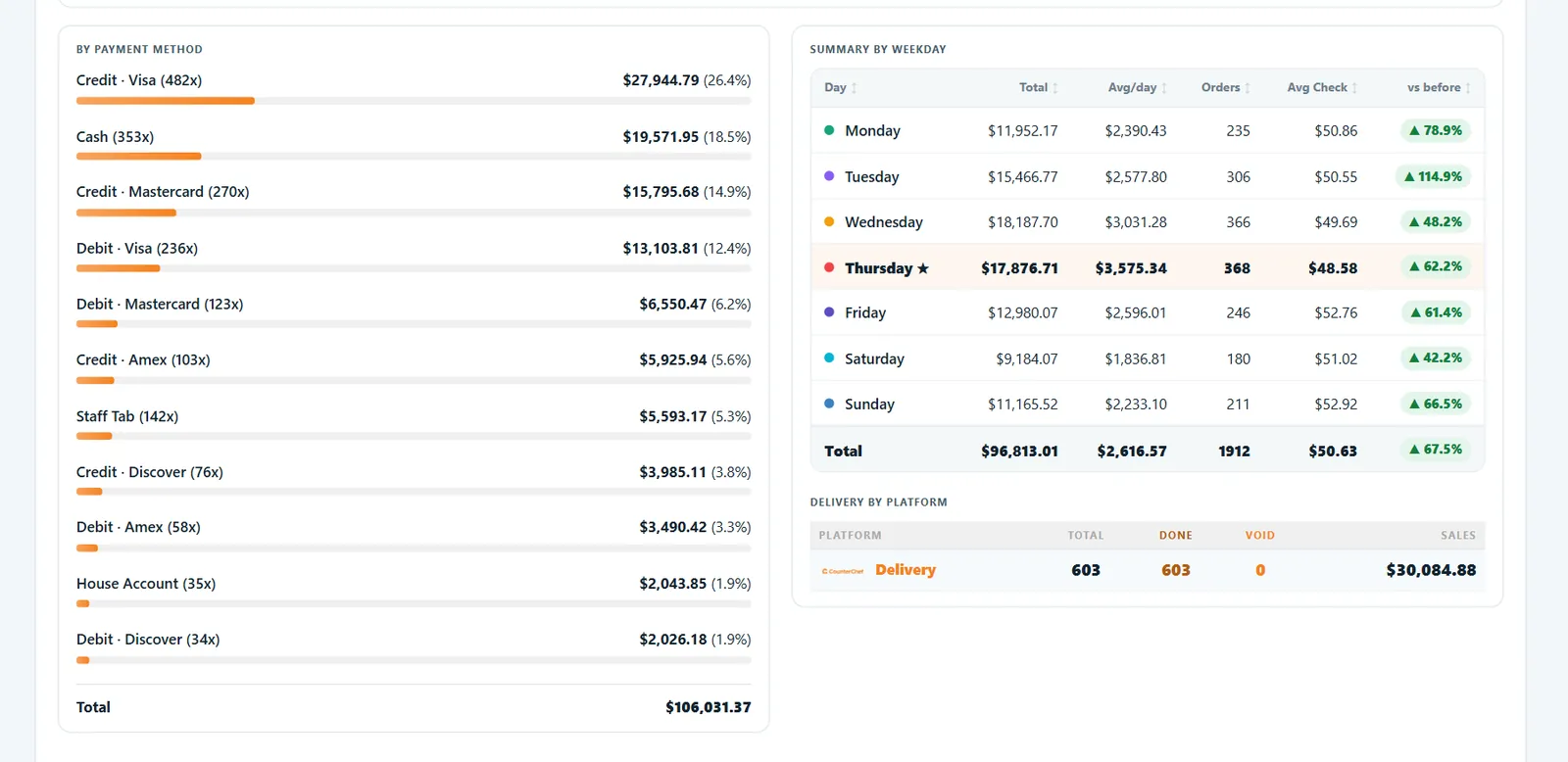
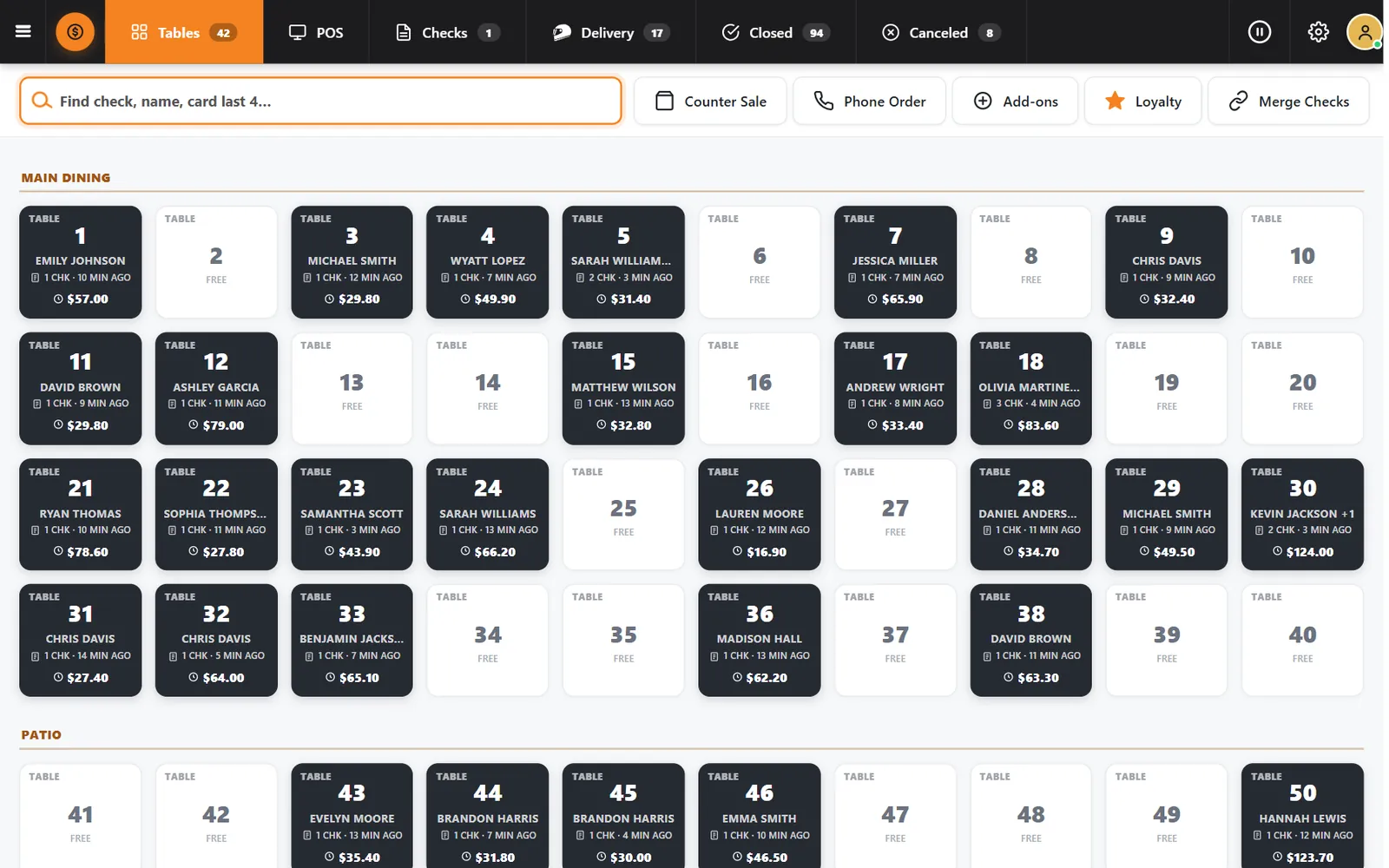
Marketing decisions are easier when sales, guest-facing ordering, and restaurant operations are connected. CounterChef runs on iPad, Android tablet, iPhone and computer; it includes your own online menu for pickup and delivery, with delivery areas by ZIP code, each with its own fee and estimated time; a kitchen display with ticket timers; a table map and server phones for dine-in; employees clock in on a tablet or computer and schedules are built in the system; tips can be shared by percentage or by hours worked; inventory and recipe costing show the cost of each dish; loyalty points and gift cards; sales tax rates with up to three decimals and by category; and reports by day, item and employee.