
Restaurant Inventory Control: Follow Every Case From the Purchase Order to the Final Count
Restaurant inventory control starts before a delivery reaches your back door and continues until every portion is sold, transferred, or recorded as waste. If you want to protect food costs and avoid running out of important ingredients, you need a consistent process that follows each case through ordering, receiving, storage, preparation, waste tracking, and counting.
Ordering decisions should start with what you already have
The easiest way to create an inventory problem is to order from memory. A manager remembers that the kitchen went through several cases of chicken last week, places the same order again, and discovers that the walk-in already contains enough chicken for another delivery cycle.
Good restaurant inventory control starts with a purchasing decision based on actual stock, expected demand, and the time it takes to receive another delivery.
Before placing an order, check three things:
- On-hand quantity: How much usable product is physically available?
- Expected usage: How much will the restaurant probably use before the next delivery?
- Delivery timing: When will the next order arrive, and how much product must cover the gap?
Set minimum and maximum quantities for important ingredients. A minimum is the point at which you need to consider reordering. A maximum is the amount you want to have after receiving a delivery.
These numbers should reflect your actual operation. A restaurant serving mostly lunch may need a different stocking pattern from one with a busy weekend dinner service.
Consider a simple chicken purchasing example.
Suppose your hypothetical restaurant has:
- Hypothetical usable chicken on hand: 24 pounds.
- Hypothetical expected usage before the next delivery: 60 pounds.
- Hypothetical safety quantity: 12 pounds.
- Hypothetical desired ending quantity after delivery: 72 pounds.
Your purchasing calculation is:
60 pounds expected usage + 12 pounds safety quantity - 24 pounds on hand = 48 pounds to order.
Every quantity in this example is hypothetical. The calculation gives you a starting order rather than relying on someone guessing how many cases look right.
Also consider upcoming events, reservations, weather-related demand changes, menu specials, and supplier holidays. These can change your expected usage considerably.
An idea to try this week: Create a short-order window. Choose a consistent time each day when a manager reviews inventory and prepares the next order. Avoid letting every department request products independently throughout the day. Consolidating requests makes duplicate orders and unnecessary purchases easier to catch.
Receiving is where you verify what the restaurant actually purchased
A purchase order tells the supplier what you requested. The invoice tells you what the supplier says it delivered. Neither proves that the correct product arrived in the correct quantity and condition.
Receiving is your opportunity to catch problems before they become inventory discrepancies.
Assign responsibility to a specific employee or manager. That person should compare the delivery against the purchase order and inspect the product before signing off.
Check the following:
- Product name and description.
- Quantity delivered.
- Unit of measurement.
- Package size.
- Product condition.
- Temperature where applicable.
- Expiration or use-by information.
- Substitutions.
- Damaged packaging.
- Invoice price.
Pay particular attention to units. An order for 10 pounds of ground beef is not equivalent to 10 cases of ground beef. An invoice might also list a case containing four packages when your order assumed six.
Record shortages and substitutions immediately. If the supplier sends a different product, make sure the kitchen knows before using it in a recipe.
A practical receiving routine should include the following steps:
- Bring the delivery to a designated receiving area.
- Retrieve the purchase order.
- Count each item against the order.
- Inspect quality and packaging.
- Check applicable temperature requirements.
- Compare invoice quantities and prices.
- Record shortages, damages, and substitutions.
- Document any credits or corrections that need follow-up.
- Move accepted products into their designated storage areas.
Do not let a delivery sit unattended while employees continue working through the kitchen. Products that need refrigeration or freezing should be handled according to applicable food-safety requirements.
An idea to try this week: Keep a receiving exception log. Instead of recording only successful deliveries, maintain a simple list of problems. Include the date, supplier, product, issue, quantity affected, and resolution. After several deliveries, you can identify recurring problems, such as short cases, incorrect package sizes, or inconsistent product quality.
This also gives managers something concrete to discuss with suppliers instead of relying on vague complaints.
Storage should preserve both food quality and inventory accuracy
Once a case passes receiving, it enters storage. This is where a restaurant can lose track of perfectly good product without actually throwing anything away.
A case gets opened, individual packages are moved, someone puts a new delivery in front of an older one, and another employee orders more because nobody knows what is available.
Storage needs to support two objectives: food safety and accurate inventory tracking.
Organize shelves by product category and assign consistent locations to important items.
For example:
- Raw proteins in designated refrigerated or frozen areas.
- Dairy products in clearly identified sections.
- Produce grouped by appropriate storage requirements.
- Dry goods organized by category.
- Sauces and prepared ingredients in labeled storage areas.
Follow applicable food-safety requirements for separation, temperature control, labeling, and storage. Requirements can vary by jurisdiction, so verify the rules adopted by your local health department.
Use first-in, first-out (FIFO) as a basic stock rotation practice. Place older usable products where employees will select them first, and put newer deliveries behind them.
However, FIFO should not mean blindly using the oldest product. Employees must still check product condition and applicable date limits.
Another important step is making package sizes visible. If employees know that a standard case contains a specific number of pounds, containers, or individual units, they can recognize when stock is running low.
An idea to try this week: Give every high-value item a home address. Write down the exact shelf, cooler, or freezer location where each important product belongs. Put that location on your inventory sheet. When someone finds an item in the wrong place, they can return it instead of creating another unofficial storage location.
This is particularly useful for expensive proteins, specialty cheeses, cooking oils, and products that several departments use.
Also establish a rule for opened cases. Every opened case should have a visible remaining quantity, either by weight, package count, or another consistent measurement.
Without that information, your inventory sheet may say you have three cases when the kitchen actually has two full cases and one partially used case.
Preparation should connect ingredient usage to actual portions
Preparation is one of the most overlooked stages of restaurant inventory control.
A manager may order the correct quantity, receive everything accurately, and store it properly. Yet the restaurant can still lose control of inventory during prep and service.
The problem often starts with inconsistent portions.
If one cook portions a chicken breast at six ounces and another uses seven ounces, the restaurant will consume more chicken than the recipe predicts.
The same problem occurs with dressings, sauces, seafood, cheese, and other ingredients that are easy to overuse.
Start by standardizing recipes and documenting the quantities required for each serving.
For example, a recipe card should identify:
- Ingredient name.
- Quantity required.
- Measurement unit.
- Preparation yield.
- Portion size.
- Expected number of servings.
Pay attention to yield. A case of raw vegetables does not necessarily produce the same weight of usable prepared vegetables after trimming.
Likewise, raw meat can lose weight during trimming and cooking. Your theoretical ingredient usage must reflect the actual recipe and preparation process.
Use scales for ingredients that need consistent weights. Use portion scoops, ladles, and other standardized tools where appropriate.
Train employees to use those tools consistently rather than treating them as optional equipment.
An idea to try this week: Run a one-shift portion audit. Choose one frequently ordered menu item. Have a manager weigh a small sample of portions during service without interrupting the kitchen. Compare the results with the documented recipe. If portions vary, identify whether the problem comes from training, equipment, recipe instructions, or workload.
Do not turn this into a disciplinary exercise. The objective is to find where the process makes consistent portions difficult.
Another useful practice is to connect prep quantities to the sales forecast. If you expect to sell 40 portions of a dish, prep should be based on the recipe's ingredient requirements for that expected volume, adjusted for appropriate operating needs.
Preparing significantly more than necessary creates additional spoilage risk, while preparing too little can lead to emergency substitutions and inconsistent service.
Waste needs a recording process, not just a trash can
Food waste is a normal part of restaurant operations. The problem is not that every restaurant has waste. The problem is when nobody records what was lost or understands why it happened.
A kitchen may discard spoiled produce, overcooked proteins, incorrect orders, expired sauces, and prep trimmings. Those losses have different causes and should not be grouped into one unexplained number.
Create a waste log that employees can complete quickly.
Record:
- Date and time.
- Product.
- Quantity.
- Unit of measurement.
- Reason for waste.
- Employee or station reporting it.
- Estimated inventory value, when practical.
Use consistent waste categories:
| Waste category | Example |
|---|---|
| Spoilage | Produce that deteriorated before use |
| Preparation loss | Trimming or unusable portions |
| Cooking error | Overcooked protein |
| Service error | Incorrectly prepared order |
| Overproduction | Prepared food left unused |
| Handling damage | Dropped or damaged product |
Distinguishing these categories helps management identify the underlying issue.
For example, high spoilage might indicate excessive purchasing or poor stock rotation. High preparation loss might suggest inconsistent trimming or an unrealistic yield assumption. High cooking-error waste might point to equipment, training, or communication problems.
A worked example: Calculate the cost of recorded waste
Suppose your hypothetical restaurant purchases chicken at a hypothetical cost of $3.20 per pound.
During one hypothetical week, employees record the following:
- Hypothetical spoiled chicken: 8 pounds.
- Hypothetical preparation loss beyond the expected usable yield: 3 pounds.
- Hypothetical cooking errors: 4 pounds.
- Hypothetical purchase cost: $3.20 per pound.
Total recorded waste:
8 + 3 + 4 = 15 pounds.
Estimated waste value:
15 pounds × $3.20 = $48.00.
Hypothetical weekly waste value: $48.00.
This is an illustrative calculation, not an industry benchmark. The actual financial impact depends on your purchase costs, product yields, and accounting method.
The next step is to investigate the causes rather than simply telling employees to waste less.
If most of the loss comes from spoilage, review purchasing quantities and storage rotation. If cooking errors account for most of it, examine station procedures and training.
An idea to try this week: Introduce a five-minute waste review at closing. The closing manager should look at the day's entries and identify the largest preventable loss. Choose one operational adjustment for the next shift. This turns waste tracking into a management habit instead of an administrative task.
Counting inventory should measure what is actually available
Inventory counts are only useful when employees count consistently.
A restaurant that counts by different methods every week will struggle to compare results. One manager may count an opened case as half a case, while another estimates it as three-quarters full.
Establish a counting method for every major product category.
For example:
- Whole packages: count individual packages.
- Cases: count full cases and partial cases separately.
- Liquids: measure by volume or use a consistent weight-based method.
- Proteins: weigh opened packages when practical.
- Produce: use consistent weight or container measurements.
Never assume an opened package contains its original quantity.
Your inventory sheet should list the product, storage location, unit of measurement, quantity on hand, and unit cost.
Count the same products in the same order each time. This reduces missed items and makes it easier to compare results across periods.
For important ingredients, use two-person verification when practical. One employee reads and counts; another records or checks the result.
Keep receiving and counting responsibilities clear. If someone counts an item, they should know whether a delivery has already been entered into the inventory record.
Understand the difference between theoretical and actual usage
Two calculations are especially useful.
Theoretical usage is the amount of product your sales and recipes indicate you should have used.
Actual usage is the amount of inventory that physically disappeared during the period, adjusted for purchases and transfers.
The basic formula is:
Beginning inventory + Purchases - Ending inventory = Actual usage.
For example, consider this hypothetical weekly ground beef inventory:
| Item | Hypothetical amount |
|---|---|
| Beginning inventory | $800.00 |
| Purchases | $500.00 |
| Ending inventory | $350.00 |
| Actual usage | $950.00 |
Calculation:
$800.00 + $500.00 - $350.00 = $950.00.
Suppose your hypothetical recipe and sales records indicate theoretical usage of $900.00.
Your variance is:
$950.00 actual usage - $900.00 theoretical usage = $50.00 unfavorable variance.
The hypothetical variance is $50.00.
That does not automatically mean employees stole product or made mistakes. It means the restaurant used more inventory value than its theoretical calculation predicted.
Possible explanations include:
- Portions larger than the recipe specifies.
- Unrecorded waste.
- Incorrect receiving quantities.
- Transfers to another location.
- Incorrect recipe costs.
- Inventory counting errors.
- Unrecorded menu substitutions.
Investigate the largest differences first. Check the physical count, purchase records, sales mix, waste log, and transfers before drawing conclusions.
An idea to try this week: Count one category twice. Have two employees independently count the same high-value inventory category without seeing each other's results. Compare the numbers. If they differ, find out whether the issue comes from unclear units, poor shelf organization, opened packaging, or inconsistent measurement.
This simple exercise can reveal weaknesses in the counting process before they distort an entire inventory report.
Build one inventory routine that follows the product through every stage
The most useful inventory system is one that connects ordering, receiving, storage, preparation, waste, and counting.
If each department maintains its own informal records, information gets lost between stages.
A manager might know that a case of tomatoes was ordered, but not whether it arrived short, was transferred to another station, or was discarded during preparation.
Use one consistent recordkeeping process.
A digital inventory sheet or inventory management system can help maintain product quantities, costs, and movement records. Whatever method you choose, make sure employees understand who enters each transaction and when it must be recorded.
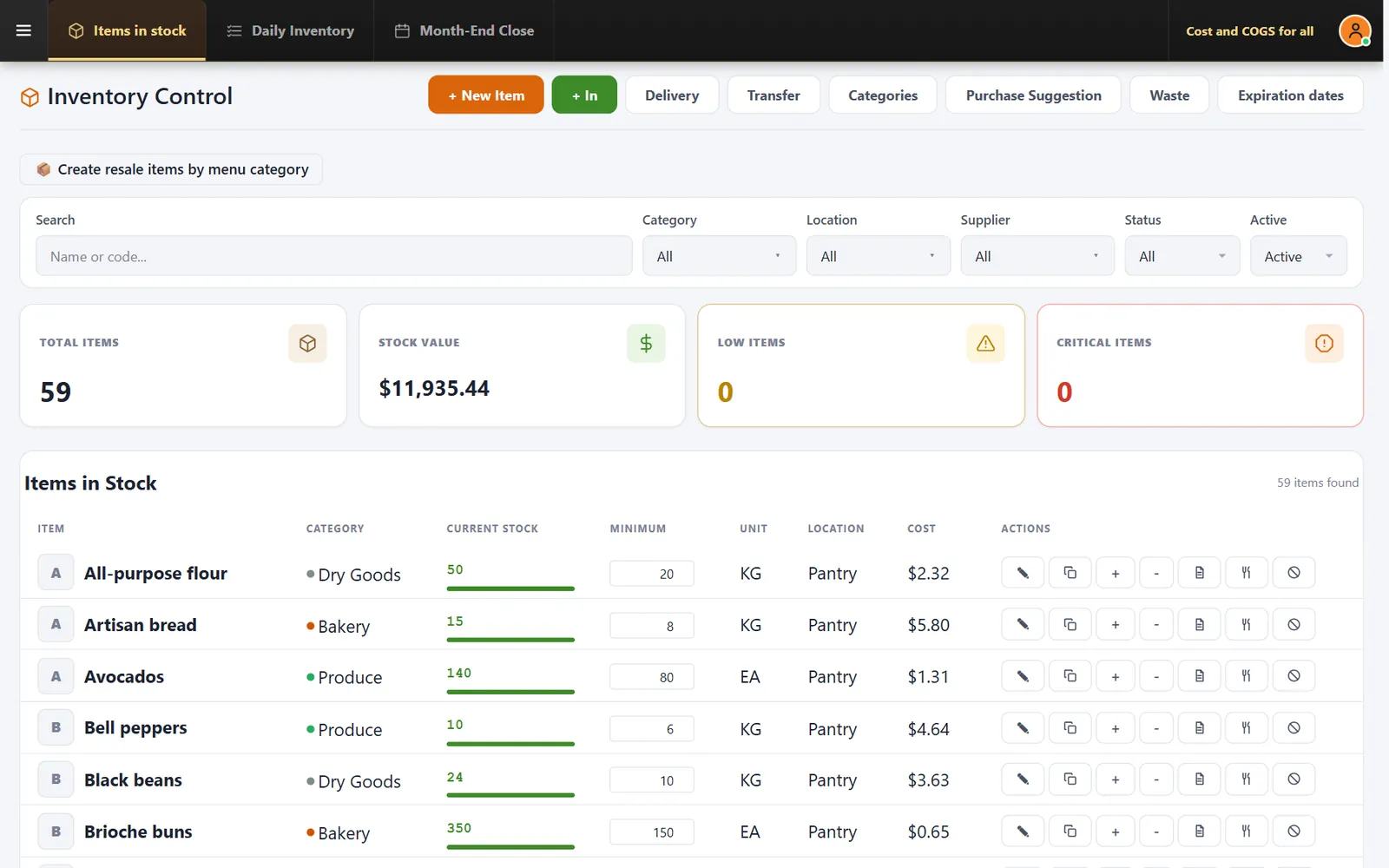
CounterChef is one option for this work. Inventory tracks stock levels and value, receiving, waste and transfers and flags low items. Purchasing compares stock with minimums, builds lists and compares supplier quotes.
Regardless of the tool, management still needs to verify deliveries, train employees, maintain accurate recipes, and investigate discrepancies.
Ready-to-copy restaurant inventory control checklist
Use this checklist to assign responsibility across the product's journey.
| Stage | Required action | Responsible person |
|---|---|---|
| Ordering | Review stock and expected usage | Manager |
| Ordering | Check minimums and delivery schedule | Manager |
| Receiving | Compare delivery with purchase order | Receiver |
| Receiving | Record shortages and damages | Receiver |
| Storage | Rotate stock using FIFO | Kitchen team |
| Storage | Return products to assigned locations | Kitchen team |
| Preparation | Follow documented recipes and yields | Prep team |
| Preparation | Use standardized portion tools | Line cooks |
| Waste | Record discarded product and reason | Employee responsible |
| Counting | Count full and partial packages | Assigned counter |
| Counting | Investigate significant variances | Manager |
At the end of each week, review the information together.
Ask five questions:
- Did we order more than we needed?
- Did deliveries match what we purchased?
- Did storage and rotation work as intended?
- Where did we lose product during preparation or service?
- Which inventory differences need investigation?
Avoid trying to fix every issue at once. Choose the most expensive or recurring problem and assign someone to correct it.
Frequently asked questions
How often should a restaurant count inventory?
The counting schedule depends on the restaurant's size, menu, purchasing patterns, and product costs. Many operators count important or expensive items more frequently than less critical supplies. A consistent weekly full inventory is a useful starting point for many restaurants, but it is a rule of thumb, not a universal requirement.
What is the most common cause of restaurant inventory discrepancies?
There is rarely one universal cause. Common contributors include inaccurate counts, inconsistent portions, unrecorded waste, receiving errors, incorrect recipe yields, and unrecorded transfers. Investigate the records before assuming that a discrepancy has one particular explanation.
How can a small restaurant control inventory without expensive systems?
Start with a spreadsheet, a standardized receiving sheet, a waste log, documented recipes, and a consistent counting routine. Assign responsibility for each step. A simple process followed consistently is more useful than a complicated system employees rarely update.
What is the difference between inventory management and restaurant inventory control?
Inventory management covers the broader process of planning stock levels, purchasing products, organizing storage, and maintaining availability. Restaurant inventory control focuses on keeping those quantities and movements accurate, identifying losses, and comparing actual usage with expected usage.
The goal is to know what entered your restaurant, where it went, how much was used, and what remains. When you can follow a case of product through every stage, you can make better purchasing decisions, reduce avoidable waste, and understand where your food costs are changing.
Related feature: Inventory.