
Restaurant Own Delivery vs Third-Party Apps: Which Model Actually Makes More Money?
Choosing between restaurant-owned delivery and third-party delivery apps is not simply a question of convenience or customer reach; it is a question of what remains in your pocket after every order is prepared, delivered, and paid for. The right decision starts with comparing the actual contribution from one order under each model, then checking whether your kitchen, staffing, delivery area, and order volume can support the operation you choose.
Start by comparing the profit from one completed order
When restaurant owners discuss delivery, the conversation often gets stuck on commission rates. One person points out that third-party platforms take a percentage of sales. Another argues that running your own delivery requires drivers, vehicles, insurance, and management.
Both are right, but neither argument tells you which option makes more money.
The useful question is:
How much money does the restaurant keep from one completed delivery order after all order-related costs?
That number is different from gross sales, food cost percentage, and even the amount deposited into your bank account.
For a meaningful comparison, separate your costs into five categories:
- Food and beverage costs.
- Packaging and order supplies.
- Payment processing.
- Delivery-related expenses.
- Labor directly associated with fulfilling the order.
Then calculate the contribution remaining under each delivery model.
This is important because a restaurant can have a profitable dine-in operation and still lose money on delivery. A dish that works financially when served on a reusable plate may become less attractive when it needs additional packaging, separate payment processing, and a driver.
Likewise, an order received through a third-party marketplace may look expensive because of its commission, but it might still produce a positive contribution without requiring the restaurant to employ additional delivery staff.
Do not choose a delivery model based on one expense in isolation.
Build a realistic hypothetical order before comparing delivery models
Let's establish one order that will remain identical throughout the comparison.
The following figures are entirely hypothetical. They are not industry averages, benchmarks, or claims about what restaurants typically pay.
Imagine an independent restaurant selling a delivery meal for $40.00 before tax and tip.
The restaurant has the following costs:
| Item | Hypothetical cost |
|---|---|
| Food ingredients | $11.00 |
| Packaging | $1.50 |
| Kitchen labor allocated to order | $4.00 |
| Other variable order supplies | $0.50 |
| Total costs before delivery and payment | $17.00 |
The order produces:
- Gross food sales: $40.00
- Food ingredients: $11.00
- Packaging: $1.50
- Kitchen labor: $4.00
- Other supplies: $0.50
- Remaining contribution before delivery expenses: $23.00
That $23.00 is the starting point.
Notice that we have not included rent, utilities, management salaries, or other fixed overhead. Those expenses still matter when evaluating the entire restaurant, but including them in this per-order comparison would make it harder to isolate the financial difference between delivery models.
We will also assume that sales tax and customer tips are excluded from the $40.00 food sale. Sales tax collected for the government is not restaurant revenue, and tips should not be treated as ordinary operating income.
Now compare the two delivery arrangements.
Third-party delivery reduces the order contribution through commissions
Suppose the restaurant receives the $40.00 order through a third-party marketplace.
For this hypothetical example, assume:
- Marketplace commission: 25% of the $40.00 food sale.
- Payment processing: included in the assumed marketplace commission for simplicity.
- Restaurant-funded promotion: $0.00.
- Additional delivery labor: $0.00.
- Additional delivery expense paid directly by the restaurant: $0.00.
The 25% commission is an illustrative assumption, not a universal rate. Actual agreements vary by contract, market, service arrangement, and other terms.
The calculation looks like this:
| Item | Hypothetical amount |
|---|---|
| Food sales | $40.00 |
| Marketplace commission at 25% | -$10.00 |
| Food ingredients | -$11.00 |
| Packaging | -$1.50 |
| Kitchen labor | -$4.00 |
| Other supplies | -$0.50 |
| Contribution per order | $13.00 |
The restaurant retains $13.00 in contribution from this order before fixed overhead and any other excluded expenses.
That is the number to compare with restaurant-owned delivery.
There is another detail worth watching: commission may be calculated on a different base depending on the agreement. Discounts, taxes, refunds, promotions, and other adjustments can affect the actual settlement.
Use the contractual commission base rather than automatically applying a percentage to whatever appears as the customer-facing total.
Restaurant-owned delivery replaces commission with operating expenses
Now imagine the restaurant receives the same $40.00 order directly through its own ordering channel and handles delivery.
The restaurant avoids the hypothetical 25% marketplace commission, but it must pay for the delivery operation.
For this example, assume the following additional expenses:
| Delivery expense | Hypothetical amount |
|---|---|
| Driver labor allocated to order | $5.00 |
| Vehicle operating expense | $2.00 |
| Direct-order payment processing | $1.20 |
| Delivery administration and supplies | $0.80 |
| Total additional delivery expenses | $9.00 |
The calculation becomes:
| Item | Hypothetical amount |
|---|---|
| Food sales | $40.00 |
| Food ingredients | -$11.00 |
| Packaging | -$1.50 |
| Kitchen labor | -$4.00 |
| Other supplies | -$0.50 |
| Driver labor | -$5.00 |
| Vehicle operating expense | -$2.00 |
| Payment processing | -$1.20 |
| Administration and supplies | -$0.80 |
| Contribution per order | $14.00 |
In this particular hypothetical situation, restaurant-owned delivery produces $14.00 compared with $13.00 through the marketplace.
<small>All figures are hypothetical and illustrative. They are not industry averages or recommended cost assumptions.</small>
The difference is just $1.00 per order.
That is an important result.
The restaurant-owned model looks better, but the advantage is small enough that one extra driver expense, an inefficient route, or a few minutes of additional labor could eliminate it.
This is why the restaurant own delivery vs third party apps decision should never be made using commission rates alone.
Use your actual commission rate in this formula
The previous example used a hypothetical 25% commission. Your agreement may have a different rate.
Here is a formula you can use with your own numbers.
Third-party contribution:
Food sales - food cost - packaging - kitchen labor - other order supplies - marketplace commission - additional restaurant-paid expenses.
Restaurant-owned delivery contribution:
Food sales - food cost - packaging - kitchen labor - other order supplies - driver labor - vehicle expense - payment processing - delivery administration.
To make the comparison easier, use the following variables:
- S = food sales per order.
- C = marketplace commission rate expressed as a decimal.
- B = all shared order costs.
- M = additional marketplace expenses paid by the restaurant.
- D = all restaurant-owned delivery expenses.
Then:
Third-party contribution = S - B - (S × C) - M
Restaurant-owned contribution = S - B - D
The difference is:
Owned delivery advantage = (S × C) + M - D
If the result is positive, restaurant-owned delivery produces more contribution per order under those assumptions.
If it is negative, the marketplace produces more contribution per order.
Using the hypothetical example:
- S = $40.00
- C = 0.25
- B = $17.00
- M = $0.00
- D = $9.00
Third-party contribution:
$40.00 - $17.00 - ($40.00 × 0.25) = $13.00.
Owned delivery contribution:
$40.00 - $17.00 - $9.00 = $14.00.
Owned delivery advantage:
$10.00 - $9.00 = $1.00.
This formula is useful because it shows exactly how much your delivery operation can afford to cost before the marketplace becomes financially preferable.
Calculate the break-even delivery cost before hiring drivers
There is another way to look at the same decision.
Instead of asking how much your own delivery operation costs, ask:
What is the maximum amount I can spend delivering an order before I lose the financial advantage?
In the hypothetical example, the marketplace commission is $10.00.
Therefore, restaurant-owned delivery can cost up to $10.00 per order and still match the marketplace contribution, assuming no other differences.
If owned delivery costs $9.00, the restaurant keeps an additional $1.00.
If it costs $10.00, both options produce the same contribution.
If it costs $12.00, the marketplace produces $2.00 more per order.
This is your break-even delivery cost.
You can calculate it directly:
Break-even owned delivery expense = (Food sales × Commission rate) + Additional marketplace expenses.
This calculation should happen before recruiting drivers, buying equipment, changing schedules, or committing to a delivery area.
It also gives you a practical target for route planning.
If the restaurant needs to spend less than $10.00 to deliver the hypothetical order, the owned model can compete financially. If your actual delivery expense is consistently above that amount, you need to change the economics before expanding.
Separate driver wages from the cost of each delivery
One of the most common mistakes in restaurant-owned delivery calculations is dividing driver wages by the number of orders without considering paid time.
A driver might be scheduled for a four-hour shift, but not every minute of that shift will involve driving.
There will be:
- Waiting for food to be ready.
- Loading orders.
- Checking addresses.
- Returning to the restaurant.
- Waiting for another order.
- Handling customer questions.
- Dealing with parking and building access.
All of that time has a cost.
Consider another entirely hypothetical calculation.
A restaurant schedules one driver for four hours at $18.00 per hour.
Driver wages:
4 hours × $18.00 = $72.00.
The restaurant completes 12 deliveries during that shift.
Allocated driver wages:
$72.00 ÷ 12 = $6.00 per delivery.
If the restaurant completes only eight deliveries:
$72.00 ÷ 8 = $9.00 per delivery.
The driver wage expense per order has increased by $3.00 without changing the hourly pay.
This is why delivery volume matters so much.
A delivery operation that looks profitable during Friday dinner might become expensive during a slow Tuesday afternoon.
Also account for applicable employer payroll taxes, insurance, overtime, and other employment costs. Wage and classification requirements vary, so confirm the applicable rules with your state or city and a qualified payroll or employment professional.
Do not build your model around an assumption that a driver can legally or practically be treated as an independent contractor simply because the restaurant wants to avoid employment expenses.
Test different commission rates instead of assuming one contract applies to every order
The commission rate is one of the easiest variables to change in your comparison.
Using the hypothetical $40.00 order and $17.00 in shared costs, the marketplace contribution changes as follows:
| Hypothetical commission rate | Commission per order | Contribution |
|---|---|---|
| 15% | $6.00 | $17.00 |
| 20% | $8.00 | $15.00 |
| 25% | $10.00 | $13.00 |
| 30% | $12.00 | $11.00 |
| 35% | $14.00 | $9.00 |
These rates are illustrative scenarios, not statements about standard marketplace pricing.
The owned-delivery contribution remains $14.00 in our example.
At a hypothetical 15% commission, the marketplace is more profitable by $3.00 per order.
At 20%, it is more profitable by $1.00.
At 25%, owned delivery is more profitable by $1.00.
At 30%, owned delivery is more profitable by $3.00.
At 35%, owned delivery is more profitable by $5.00.
The break-even commission rate is 22.5%, because $9.00 in owned delivery expenses divided by $40.00 in sales equals 22.5%.
This gives the owner a useful negotiating reference.
It also shows why a restaurant should not automatically assume that owning delivery is cheaper.
The answer depends on the actual commission, order value, driver utilization, and additional costs.
Recognize that the two delivery models may attract different orders
There is another problem with a simple per-order comparison.
It assumes that the restaurant receives the same order under both arrangements.
In reality, customer behavior may differ.
A customer who discovers a restaurant through a marketplace might never have ordered directly. A regular customer who already knows the restaurant may be willing to use its own online menu.
These are different acquisition situations.
For that reason, evaluate at least three categories:
Existing customers who switch to direct ordering.
These customers already know the restaurant. If they move from marketplace ordering to direct ordering, the restaurant may retain more contribution without needing to acquire a new customer.
New customers who discover the restaurant through a marketplace.
These orders may justify the commission because the marketplace provides a way for the restaurant to reach customers who might otherwise never find it.
Customers who would not order without a delivery option.
These customers represent additional business, but only if the restaurant can fulfill their orders without disrupting its existing operation.
Track these categories separately when possible.
Otherwise, you may mistakenly credit the direct ordering channel for sales that would have happened anyway, or treat every marketplace order as an entirely new customer.
Try these five operational tests before making a permanent decision
The financial formula is necessary, but the kitchen and delivery operation determine whether the numbers can be achieved.
Here are five practical tests an independent restaurant can run this week.
1. Run a delivery-only menu profitability audit
Take your 10 most frequently ordered delivery items.
For each item, record:
- Menu price.
- Ingredient cost.
- Packaging cost.
- Preparation time.
- Whether it travels well.
- Whether it requires additional finishing or assembly.
Then calculate the contribution after the relevant delivery expenses.
You may discover that your most popular delivery item is not your most profitable one.
A complicated entrée with several separate containers may produce less contribution than a simpler meal with a higher price and fewer packaging requirements.
Do not assume that your dine-in bestsellers should automatically lead your delivery menu.
2. Measure the time between food readiness and driver departure
For one week, record two times on every delivery order:
- When the order is ready.
- When the driver leaves the restaurant.
The difference is your departure delay.
This is a useful measurement because restaurant owners sometimes focus on driving time while ignoring the minutes spent waiting for a driver to arrive or collect an order.
If food regularly sits for 12 minutes before departure, you may have a scheduling problem rather than a demand problem.
Test a different driver start time, a more disciplined pickup process, or a narrower delivery window.
Do not hire another driver until you understand where the existing operation is losing time.
3. Create a delivery radius based on actual route economics
A five-mile delivery radius does not mean the same thing in every neighborhood.
One route might take eight minutes. Another might take 25 minutes because of traffic, difficult parking, or apartment access.
Instead of setting delivery zones based only on distance, group addresses by actual travel time.
For a week, record:
- Delivery address or anonymized route identifier.
- Departure time.
- Arrival time.
- Return time.
- Number of orders on the route.
- Any unusual delay.
Then calculate the total driver time per completed order.
You might discover that a nearby neighborhood is expensive to serve because of access problems, while a slightly farther area has easier routes and better order density.
Use that information to adjust your delivery boundaries.
4. Introduce a delivery menu that protects the kitchen during peak periods
Delivery orders can create problems even when they are profitable individually.
Imagine a kitchen with one grill cook and one fryer cook.
During a busy dinner service, delivery orders arrive at the same time as dine-in tickets. The delivery orders may be profitable, but they can delay tables, increase ticket times, and create mistakes.
Test a smaller delivery menu during peak hours.
Keep dishes that:
- Share ingredients with existing preparation.
- Can be assembled consistently.
- Travel without major quality deterioration.
- Do not create excessive station congestion.
You can also temporarily restrict dishes that require too much finishing during a busy service.
The goal is not to eliminate delivery sales. It is to protect the kitchen's ability to fulfill both channels properly.
5. Calculate the cost of an empty return trip
A driver may complete one delivery and return to the restaurant without another order.
That return trip still consumes paid time and vehicle resources.
For each delivery shift, record the number of completed orders and the total driver hours, including waiting and return time.
Then calculate:
Total driver labor and vehicle expense ÷ completed deliveries.
This gives you a more realistic cost per delivery than calculating the cost of the outbound trip alone.
If the restaurant can group orders without creating unacceptable delays, route density may improve.
However, do not group orders simply to reduce costs if doing so causes food to arrive cold or late.
Use this ready-to-copy delivery profitability worksheet
The following worksheet is designed to compare both models using the same order value and shared costs.
Copy it into a spreadsheet or print it for a weekly management meeting.
| Input | Your restaurant |
|---|---|
| Average food sales per delivery | $_____ |
| Food ingredients per order | $_____ |
| Packaging per order | $_____ |
| Kitchen labor per order | $_____ |
| Other variable supplies | $_____ |
| Marketplace commission rate | _____% |
| Marketplace-funded or restaurant-funded promotions | $_____ |
| Other marketplace-related restaurant expenses | $_____ |
| Driver labor per order | $_____ |
| Vehicle expense per order | $_____ |
| Direct-order payment processing | $_____ |
| Delivery administration per order | $_____ |
Calculation checklist
- Confirm that the food sales figure excludes sales tax and tips.
- Confirm the actual commission base in the marketplace agreement.
- Include restaurant-funded discounts and promotions.
- Include packaging in both models.
- Include driver waiting and return time.
- Include payment processing for direct orders.
- Include vehicle expenses and applicable employment costs.
- Exclude fixed overhead from the initial per-order comparison.
- Calculate contribution for both models.
- Compare the results using actual completed orders, not just incoming orders.
At the end of each week, calculate:
Weekly delivery contribution = Contribution per order × Completed orders.
Then compare that figure with actual delivery-related expenses that were not included in your original estimate.
This last step matters because a spreadsheet can look accurate while the operation quietly accumulates costs through refunds, remakes, missed pickups, and idle labor.
Evaluate the operational risks before choosing restaurant-owned delivery
Restaurant-owned delivery provides more control, but it also creates more responsibility.
The restaurant must manage the entire delivery process.
That includes driver scheduling, dispatch, delivery boundaries, customer communication, order accuracy, and handling problems when a delivery goes wrong.
There are several questions worth answering before starting:
Who manages drivers during service?
A restaurant manager should not have to abandon the kitchen, dining room, and staff to coordinate every delivery.
Assign clear responsibility for dispatch and escalation.
What happens when a driver calls out?
Have a backup plan. Otherwise, one absence can create a backlog of orders that the kitchen has already prepared.
How will the restaurant handle vehicle problems?
Determine who is responsible for vehicle maintenance, fuel, insurance, and unexpected breakdowns. Confirm the applicable insurance requirements with a qualified professional.
What happens when an order is incorrect?
Define who handles customer communication, replacement food, refunds, and delivery costs.
How will the restaurant manage delivery boundaries?
Create clear ZIP code or address-based rules. Avoid promising delivery to areas that the operation cannot reliably serve.
These questions are not administrative details. They determine whether the owner can run the delivery operation without becoming its full-time dispatcher.
Consider the customer relationship, not just the transaction
A marketplace can provide customer discovery, while restaurant-owned ordering can give the restaurant more direct control over the ordering experience.
That distinction has long-term value.
When a customer orders directly, the restaurant can generally communicate its menu, service policies, delivery expectations, and brand identity more directly, subject to applicable privacy and marketing rules.
It can also develop a more consistent relationship with repeat customers.
However, owning the ordering channel does not automatically create customer loyalty.
A poorly designed menu, confusing delivery instructions, unreliable delivery times, or weak customer service can make direct ordering unattractive.
The restaurant needs a reason for customers to return.
That reason might be consistent food quality, dependable delivery, a menu that works particularly well for takeout, or a convenient ordering experience.
One practical exercise is to ask five regular customers how they currently decide where to order delivery.
Do not lead them toward a particular answer.
Ask what makes them choose a restaurant, what makes them abandon an order, and what would make ordering directly more convenient.
You may discover that convenience, not price, is the biggest obstacle to moving repeat customers toward direct ordering.
Avoid the mistake of treating every marketplace order as expensive
A marketplace commission can look painful on a statement.
But eliminating the commission does not automatically create additional profit.
Suppose the restaurant receives 100 hypothetical delivery orders per week, each with $40.00 in food sales.
At a hypothetical 25% commission, the marketplace commission totals:
100 × $40.00 × 25% = $1,000.00.
That is a substantial expense.
But imagine the restaurant needs two additional driver shifts, incurs vehicle expenses, and spends additional management time to handle those same 100 orders.
The correct comparison is not $1,000.00 against zero.
It is $1,000.00 against the complete cost of replacing the delivery service.
There is also a second question: would all 100 orders move to the restaurant's direct channel?
If only 60 of the 100 customers switch, the restaurant cannot assume it will retain the other 40 orders.
The remaining marketplace orders may still be valuable, even after commission.
Build a conservative migration assumption into your financial plan.
For example, test scenarios in which 25%, 50%, and 75% of existing marketplace customers move to direct ordering. These are planning scenarios, not predictions.
Then calculate what happens to total weekly contribution under each scenario.
This prevents an owner from building a delivery operation around an unrealistic assumption that every customer will immediately change ordering habits.
A hybrid delivery strategy can be more practical than choosing one side
For many independent restaurants, the decision does not have to be entirely one model or the other.
A hybrid strategy can separate customer acquisition from repeat-order fulfillment.
The restaurant can maintain marketplace availability for discovery while encouraging existing customers to use its own ordering channel where permitted.
It can also use different delivery arrangements for different operating periods.
For example:
- Restaurant-owned delivery during predictable dinner periods.
- Marketplace fulfillment during periods when driver utilization would be too low.
- A smaller direct delivery zone during weekdays.
- A larger delivery area during selected high-volume periods.
- Pickup-only service when the kitchen is under unusual pressure.
The important point is to measure each arrangement separately.
A restaurant that handles 20 direct orders on Saturday evening may have a very different cost structure from one that handles three direct orders on Tuesday afternoon.
Do not use the Saturday economics to justify the Tuesday schedule.
A hybrid operation also gives the owner flexibility when demand changes.
The restaurant can expand or reduce its own delivery coverage without necessarily abandoning the marketplace channel.
Make delivery decisions using a weekly operating review
The delivery model should be reviewed regularly, not just when signing an agreement or hiring a driver.
Create a short weekly meeting with the person responsible for kitchen operations and whoever manages delivery.
Review these numbers:
| Weekly measurement | What it tells you |
|---|---|
| Total completed delivery orders | Actual fulfilled demand |
| Average food sales per order | Revenue quality |
| Average contribution per order | Delivery profitability |
| Commission paid | Marketplace expense |
| Driver hours | Labor utilization |
| Driver expense per order | Delivery efficiency |
| Average delivery time | Service reliability |
| Refunds and remakes | Execution problems |
| Orders by ZIP code | Delivery area performance |
| Orders by day and hour | Scheduling opportunities |
Do not stop at identifying the most profitable channel.
Ask what operational change would improve the result next week.
If driver expense is high, investigate scheduling and route density.
If packaging is expensive, test alternative packaging without compromising food quality.
If refunds are increasing, identify whether the problem comes from preparation, dispatch, or delivery.
If the average order value is low, consider whether certain menu combinations make sense for delivery.
A useful weekly review should finish with one or two specific actions, an assigned person, and a date to evaluate the result.
How CounterChef fits into an owned-delivery operation
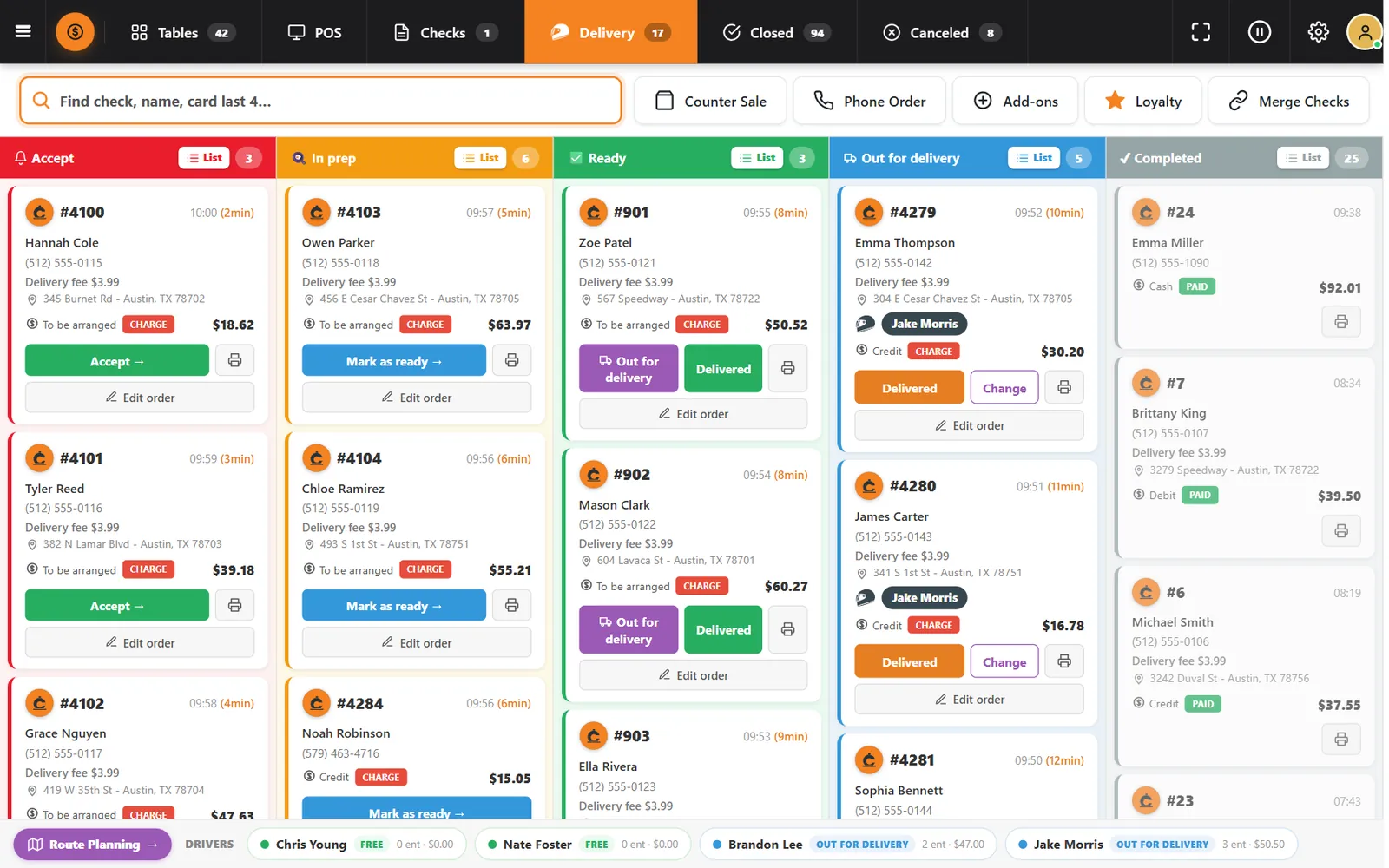
Restaurants get their own online menu, ZIP code delivery zones, an order board, barcode dispatch, driver pages, routes and driver settlement.
These are the operational elements a restaurant may want to consider when organizing its own delivery process.
Choose the delivery model that fits your actual order economics
The best delivery model is the one that produces sustainable contribution while allowing the restaurant to maintain food quality, service standards, and manageable labor requirements.
Third-party marketplaces can make sense when customer discovery and access to delivery fulfillment justify the commission. Restaurant-owned delivery can make sense when repeat demand, order density, and driver utilization support the additional operating responsibilities.
A hybrid arrangement may be the most practical starting point.
Before making a permanent decision, calculate the contribution from an identical order under both models, insert your actual commission rate, and test the result against different order volumes.
Then run a short operational pilot.
Measure completed orders, total driver hours, actual expenses, delivery times, and customer complaints. Do not expand until the numbers work under realistic conditions.
Most importantly, remember that avoiding a commission is not the same as making a profit. The restaurant still has to prepare the food, get it to the customer, and pay everyone involved.
Frequently asked questions
Is restaurant-owned delivery always cheaper than third-party delivery apps?
No. Restaurant-owned delivery removes the marketplace commission but introduces driver labor, vehicle expenses, payment processing, insurance considerations, scheduling, and administration.
The better option depends on the relationship between the marketplace commission and the actual cost of fulfilling an order independently.
Calculate both models using the same food sales and kitchen costs before deciding.
What commission rate should I use when comparing delivery options?
Use the actual commission rate in your restaurant's agreement.
If you are evaluating a possible arrangement and do not have a contract yet, test several hypothetical rates, such as 15%, 20%, 25%, and 30%.
These are illustrative modeling scenarios, not standard industry rates.
Remember to check what the commission applies to and whether promotions, discounts, refunds, or other charges create additional expenses.
How many delivery orders do I need before hiring my own drivers?
There is no universal order threshold.
The answer depends on average order value, delivery distance, driver wages, scheduling, route density, and how consistently orders arrive.
Calculate driver expense per completed order at different volumes.
For example, compare what happens when one driver completes six, eight, or 12 deliveries during the same scheduled shift.
Also consider whether demand is concentrated into a few predictable hours or spread throughout the day.
A delivery operation needs enough consistent volume to use paid driver time productively.
Should a restaurant stop using third-party marketplaces after launching direct delivery?
Not necessarily.
A marketplace may still help introduce the restaurant to customers who have not ordered before, while direct ordering may be more attractive for existing customers.
A hybrid strategy can preserve marketplace discovery while giving repeat customers another way to order.
Track the contribution from each channel separately and monitor whether direct orders are genuinely incremental or simply replacing orders that would have arrived through another channel.
The objective is not to eliminate every commission. It is to build a delivery operation that produces a healthy contribution without creating unnecessary complexity for the restaurant.
Related feature: Delivery overview.