
Restaurant Food Date Labeling: How to Label, Store, and Rotate Food in Your Kitchen
Restaurant food date labeling is one of those kitchen routines that looks simple until a busy shift, a staffing change, or a forgotten container creates confusion about what is safe to use. A reliable system tells every employee what is in a container, when it was prepared or opened, where it belongs, and when it must be reviewed or discarded under the applicable food safety rules.
A good date label answers five questions before anyone uses the food
A label should do more than display a date. It should give the next employee enough information to identify the product and make a storage decision without tracking down the person who prepared it.
At a minimum, build your restaurant food date labeling procedure around five questions:
- What is inside the container?
- When was it prepared, opened, or transferred?
- What is its applicable discard or review date?
- Who prepared or labeled it?
- Does it need special storage or handling instructions?
The exact information required can depend on the food, preparation process, and local regulations. Your written policy should distinguish between information required by the health code and additional information your restaurant uses for accountability.
For example, a container of house-made ranch dressing should not simply say "ranch." A more useful label identifies the product, preparation date, applicable discard date, and employee initials.
That information helps the next shift make a decision instead of guessing.
It also makes inventory rotation easier. Employees can compare labels without opening containers, smelling products, or asking how long something has been sitting in the refrigerator.
Local health code requirements determine your date limits
Before setting shelf-life rules, understand which food safety requirements apply to your operation.
The FDA Food Code is a model code that jurisdictions can adopt, modify, or supplement. It is not automatically the law everywhere in the United States.
Time limits come from the local health code and the FDA Food Code as adopted locally. Requirements can differ by jurisdiction, food category, storage conditions, and handling procedure.
Do not copy another restaurant's discard-date policy and assume it applies to your kitchen.
Start by checking with your local health department. Confirm the applicable requirements for:
- Refrigerated ready-to-eat foods requiring date marking.
- Foods prepared in-house.
- Commercially packaged foods after opening.
- Foods transferred from their original packaging.
- Refrigerated storage temperatures.
- Foods that are frozen and later thawed.
- Products with manufacturer instructions.
- Special processes or food handling procedures.
Pay particular attention to how your jurisdiction defines the start of a holding period and how it treats products prepared from multiple ingredients.
For example, a sauce made with several ingredients may have a different handling consideration from an unopened commercial product. Your team needs one documented rule that reflects the applicable requirements.
If you are uncertain, ask your inspector or a qualified food safety professional before assigning a shelf life.
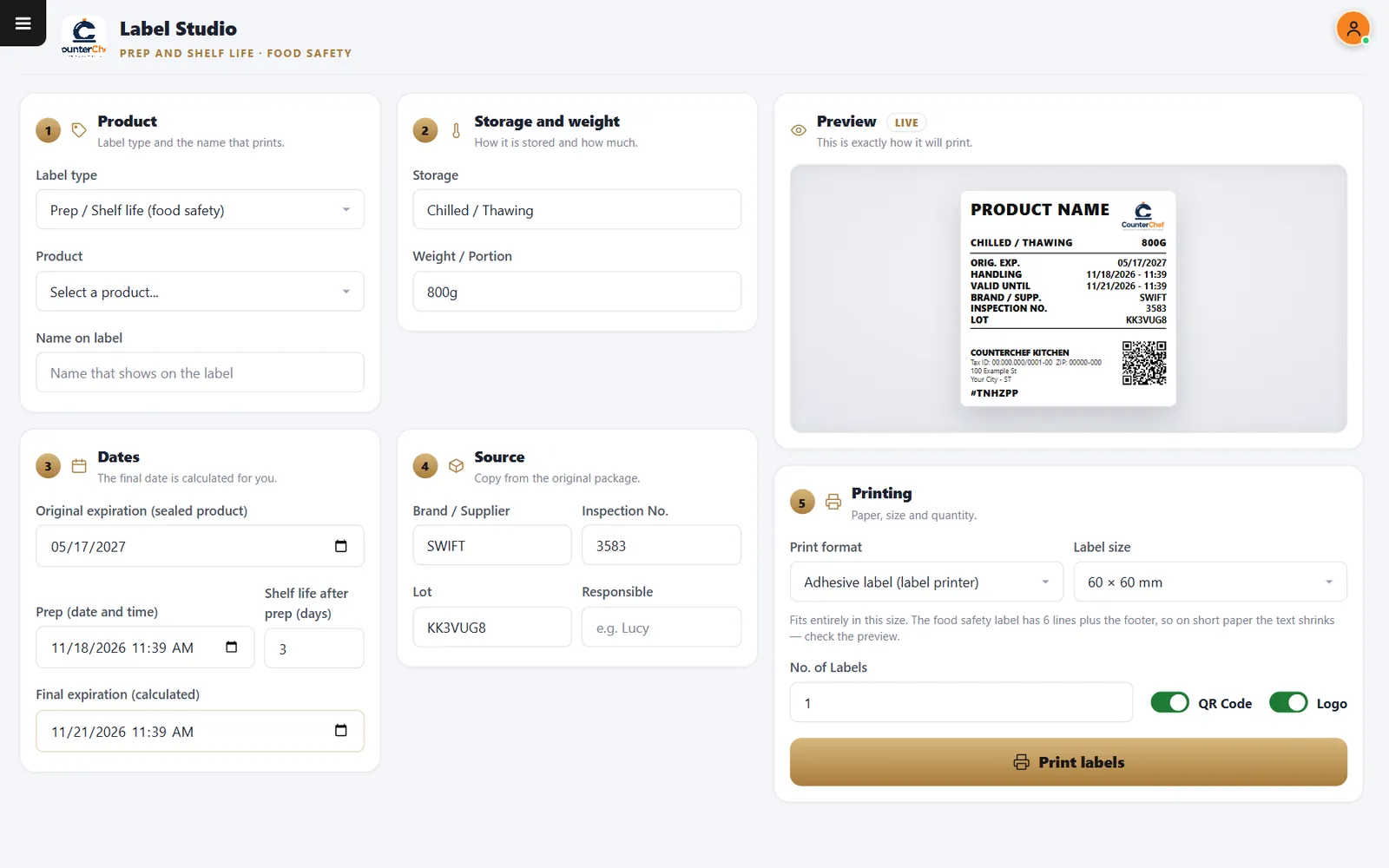
Every food label should follow the same format
A consistent label layout prevents employees from interpreting dates differently.
Here is a practical format for an independent restaurant:
| Label field | Example |
|---|---|
| Product | House-made ranch |
| Prepared/opened | November 18, 2026 |
| Discard/review date | November 20, 2026 |
| Prepared by | JD |
| Storage | Refrigerated |
| Batch or lot | R-1118-A |
You do not necessarily need every field on every label. However, your system should clearly identify the information required for each product.
Product name: Use a specific name. "Sauce" is not enough when the refrigerator contains several sauces.
Preparation or opening date: Record the event that starts the applicable holding period. Do not let employees substitute the date they moved a container to another shelf.
Discard date: Use the date established by your written procedure and applicable local requirements. Avoid informal calculations or guesses.
Employee initials: Make it possible to identify who prepared the batch if a question comes up.
Storage instructions: Include instructions when they help prevent handling mistakes, such as refrigerated or frozen storage.
Batch or lot identification: This can help connect a container to a preparation record, particularly when you produce multiple batches of the same item.
Keep labels readable, attached securely, and positioned where employees can see them without removing the container.
A date written on a loose piece of tape that falls off during cleaning is not a dependable system.
Separate preparation dates from opening dates
One common labeling mistake is treating preparation and opening as interchangeable.
They are different events, and your procedure should explain which date employees must record.
Consider three situations.
House-made food: An employee prepares a batch of tomato sauce. The preparation date identifies when the batch was made.
Commercially packaged food: An employee opens a container of mayonnaise. The opening date identifies when the original packaging was opened.
Transferred food: An employee moves an ingredient into a smaller storage container. The transfer date should not automatically replace the original preparation or opening date.
The last situation deserves special attention.
Employees sometimes transfer food into clean containers and write the current date on the new label. That can make an older product appear newer.
Your procedure should require employees to preserve the relevant original date information when transferring food.
A useful training instruction is:
"Changing containers does not restart the clock. Copy the original product information and applicable date before moving the food."
This single instruction can prevent a surprising amount of confusion.
First-in, first-out shelving makes labels useful
Labels tell employees when food entered the system. First-in, first-out (FIFO) shelving tells them which product to use first.
The two practices work together.
FIFO means employees organize products so that older inventory is used before newer inventory, subject to product-specific safety requirements and usability.
It does not mean using an older product regardless of its condition or discard date. A product that has reached its discard point must be handled according to the applicable food safety procedure.
Set up your shelves so that rotation happens naturally.
Put older products in front. When a new batch arrives, move the older usable batch forward and place the new batch behind it.
Keep product groups together. Store similar ingredients in designated locations so employees do not have to search across multiple shelves.
Make dates visible. Turn labels toward the aisle rather than stacking containers with their dates hidden.
Avoid unnecessary stacking. Employees should be able to inspect labels without removing several containers.
Use consistent shelf assignments. Keep frequently used sauces, dressings, prepared vegetables, and other ingredients in predictable locations.
A practical refrigerator arrangement
| Shelf or zone | Products | Rotation practice |
|---|---|---|
| Upper designated area | Ready-to-eat prepared foods | Older usable products forward |
| Middle designated area | Sauces and prepared ingredients | Group by product |
| Lower designated area | Other foods stored according to food safety requirements | Keep labels visible |
| Separate designated section | New deliveries and newly prepared batches | Date and rotate before stocking |
This is an organizational example, not a substitute for required storage arrangements. Follow local rules for food placement, separation, and protection against contamination.
Assign labeling responsibilities by position
A labeling policy fails when everybody assumes somebody else is responsible.
Give each position a specific job.
Kitchen manager
- Establish approved labeling procedures.
- Confirm discard-date calculations against local requirements.
- Review refrigerator organization.
- Check labels during opening and closing inspections.
- Investigate missing or conflicting dates.
- Train new employees and document training.
Prep cooks
- Label products immediately after preparation.
- Record the correct preparation information.
- Transfer original date information when changing containers.
- Keep batch identification consistent.
- Report products with unclear or missing information.
Line cooks
- Check labels before placing ingredients on the station.
- Rotate existing inventory before adding new product.
- Keep labels visible during service.
- Return ingredients to appropriate storage.
- Report products approaching their discard dates.
Dish and closing staff
- Follow the approved procedure when cleaning storage areas.
- Avoid removing or damaging labels unnecessarily.
- Return containers to their designated locations.
- Notify a manager about missing labels or unidentified food.
Front-of-house staff
If servers, bartenders, or runners handle prepared foods, include them in the policy.
They should know how to identify labeled products, where those products belong, and whom to contact when a label is missing.
Do not assume that food safety training is limited to the kitchen.
Use a simple receiving-to-storage routine
Labeling should start when food enters your operation, not only when somebody prepares a recipe.
Create a routine that covers three stages.
At receiving
- Inspect incoming products.
- Check packaging and product identification.
- Record applicable lot or manufacturer information.
- Follow receiving procedures for temperature-sensitive products.
- Identify any manufacturer storage instructions.
During preparation
- Identify the product before filling its container.
- Use the correct preparation or opening date.
- Calculate the applicable discard date using the approved procedure.
- Apply the label before moving on to another task.
- Place the container in its designated storage location.
During storage
- Keep labels readable.
- Maintain FIFO organization.
- Check dates during scheduled inspections.
- Separate products that need manager review.
- Follow the established discard procedure.
This sequence is easier to teach than a long list of disconnected rules.
It also gives managers a way to identify where a labeling problem occurred: receiving, preparation, or storage.
Try three practical improvements this week
A restaurant does not need a complicated project to improve date labeling. Start with small changes that fit existing shifts.
1. Introduce a label handoff check
At shift change, have the outgoing and incoming kitchen leads inspect the same designated refrigerator section.
The outgoing lead identifies products that need attention. The incoming lead confirms that the labels are readable and the products are in the correct locations.
This takes responsibility away from an informal verbal handoff.
Use a simple note:
- Products approaching their discard dates.
- Containers missing required information.
- Products awaiting manager review.
- New batches that need rotation.
- Any unresolved labeling questions.
The goal is to prevent the incoming team from discovering problems halfway through service.
2. Run a five-minute refrigerator label audit
Choose one refrigerator each day.
Have the manager inspect a small section rather than trying to review every storage area during a busy period.
Check whether:
- Every applicable product has a readable label.
- Dates match the written procedure.
- Labels belong to the correct products.
- Older usable products are positioned appropriately.
- Unidentified products have been addressed.
Rotate the inspection area throughout the week.
This creates a repeatable management habit without requiring an employee to stop normal kitchen operations for a lengthy inspection.
3. Track repeated labeling mistakes by category
Instead of simply recording that employees forgot labels, identify the recurring problem.
For example:
- Missing preparation dates.
- Incorrect product names.
- Transferred products receiving new dates.
- Labels placed where they cannot be read.
- New inventory stocked in front of older inventory.
Review the pattern with the team during pre-shift.
If transferred products are the recurring issue, demonstrate the correct transfer procedure. If labels are frequently missing during prep, move the labeling supplies closer to the preparation station.
Fix the process before blaming the employee.
A useful management principle is to make the correct action easier than the incorrect one.
Use a ready-to-copy daily date labeling checklist
The following checklist can be printed and kept near the kitchen manager's station.
Daily food date labeling checklist
| Inspection item | Complete |
|---|---|
| Applicable prepared foods have readable labels | ☐ |
| Opened products have required date information | ☐ |
| Product names are specific and identifiable | ☐ |
| Preparation or opening dates are recorded correctly | ☐ |
| Discard dates follow the approved procedure | ☐ |
| Transferred products retain relevant original dates | ☐ |
| Older usable inventory is positioned forward | ☐ |
| New products are placed behind existing inventory | ☐ |
| Labels face outward and remain attached | ☐ |
| Unidentified products are addressed by a manager | ☐ |
| Refrigerator organization follows food safety procedures | ☐ |
| Employees know how to report labeling problems | ☐ |
Date: ____________________
Shift: ____________________
Manager: ____________________
Corrective actions required: ____________________
Follow-up completed by: ____________________
The manager should record actual corrective actions rather than checking every box automatically.
If an item fails inspection, identify the product, explain the issue, and document what happened to it.
That creates a useful record for identifying recurring operational problems.
Train employees with real containers, not just written policies
A signed training sheet does not prove that an employee knows how to label food correctly.
Show employees the actual process.
During onboarding, use three or four containers representing different situations:
- A freshly prepared batch.
- A commercially packaged product that has been opened.
- A product transferred into a different container.
- A product with missing or conflicting date information.
Ask the employee to explain what information belongs on each label.
Then ask them to demonstrate where each container belongs in the refrigerator.
This tests both labeling and FIFO knowledge.
Include one deliberate mistake in the exercise, such as a transferred product with a newer date written on it. Ask the employee what they would do.
The correct response should be to stop and ask a supervisor rather than inventing a date.
Train employees to follow these rules:
- Never guess a preparation or opening date.
- Never create a new holding period by changing containers.
- Never remove an existing label without preserving required information.
- Never use a product simply because it looks or smells acceptable.
- Never change an approved discard date without authorization.
- Report missing, unreadable, or conflicting labels immediately.
Repeat the demonstration when employees change positions or when your labeling procedure changes.
Calculate the financial cost of poor labeling
Date labeling is a food safety responsibility, but it also affects purchasing and food costs.
A restaurant that cannot identify its inventory may discard usable products unnecessarily. A restaurant that keeps products without reliable date information may create more serious safety risks.
Consider a hypothetical example.
Hypothetical monthly ranch dressing waste calculation:
| Item | Hypothetical amount |
|---|---|
| Batches discarded due to labeling confusion | 8 |
| Cost per batch | $12.00 |
| Monthly waste | $96.00 |
| Annualized waste at the same rate | $1,152.00 |
Calculation:
8 batches × $12.00 = $96.00 per month.
$96.00 × 12 months = $1,152.00 per year.
These figures are entirely hypothetical and do not represent an industry average or expected savings.
Now suppose the restaurant introduces a clearer label format, improves FIFO shelving, and trains prep employees to preserve original date information.
The manager can track the same waste category over the following months.
Do not assume that every discarded batch can be eliminated. Some products must be discarded for legitimate food safety or quality reasons.
The goal is to distinguish necessary waste from waste caused by poor organization and unclear records.
Choose labeling tools that fit your actual kitchen
The best labeling method is one that employees can use consistently during real preparation work.
A small kitchen may manage with approved labels, permanent markers, and a printed reference sheet. A larger operation may benefit from standardized printed labels and batch identification.
Whatever you choose, check that:
- Labels remain readable in your storage conditions.
- Employees can identify the required fields quickly.
- The labeling process fits your preparation workflow.
- Labels can be applied without contaminating food-contact surfaces.
- Managers can verify the information during inspections.
CounterChef prints prep and shelf-life labels with storage, dates, lot, brand and a QR code.
Keep your labeling procedure independent of any particular tool. Employees must understand what the information means, when it should be recorded, and what to do when something is missing.
Review the system every month and after major changes
Once the system is running, schedule a monthly review.
Look at the same operational questions each time:
- Which products most frequently have missing labels?
- Which preparation stations have the most labeling errors?
- Are employees following FIFO shelving?
- Are transferred products retaining their original information?
- Are managers applying discard-date procedures consistently?
- Have new menu items created labeling requirements that need clarification?
- Have local health code requirements or approved procedures changed?
Also review the system whenever you change recipes, preparation methods, storage arrangements, or suppliers.
A product that previously arrived ready to use may now be prepared in-house. That change can affect which dates and records your team needs.
When regulatory questions arise, confirm the answer with your local health department or a qualified food safety professional.
Do not let an old training document become the authority for a new process.
Frequently asked questions
What should be included on a restaurant food date label?
A useful label identifies the product, preparation or opening date, applicable discard date, and employee initials. Storage instructions and batch or lot information can also help with inventory management and traceability. Follow the specific labeling requirements adopted by your local jurisdiction.
Does changing a food container restart its shelf life?
No. Transferring food into another container does not automatically restart its holding period. Preserve the relevant original preparation or opening information and follow your approved food safety procedure.
What does FIFO mean in a restaurant kitchen?
FIFO stands for first-in, first-out. It means organizing inventory so older usable products are used before newer products. Employees should place older products toward the front and newer products behind them, while still checking applicable discard dates and food safety requirements.
How long can prepared food stay in a restaurant refrigerator?
There is no single holding period that should be applied to every prepared food in every restaurant. Time limits come from the local health code and the FDA Food Code as adopted locally, along with applicable product-specific requirements. Confirm the rules with your local health department before establishing discard dates.
Related feature: Food labels.