
How to Calculate Food Cost Percentage and Actually Use It in Your Restaurant
Food cost percentage tells you how much of your restaurant's food sales goes toward the ingredients used to make the food you sell. Calculating it is straightforward, but the real value comes from using the number to price your menu, control inventory, identify waste, and make better purchasing decisions.
1. Food cost percentage shows how much of your sales goes toward ingredients
Food cost percentage is the relationship between the cost of the food you use and the revenue you generate from selling that food.
For example, if your restaurant spends $3,000 on food ingredients and generates $10,000 in food sales, your food cost percentage is 30%.
That means you spend 30 cents on ingredients for every dollar of food revenue.
The remaining 70 cents is what you have left before accounting for labor, rent, utilities, credit card processing, insurance, equipment, marketing, and other operating expenses.
This distinction matters. A restaurant can have a food cost percentage that looks reasonable and still lose money because its other expenses are too high. Food cost is one part of the financial picture, not a measure of overall profitability.
Restaurant owners use food cost percentage for several practical reasons:
- Menu pricing: Determine whether the selling price of each dish covers its ingredients and leaves enough gross profit.
- Inventory control: Understand how much food is being consumed relative to sales.
- Purchasing decisions: Identify expensive ingredients and evaluate whether suppliers are affecting profitability.
- Waste management: Find out whether spoilage, overportioning, preparation mistakes, or food sent back to the kitchen are increasing costs.
- Menu analysis: Identify dishes that generate good gross profit and dishes that need attention.
- Financial planning: Track whether ingredient costs are changing faster than menu prices.
There are two different measurements worth understanding: actual food cost and theoretical food cost.
Actual food cost measures the value of the inventory your restaurant actually consumed during a period. Theoretical food cost estimates how much ingredients should have cost based on the recipes and quantities sold.
Comparing these two numbers is one of the most useful ways to identify problems in a restaurant kitchen.
2. Calculate food cost percentage using this formula
The basic formula is:
Food Cost Percentage = (Cost of Food Used ÷ Food Sales Revenue) × 100
You need two numbers:
- Cost of food used: The dollar value of the ingredients consumed during the period.
- Food sales revenue: The revenue generated by selling food during the same period.
Make sure both numbers cover exactly the same dates.
For actual food cost, calculate the cost of food used with this formula:
Beginning Inventory + Purchases − Ending Inventory = Cost of Food Used
Here is what each component means:
- Beginning inventory: The value of all food ingredients in storage, refrigerators, freezers, and other inventory locations at the start of the period.
- Purchases: The value of food ingredients purchased during that period, including applicable adjustments for credits and returns.
- Ending inventory: The value of all remaining food ingredients at the end of the period.
The reason you subtract ending inventory is simple: ingredients that are still in your restaurant have not necessarily been used.
If you purchased $5,000 worth of ingredients but still have $1,500 worth on hand, you did not consume the entire $5,000.
Once you know the cost of food used, divide it by food sales revenue.
Use food sales rather than total restaurant revenue. If your restaurant sells alcoholic beverages, for example, those sales should not be included in the food sales denominator when calculating food cost percentage.
For consistency, use net food sales after discounts and refunds, excluding sales tax. Sales tax collected from customers is not restaurant revenue.
3. Work through a complete food cost calculation in dollars
Let's walk through a complete calculation using a hypothetical independent restaurant.
Every number below is hypothetical and is included only to demonstrate the calculation.
Hypothetical example: A neighborhood restaurant calculating its monthly food cost
The restaurant wants to calculate its food cost percentage for October.
Its inventory and purchasing records show:
| Item | Hypothetical amount |
|---|---|
| Beginning inventory on October 1 | $4,000 |
| Food purchases during October | $8,500 |
| Ending inventory on October 31 | $3,000 |
| Net food sales during October | $30,000 |
Step 1: Calculate the cost of food used.
Beginning Inventory + Purchases − Ending Inventory
$4,000 + $8,500 − $3,000 = $9,500
The restaurant used $9,500 worth of food ingredients during October.
Step 2: Divide food used by food sales.
$9,500 ÷ $30,000 = 0.3167
Step 3: Multiply by 100 to get the percentage.
0.3167 × 100 = 31.67%
<text>Hypothetical final result: 31.67% food cost.</text>
This means the restaurant spent approximately 31.67 cents on ingredients for every dollar of food sales.
Step 4: Calculate gross profit from food.
Food Sales − Cost of Food Used = Food Gross Profit
$30,000 − $9,500 = $20,500
The restaurant generated $20,500 in food gross profit before labor and other operating expenses.
This is an important distinction. The restaurant did not make $20,500 in net profit. It still needs to pay its employees, rent, utilities, insurance, and other expenses.
Step 5: Calculate the gross profit percentage.
100% − 31.67% = 68.33%
The restaurant retained approximately 68.33% of food sales after ingredient costs.
Now the owner has three useful numbers:
- Food cost percentage: 31.67%.
- Food gross profit: $20,500.
- Food gross profit percentage: 68.33%.
These figures provide a starting point for evaluating menu prices, purchasing, and kitchen operations.
4. Calculate theoretical food cost for individual menu items
Your restaurant's overall food cost percentage tells you what happened across the entire operation. It does not necessarily tell you which dishes are responsible for the result.
For that, you need to calculate the food cost of individual menu items.
Start with a recipe card for every dish you sell. A recipe card should list each ingredient, the quantity used, and the cost of that quantity.
Consider a hypothetical cheeseburger.
Hypothetical example: Cheeseburger recipe costing
| Ingredient | Quantity | Hypothetical unit cost | Ingredient cost |
|---|---|---|---|
| Ground beef | 6 oz | $0.50 per oz | $3.00 |
| Burger bun | 1 | $0.55 each | $0.55 |
| Cheese | 1 slice | $0.30 each | $0.30 |
| Lettuce | 1 portion | $0.12 | $0.12 |
| Tomato | 2 slices | $0.18 | $0.18 |
| Pickles | 3 slices | $0.08 | $0.08 |
| Sauce | 1 portion | $0.15 | $0.15 |
| Total | $4.38 |
All quantities and prices in this example are hypothetical.
The total ingredient cost for one cheeseburger is $4.38.
Suppose the restaurant sells this burger for a hypothetical menu price of $14.00.
The formula becomes:
($4.38 ÷ $14.00) × 100 = 31.29%
The hypothetical cheeseburger has a food cost percentage of 31.29%.
Its gross profit per serving is:
$14.00 − $4.38 = $9.62
This $9.62 is the amount remaining after ingredient costs, not net profit.
You can use the same method for every item on your menu.
A pizza needs a recipe that includes dough, sauce, cheese, toppings, and any other ingredients. A salad needs quantities for greens, vegetables, dressing, proteins, and garnishes. A pasta dish needs pasta, sauce, protein, cheese, and other components.
Remember to account for preparation yields.
If you buy a whole chicken but only a portion becomes usable meat, calculating the recipe cost using the purchase weight alone will underestimate the true cost of the usable ingredient.
The same issue applies to vegetables that require trimming, meats with bones, seafood with shells, and other ingredients that lose weight during preparation.
For these ingredients, calculate the usable yield:
Yield Percentage = (Usable Weight ÷ Purchased Weight) × 100
Then calculate the cost per usable unit:
Cost per Usable Unit = Purchase Cost ÷ Usable Quantity
For example, if a hypothetical restaurant pays $40 for 20 pounds of raw produce and gets 16 pounds of usable product after trimming:
16 ÷ 20 × 100 = 80% yield.
$40 ÷ 16 = $2.50 per usable pound.
The ingredient should therefore be costed at $2.50 per usable pound, not $2.00 per purchased pound.
This is particularly important for proteins and produce, where preparation losses can make a noticeable difference.
5. Use food cost percentage to set and adjust menu prices
Once you know the cost of a dish, you can calculate the selling price required to reach a specific food cost percentage.
The formula is:
Menu Price = Recipe Cost ÷ Target Food Cost Percentage
When using this formula, express the target percentage as a decimal.
For example, a target of 30% becomes 0.30.
Using the hypothetical cheeseburger from the previous section:
- Recipe cost: $4.38.
- Target food cost percentage: 30%.
- Calculation: $4.38 ÷ 0.30.
- Required menu price: $14.60.
This means the restaurant would need to charge $14.60 for the burger to achieve a 30% food cost percentage based on the calculated recipe cost.
If the restaurant currently charges $14.00, its actual theoretical food cost is 31.29%, slightly above the selected target.
There are several ways to respond:
Option 1: Increase the menu price.
The restaurant could move the price to $14.60, assuming customers and the local market support that price.
Option 2: Reduce the recipe cost.
The owner could review portion sizes, negotiate supplier terms, compare ingredient alternatives, or adjust the recipe without compromising the dish.
Option 3: Keep the price and accept the higher food cost.
A dish does not automatically need to meet the same food cost percentage as every other item. If it generates sufficient gross profit and supports the restaurant's overall strategy, the higher percentage may be acceptable.
The important thing is to make the decision deliberately.
Do not increase menu prices simply because an ingredient becomes more expensive. First, calculate the actual impact on the recipe, evaluate the gross profit dollars, and consider how the dish performs in terms of sales volume.
A menu item with a higher food cost percentage can generate more gross profit dollars than a cheaper dish with a lower percentage.
That is why looking at percentages alone can lead to poor pricing decisions.
6. Compare actual and theoretical food cost to find operational problems
One of the most useful applications of food cost percentage is comparing what your recipes say you should have spent with what your inventory records show you actually spent.
Theoretical food cost is calculated using the quantities of ingredients specified in your recipes and the number of dishes sold.
Actual food cost is calculated using beginning inventory, purchases, and ending inventory.
Ideally, the two numbers should be reasonably close, although they will rarely match perfectly.
Consider another hypothetical example:
A restaurant sells 500 cheeseburgers during a month.
Its recipe card shows an ingredient cost of $4.38 per burger.
Theoretical food cost:
500 × $4.38 = $2,190.
Now suppose the restaurant's inventory calculation shows that it actually used $2,500 worth of ingredients attributable to those burgers.
Actual cost: $2,500.
Difference:
$2,500 − $2,190 = $310.
The restaurant spent a hypothetical $310 more than the recipe calculations predicted.
That difference deserves investigation.
Possible explanations include:
- Employees using larger portions than the recipe specifies.
- Food being wasted during preparation.
- Incorrect inventory counts.
- Ingredients spoiling before use.
- Unrecorded meals for employees.
- Complimentary dishes or customer remakes.
- Incorrect recipe quantities.
- Supplier price increases that have not been reflected in recipe costs.
- Inventory theft or unrecorded transfers between locations.
Do not immediately assume that employees are wasting food or that inventory is disappearing.
First, check whether the recipe costs and inventory records are accurate. A recipe calculated using an outdated invoice price will produce an incorrect theoretical food cost.
Next, check portion sizes. A kitchen may consistently use seven ounces of beef when the recipe specifies six ounces. That small difference can become expensive across hundreds of servings.
Also look at waste logs, preparation procedures, and storage practices.
The goal is to find the reason for the difference, not simply to force the actual number to match the theoretical number.
If you monitor this comparison consistently, you can identify problems before they become larger financial issues.
7. Track food cost regularly and build it into your restaurant's routine
Food cost percentage is only useful when the underlying numbers are accurate and updated.
Calculating it once a year or only when profits decline is not enough. Ingredient prices change, sales patterns shift, portions drift, and inventory gets wasted.
Build a routine that keeps your numbers current.
Update ingredient costs whenever supplier prices change.
Keep copies of supplier invoices and review the prices of important ingredients. If the cost of ground beef, cooking oil, cheese, or chicken changes, update the corresponding ingredient cost in your recipe calculations.
Do not assume that the price you paid last month is still accurate.
Count inventory consistently.
Choose a regular schedule and use the same valuation method each time.
Count ingredients across all storage areas, including walk-in refrigerators, freezers, dry storage, and preparation stations.
Use consistent units of measurement. If an ingredient is purchased by the case but used by the ounce, establish a reliable conversion.
Review your highest-cost ingredients.
You do not need to start by analyzing every ingredient in the same level of detail.
Pay particular attention to ingredients that represent a significant portion of your purchasing, especially proteins, dairy products, cooking oils, and other expensive items.
Review food sales separately from other revenue.
Keep food, beverage, and other sales categories separate where possible. This makes your food cost calculation more meaningful.
Look at both percentages and dollar amounts.
A food cost percentage can increase because ingredient costs rose, because selling prices fell, or because the sales mix changed.
The percentage alone does not explain what happened.
Review gross profit per item and total gross profit alongside the percentage.
Use menu performance to decide what to change.
A useful approach is to combine two measurements:
- Popularity: How frequently customers order an item.
- Profitability: How much gross profit the item generates.
This creates four practical menu categories:
- Star: Popular items that generate strong gross profit.
- Plowhorse: Popular items that generate relatively low gross profit.
- Puzzle: Less popular items that generate strong gross profit.
- Dog: Less popular items that generate relatively low gross profit.
These categories help you decide whether to promote an item, adjust its recipe, change its price, or consider removing it.
A practical way to organize this work
CounterChef provides several tools for keeping these calculations connected to daily restaurant operations.
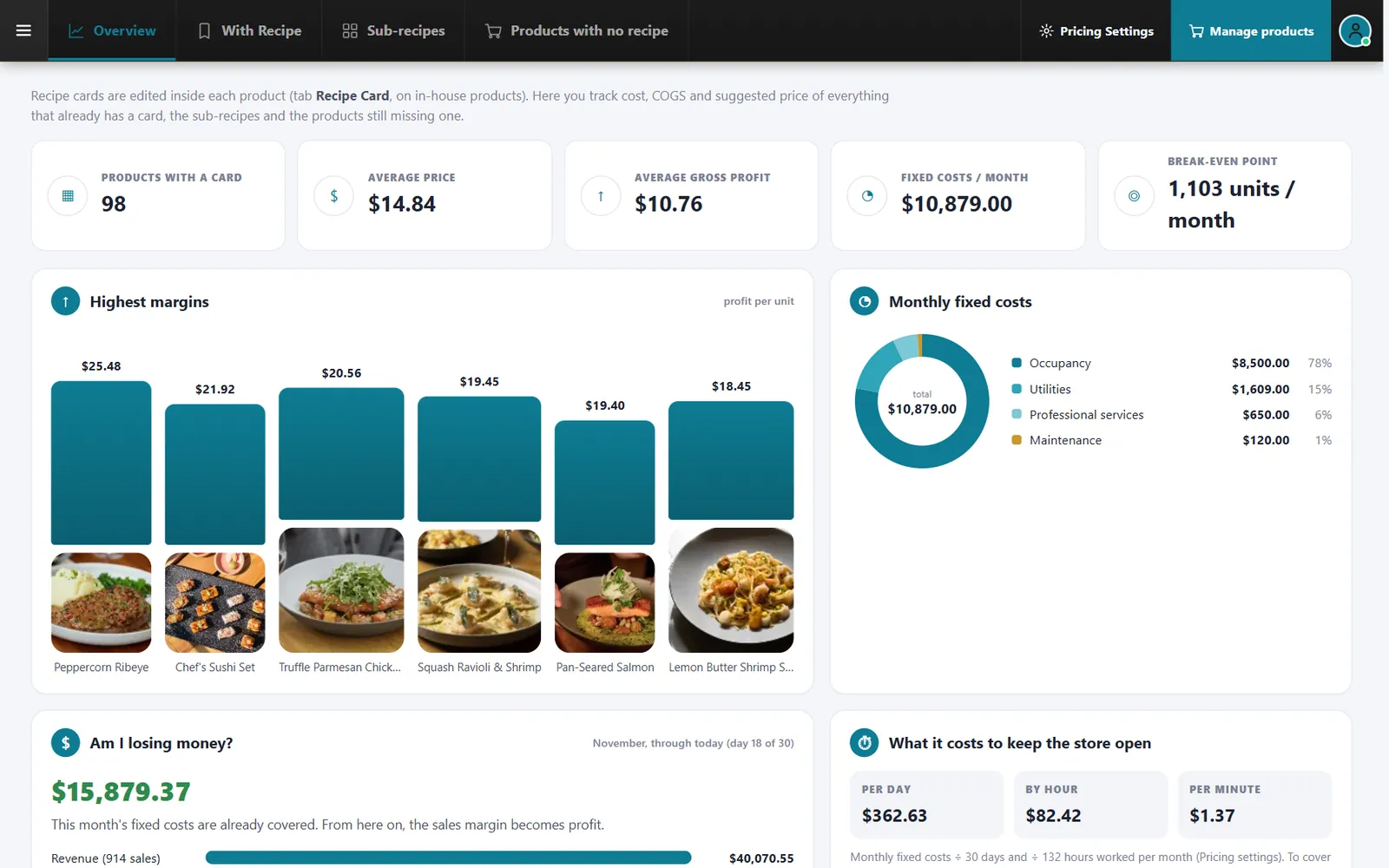
Each stock item has a cost that you update as invoices change. A recipe card links ingredients and quantities to a menu item, allowing the restaurant to calculate the ingredient cost of individual dishes.
The Pricing and Costs screen shows gross profit and which items still have no recipe, making it easier to identify incomplete menu costing. The COGS report sorts items into Star, Plowhorse, Puzzle and Dog.
This connects ingredient purchasing, recipe costing, menu pricing, and menu performance in one workflow.
The important principle is to keep the underlying information current. A calculation is only as reliable as the inventory quantities, invoice costs, and recipes behind it.
Frequently asked questions
1. What is a good food cost percentage for a restaurant?
There is no single food cost percentage that works for every restaurant.
A restaurant's concept, menu, portion sizes, ingredient quality, purchasing arrangements, and selling prices all affect its food cost.
A range around 28% to 35% is sometimes used as a rule of thumb, but it varies by concept and is not a universal industry standard or a guarantee of profitability.
A full-service restaurant, a pizzeria, a burger restaurant, and a fine-dining establishment can have very different cost structures.
Rather than copying another restaurant's target, calculate your own recipe costs and determine what food cost percentage supports your operating expenses and profit goals.
2. Should I include labor in food cost percentage?
No. Food cost percentage measures ingredient costs relative to food sales.
Employee wages, payroll taxes, and other labor expenses are not included in the basic food cost calculation.
However, labor is an important part of your restaurant's overall cost structure. You should track labor costs separately and consider them alongside food cost when evaluating profitability.
Some restaurants also calculate prime cost, which combines food and beverage costs with labor costs to provide a broader view of operating expenses.
3. How often should I calculate food cost percentage?
At a minimum, calculate actual food cost monthly using beginning inventory, purchases, and ending inventory.
You can also monitor theoretical food cost more frequently if your sales and recipe information is updated regularly.
Restaurants with significant ingredient price fluctuations, high inventory turnover, or frequent waste may benefit from weekly reviews.
The key is consistency. Comparing one month's results with another is only useful when you use the same calculation method and comparable accounting periods.
4. Why is my actual food cost higher than my theoretical food cost?
A higher actual food cost means the restaurant consumed more ingredient value than its recipes and sales records predicted.
Common causes include overportioning, preparation waste, spoilage, incorrect inventory counts, unrecorded meals, remakes, and outdated ingredient prices.
Start by checking your inventory counts, supplier invoices, and recipe cards. Then investigate portion control and kitchen waste.
Do not change menu prices or reduce portions until you understand what is causing the difference.
Sometimes the problem is not the kitchen. It is simply inaccurate costing information.
Related feature: Recipe costing.