
How to Cost a Cocktail: Calculate Pour Cost, Price Drinks, and Protect Your Margins
A cocktail can sell consistently, look good on the menu, and still make less money than you think. To cost it properly, you need to account for every ingredient that reaches the glass, including modifiers, syrups, bitters, garnish, and any product lost during preparation.
The cocktail pour cost formula gives you a starting point, but the real work is building an accurate recipe cost, deciding what the selling price needs to accomplish, and making sure the drink your bartender serves matches the drink you calculated.
Start with the cocktail pour cost formula, but understand what it measures
Pour cost is the percentage of a cocktail's selling price that goes toward the cost of its ingredients.
The basic formula is:
Pour Cost (%) = (Total Ingredient Cost ÷ Selling Price) × 100
For example, assume a cocktail costs $3.00 in ingredients and sells for $12.00.
- Ingredient cost: $3.00
- Selling price: $12.00
- Calculation: ($3.00 ÷ $12.00) × 100
- Pour cost: 25%
That means 25 cents of every dollar in cocktail sales goes toward the ingredients in that drink.
The remaining 75% is not profit. It must still help cover bartender wages, barback labor, rent, utilities, credit card processing, equipment, cleaning supplies, insurance, and other operating expenses.
This distinction matters. A drink with a 20% pour cost is not automatically more profitable than one with a 25% pour cost. The cheaper drink might take longer to prepare, require more labor, or sell less frequently.
Pour cost is an ingredient-control measure, not a complete measure of profitability.
Cost every ingredient before deciding what the cocktail should sell for
The first step is to calculate the actual cost of each ingredient in the recipe.
Start with the purchase price and the usable quantity. Then calculate the cost of the amount that goes into one drink.
For a bottled spirit, use:
Cost Per Ounce = Bottle Cost ÷ Usable Bottle Ounces
Suppose a hypothetical bottle costs $36.00 and contains 750 mL.
Using the conversion of approximately 29.57 mL per US fluid ounce:
- Bottle volume: 750 mL
- Conversion: 29.57 mL per US fluid ounce
- Bottle volume in ounces: 750 ÷ 29.57 = 25.37 ounces
- Bottle cost: $36.00
- Cost per ounce: $36.00 ÷ 25.37 = approximately $1.42
If the cocktail uses 2 ounces, the base spirit costs approximately $2.84.
Repeat the process for every spirit, liqueur, juice, syrup, mixer, and garnish.
Do not assume that small ingredients are too inexpensive to matter. A quarter-ounce of an expensive liqueur, a specialty bitters portion, or a fresh garnish can meaningfully change the final recipe cost.
Also distinguish between purchased quantity and usable quantity. If a product has preparation waste, trimming loss, or spoilage, use the amount you can actually serve.
Work through three cocktails ounce by ounce
A useful costing exercise is to take three different drinks from your menu and calculate them from scratch.
The following examples use hypothetical purchase prices, recipe quantities, ingredient costs, and selling prices. They are illustrations, not market quotations or recommended industry benchmarks.
Example 1: A classic Margarita
<PRIVATE_NOTE> </PRIVATE_NOTE>
Assume the restaurant makes a Margarita with tequila, orange liqueur, fresh lime juice, agave syrup, and a salt rim.
Hypothetical purchase costs:
- Tequila: $32.00 per 750 mL bottle
- Orange liqueur: $24.00 per 750 mL bottle
- Fresh lime juice: $0.16 per fluid ounce
- Agave syrup: $0.22 per fluid ounce
- Salt allocation: $0.03 per drink
Convert the two bottled spirits into cost per ounce.
Tequila:
- Bottle volume: 25.37 ounces
- Bottle cost: $32.00
- Cost per ounce: $32.00 ÷ 25.37 = $1.26
Orange liqueur:
- Bottle volume: 25.37 ounces
- Bottle cost: $24.00
- Cost per ounce: $24.00 ÷ 25.37 = $0.95
Now calculate the recipe.
| Ingredient | Recipe quantity | Hypothetical unit cost | Cost per drink |
|---|---|---|---|
| Tequila | 2 oz | $1.26/oz | $2.52 |
| Orange liqueur | 0.75 oz | $0.95/oz | $0.71 |
| Lime juice | 1 oz | $0.16/oz | $0.16 |
| Agave syrup | 0.5 oz | $0.22/oz | $0.11 |
| Salt rim | 1 portion | $0.03/portion | $0.03 |
| Total | $3.53 |
The hypothetical ingredient cost is $3.53 per Margarita.
Assume the menu price is $14.00.
- Ingredient cost: $3.53
- Selling price: $14.00
- Pour cost: ($3.53 ÷ $14.00) × 100
- Pour cost: 25.21%
The drink has a hypothetical pour cost of approximately 25.2%.
Notice that the salt rim is included. It may seem insignificant, but leaving it out makes the recipe cost incomplete.
If the restaurant also serves a lime wedge, add its cost separately. A garnish is still an ingredient, even when the customer does not consume it.
Example 2: An Old Fashioned with a more expensive spirit
An Old Fashioned looks simple, but its ingredient costs can be concentrated in the base spirit.
Assume the restaurant uses a whiskey purchased for $48.00 per 750 mL bottle.
Hypothetical ingredient purchase costs:
- Whiskey: $48.00 per 750 mL
- Simple syrup: $0.12 per fluid ounce
- Bitters: $0.08 per dash
- Orange peel: $0.18 per garnish
- Cocktail cherry: $0.35 per garnish
First, calculate the whiskey cost.
- Bottle volume: 25.37 ounces
- Bottle cost: $48.00
- Cost per ounce: $48.00 ÷ 25.37 = $1.89
The recipe:
| Ingredient | Recipe quantity | Hypothetical unit cost | Cost per drink |
|---|---|---|---|
| Whiskey | 2 oz | $1.89/oz | $3.78 |
| Simple syrup | 0.25 oz | $0.12/oz | $0.03 |
| Aromatic bitters | 3 dashes | $0.08/dash | $0.24 |
| Orange peel | 1 portion | $0.18/portion | $0.18 |
| Cocktail cherry | 1 each | $0.35/each | $0.35 |
| Total | $4.58 |
Assume a hypothetical menu price of $16.00.
- Ingredient cost: $4.58
- Selling price: $16.00
- Pour cost: ($4.58 ÷ $16.00) × 100
- Pour cost: 28.63%
The pour cost is approximately 28.6%.
There are two practical lessons here.
First, the whiskey accounts for most of the ingredient cost. Reducing the cherry allocation will have a relatively small effect compared with changing the whiskey portion or negotiating a better purchase price.
Second, the garnish is not free. A cherry and orange peel together add $0.53 to the drink.
If you serve this cocktail frequently, a small garnish expense repeated across many orders becomes a real purchasing cost.
Example 3: A house-batched Whiskey Sour
A Whiskey Sour is a good example of why batch preparation needs its own costing method.
Suppose the restaurant prepares a dilution-free batch containing whiskey, lemon juice, and simple syrup. Bartenders add egg white separately when the drink is ordered.
The batch contains no water or ice. This is important because the ingredients are being combined before service, not diluted.
Hypothetical purchase costs:
- Whiskey: $40.00 per 750 mL bottle
- Lemon juice: $0.18 per fluid ounce
- Simple syrup: $0.12 per fluid ounce
- Egg white: $0.35 per portion
- Angostura bitters: $0.08 per dash
- Lemon garnish: $0.15 per portion
The batch recipe is:
- Whiskey: 12 ounces
- Lemon juice: 6 ounces
- Simple syrup: 4 ounces
Total batch volume: 22 ounces.
Calculate the batch cost.
Whiskey:
- Bottle volume: 25.37 ounces
- Bottle cost: $40.00
- Cost per ounce: $40.00 ÷ 25.37 = $1.58
- Quantity used: 12 ounces
- Batch whiskey cost: 12 × $1.58 = $18.96
Lemon juice:
- Quantity used: 6 ounces
- Cost per ounce: $0.18
- Batch lemon cost: 6 × $0.18 = $1.08
Simple syrup:
- Quantity used: 4 ounces
- Cost per ounce: $0.12
- Batch syrup cost: 4 × $0.12 = $0.48
Total batch cost:
- Whiskey: $18.96
- Lemon juice: $1.08
- Simple syrup: $0.48
- Total: $20.52
The batch contains 22 ounces.
If each cocktail receives 2 ounces of batch:
- Total batch volume: 22 ounces
- Portion size: 2 ounces
- Theoretical servings: 22 ÷ 2 = 11
- Cost per batch portion: $20.52 ÷ 11 = $1.87
Now add the ingredients used during service.
| Ingredient | Recipe quantity | Hypothetical unit cost | Cost per drink |
|---|---|---|---|
| Whiskey Sour batch | 2 oz | $0.93/oz | $1.87 |
| Egg white | 1 portion | $0.35/portion | $0.35 |
| Bitters | 2 dashes | $0.08/dash | $0.16 |
| Lemon garnish | 1 portion | $0.15/portion | $0.15 |
| Total | $2.53 |
Assume the restaurant sells the drink for $13.00.
- Ingredient cost: $2.53
- Selling price: $13.00
- Pour cost: ($2.53 ÷ $13.00) × 100
- Pour cost: 19.46%
The hypothetical pour cost is approximately 19.5%.
The key is that the batch does not eliminate the need for individual recipe costing. It changes where the calculation happens.
You calculate the cost of the complete batch, divide by its actual usable portions, and then add anything the bartender adds separately.
If the batch contains water, account for that in the batch volume and recipe specifications. If it is intentionally dilution-free, keep it that way in the recipe and let the bartender follow a separate preparation method for shaking or stirring with ice.
Never assume that the final cocktail volume equals the batch volume. Ice dilution is part of preparation, not an excuse to change the measured amount of alcohol.
Account for garnish, waste, and preparation loss
Many bars calculate the spirit and mixer costs correctly but underestimate the cost of everything around them.
Garnishes deserve particular attention.
A citrus wheel, peel, cherry, herb sprig, dehydrated fruit slice, or edible flower has a purchase cost. Some garnishes also have preparation labor and significant unusable portions.
For example, assume a hypothetical case of 100 oranges costs $45.00.
The purchase cost per orange is:
$45.00 ÷ 100 = $0.45.
If one orange produces four usable garnishes:
$0.45 ÷ 4 = $0.1125 per garnish.
The garnish cost is approximately $0.11, before accounting for any additional preparation loss.
Do not divide the purchase price by the number of oranges you hope to use. Count what you actually obtain from the product.
There are several ways to improve accuracy:
- Record the number of usable garnishes from a test batch.
- Include trimming and spoilage in your yield calculation.
- Standardize the size of fruit wedges and herb portions.
- Keep garnish containers covered and properly refrigerated.
- Review how many prepared garnishes remain unused at closing.
The same thinking applies to fresh juice, infused spirits, house syrups, and other prepared ingredients.
A juice recipe that starts with a certain number of lemons does not automatically produce a predictable amount of usable juice. Measure the yield rather than relying on an estimate.
Use the correct price formula when setting a menu price
Once the full ingredient cost is known, you can work backward from your desired pour cost.
The formula is:
Selling Price = Total Ingredient Cost ÷ Target Pour Cost (as a decimal)
Suppose a cocktail costs a hypothetical $3.20 to make and the owner wants to test a 25% pour cost.
- Ingredient cost: $3.20
- Target pour cost: 25%
- Decimal conversion: 0.25
- Selling price: $3.20 ÷ 0.25
- Selling price: $12.80
The restaurant could test a menu price of $13.00.
At $13.00:
- Ingredient cost: $3.20
- Selling price: $13.00
- Actual pour cost: ($3.20 ÷ $13.00) × 100
- Actual pour cost: 24.62%
The formula helps establish a starting price. It does not decide the final menu price for you.
Consider the following before putting the number on the menu:
Customer expectations: A premium spirit, unusual preparation, or signature presentation may support a different price from a straightforward highball.
Competitive positioning: Your price needs to make sense within your local market and concept.
Preparation labor: A drink that takes several minutes to prepare may need a different contribution margin from one that can be made quickly.
Sales volume: A cocktail that sells consistently can contribute more total gross profit than an expensive drink that rarely moves.
Menu structure: Prices across the cocktail list should make sense together. A small difference in ingredient cost does not always justify a large difference in selling price.
A useful rule of thumb is that many operators use pour-cost targets somewhere around 20% to 25% for certain cocktails, but the appropriate figure varies by concept, location, spirit selection, and operating expenses. Treat this as a planning reference, not a universal benchmark.
Compare gross profit dollars instead of looking only at percentages
Two cocktails can have different pour costs and still generate similar gross profit dollars.
Use:
Gross Profit per Drink = Selling Price − Ingredient Cost
Consider two hypothetical cocktails.
| Cocktail A | Cocktail B | |
|---|---|---|
| Selling price | $12.00 | $16.00 |
| Ingredient cost | $2.40 | $4.00 |
| Pour cost | 20% | 25% |
| Gross profit per drink | $9.60 | $12.00 |
Cocktail B has the higher pour cost, but it generates $2.40 more gross profit per drink.
Neither drink is automatically the better choice.
If Cocktail A sells 30 times in a week:
- Gross profit per drink: $9.60
- Weekly sales: 30 drinks
- Weekly gross profit: 30 × $9.60 = $288.00
If Cocktail B sells 20 times in a week:
- Gross profit per drink: $12.00
- Weekly sales: 20 drinks
- Weekly gross profit: 20 × $12.00 = $240.00
Cocktail A generates more weekly gross profit despite its lower selling price.
These figures are hypothetical and exclude labor and other operating expenses. They demonstrate why an owner should review both the percentage and the dollars.
Separate recipe cost from actual bar performance
The recipe calculation tells you what a cocktail should cost when prepared correctly.
Actual beverage cost tells you what the restaurant spent relative to what it sold.
Those figures can differ.
Imagine a cocktail has a theoretical ingredient cost of $3.00. If bartenders consistently pour an extra quarter-ounce of a spirit, the actual cost increases.
Other causes include:
- Drinks made incorrectly and remade.
- Complimentary drinks not recorded.
- Overfilled glasses.
- Unrecorded staff consumption.
- Spills during service.
- Incorrect inventory counts.
- Incorrect purchase-unit conversions.
- Garnishes prepared in excess and discarded.
A useful way to investigate the difference is to compare theoretical usage with actual inventory movement.
For a spirit:
Theoretical Usage = Number of Drinks Sold × Standard Ounces per Drink
Suppose a hypothetical bar sells 80 cocktails containing 2 ounces of whiskey.
- Cocktails sold: 80
- Standard whiskey portion: 2 ounces
- Theoretical usage: 80 × 2 = 160 ounces
If inventory records show that 180 ounces were used, there is a 20-ounce difference.
That difference is worth investigating, but it does not automatically prove overpouring. It could reflect waste, unrecorded drinks, count errors, or timing differences between purchases and sales.
Look for the cause before changing the recipe.
Try three practical costing exercises this week
Costing improves when it becomes part of the operating routine rather than an occasional spreadsheet exercise.
Here are three practical ideas to test.
1. Run a bartender portion-calibration exercise
Pick your five highest-volume cocktails.
Have each bartender prepare the drinks using the written recipes and standard tools. Measure the actual spirit portions during the exercise.
Record:
- Required spirit quantity.
- Actual measured quantity.
- Difference in ounces.
- Estimated ingredient cost of the difference.
For example, if a bartender consistently pours 2.25 ounces instead of 2 ounces, the additional 0.25 ounce has a measurable cost.
Use the exercise as training, not punishment. Check whether the jigger is appropriate, whether the recipe is clear, and whether the station layout encourages consistent preparation.
Repeat the exercise after training.
2. Create a garnish yield test
Choose one expensive or frequently wasted garnish.
Buy or set aside a known quantity, prepare it as your bartenders normally would, and count the usable portions.
Record:
- Purchase quantity.
- Purchase cost.
- Preparation waste.
- Usable portions.
- Cost per usable portion.
Then standardize the cutting method and compare the results.
You may find that changing how an orange is cut produces more usable garnishes without changing the guest-facing presentation.
This is a small operational adjustment that can improve cost accuracy and reduce waste.
3. Track gross profit per bartender station during a shift
Instead of reviewing the entire bar as one operation, choose a shift and examine the drinks produced at each station.
Compare:
- Cocktail sales.
- Recipe ingredient costs.
- Gross profit dollars.
- Remakes and complimentary drinks.
- Preparation bottlenecks.
The objective is not to rank bartenders by sales. It is to identify operational problems.
For example, a cocktail with good gross profit may require an unusually long preparation time. If it slows down service during a busy period, its operational value may be different from what the ingredient calculation suggests.
You might move a garnish, change the order of preparation, or simplify a batch process without changing the drink itself.
Use this checklist to cost a cocktail from start to finish
Copy this checklist into your bar's recipe documentation and complete it whenever you introduce a new cocktail or revise an existing one.
Cocktail costing checklist
| Task | Complete |
|---|---|
| Record every spirit and its purchase price | ☐ |
| Convert bottle volumes into US fluid ounces | ☐ |
| Calculate the cost per ounce of each spirit | ☐ |
| Record the exact quantity of every ingredient | ☐ |
| Cost juices, syrups, mixers, and bitters | ☐ |
| Include garnish and finishing ingredients | ☐ |
| Calculate usable yield for prepared ingredients | ☐ |
| Include realistic preparation waste | ☐ |
| Calculate total ingredient cost per drink | ☐ |
| Calculate the proposed selling price | ☐ |
| Calculate pour cost percentage | ☐ |
| Calculate gross profit dollars | ☐ |
| Test the recipe with the bar team | ☐ |
| Confirm the serving specification is consistent | ☐ |
| Schedule a review of ingredient prices | ☐ |
A completed costing sheet should contain enough information for another bartender or manager to reproduce the drink without guessing.
Include the glassware, ice type, garnish, preparation method, and final serving instructions. Those details make the recipe operationally useful.
Review cocktail costs whenever purchasing prices change
A recipe is only as accurate as its ingredient prices.
A supplier price change can affect a drink even when the recipe has not changed.
Create a regular review schedule. A monthly review is a reasonable starting point for many independent restaurants, with additional checks when you receive a significant price change or switch products.
Prioritize ingredients that appear in multiple cocktails.
If a whiskey appears in six drinks, a purchase-price increase affects six recipes. If a specialty liqueur appears in only one seasonal cocktail, its impact is more limited.
A practical review should include:
- Updated purchase prices.
- Revised cost per ounce or usable portion.
- Updated ingredient costs.
- Current menu selling prices.
- New pour cost percentages.
- Gross profit per drink.
- Any menu or recipe changes needed.
Avoid changing menu prices automatically every time a supplier raises a price. First determine how much the increase changes the finished cocktail cost and whether the drink's selling price still makes sense.
Sometimes a small adjustment to a recipe or purchasing specification is enough. In other cases, a menu price change is the more sensible decision.
Keep the original recipe and the revised version documented so the team knows which specification is current.
Make cocktail costing part of your menu management routine
A cocktail list should be reviewed as a collection of individual business decisions.
One drink may be inexpensive and sell frequently. Another may have a higher ingredient cost but attract customers who order additional food. A third may look good on the menu but require too much preparation time for its sales volume.
Use three measurements together:
- Pour cost percentage: How much of the selling price goes toward ingredients?
- Gross profit dollars: How much remains after ingredient costs?
- Sales volume: How frequently does the drink sell?
You can add preparation time and waste as further operational measures.
This gives you a more useful picture than simply labeling every cocktail above a certain pour cost as a problem.
For example, a cocktail with a 28% pour cost may be worth keeping if it generates strong gross profit dollars and sells consistently. A cocktail with a 19% pour cost may deserve attention if it barely sells and occupies valuable bar preparation space.
The goal is to build a cocktail menu that makes financial sense and can be executed consistently during service.
Where recipe documentation fits into the process
Accurate costing depends on having a reliable connection between recipes, ingredients, and menu items.
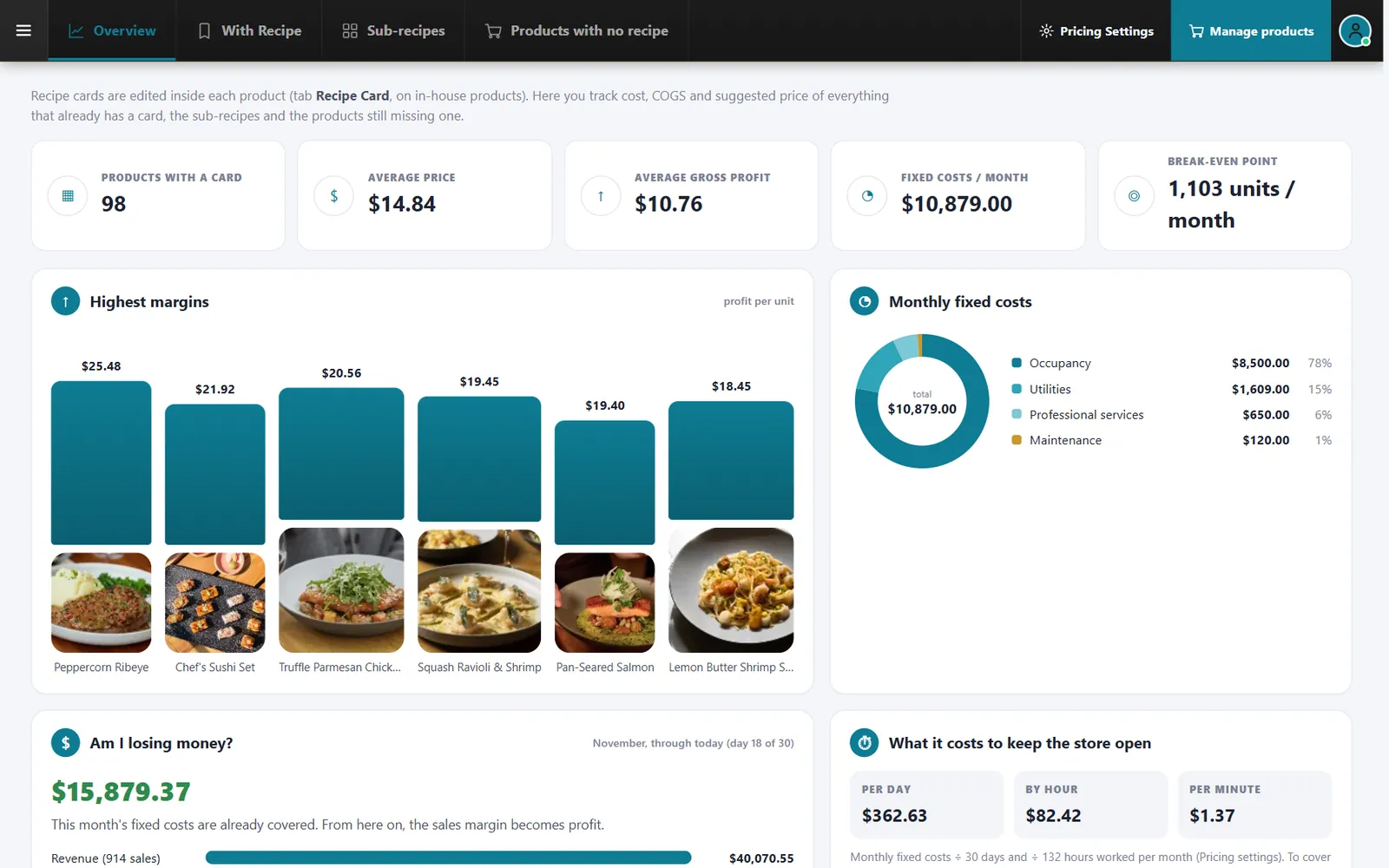
CounterChef provides a recipe card that links ingredients and quantities to a menu item. Its Pricing and Costs screen shows gross profit and which items still have no recipe.
That makes recipe completeness an important part of the costing process: an item cannot have a dependable ingredient-cost calculation if its recipe has not been documented.
Regardless of the tool you use, establish one standard recipe for every cocktail and make sure the bar team works from the same quantities.
Frequently asked questions
What is the cocktail pour cost formula?
The cocktail pour cost formula is:
Pour Cost (%) = (Total Ingredient Cost ÷ Selling Price) × 100
Add the cost of every ingredient in one serving, including spirits, liqueurs, juices, syrups, bitters, mixers, and garnishes. Divide that total by the menu selling price and multiply by 100.
What is a good pour cost percentage for cocktails?
It depends on the restaurant's concept, location, ingredient quality, pricing strategy, and operating expenses.
A range of approximately 20% to 25% is sometimes used as a rule of thumb for cocktail planning, but it is not a universal standard. Some concepts and premium drinks operate at different levels.
The important thing is to understand both ingredient cost percentage and gross profit dollars.
Should garnish be included when calculating cocktail cost?
Yes. Every ingredient served with the cocktail should be included.
This includes citrus wheels, peels, cherries, olives, herbs, salt rims, and other finishing ingredients. Calculate garnish cost using usable yield rather than simply dividing the purchase price by the number of items purchased.
If preparation creates waste, account for that as well.
How often should a restaurant recalculate cocktail costs?
Review costs at least monthly as a starting point, and whenever a significant ingredient price, recipe, or supplier specification changes.
High-volume cocktails and drinks containing expensive spirits deserve particular attention.
Also compare theoretical recipe costs with actual inventory usage. If the two numbers differ, investigate portion sizes, waste, remakes, unrecorded drinks, and inventory accuracy before making changes to the menu.
The bottom line: A reliable cocktail costing process starts with measured recipes, includes every ingredient, and connects pour cost to selling price and gross profit. Build that process into purchasing, bartender training, and regular menu reviews, and you will have a much clearer picture of what your bar is actually earning.
Related feature: Recipe costing.