
How to Calculate Bakery Profit Margin by Product: Batch Costs, Labor, and Unsold Goods
A bakery can sell out of its most popular pastry every morning and still make less money than expected. The problem is often hidden in batch costs: ingredients, hands-on labor, production waste, and finished goods that never reach a customer. To calculate bakery profit margin accurately, you need to know what each product costs to make, how much labor it consumes, and how much of the batch actually sells.
Start with the cost of a complete production batch
The most useful place to begin is not the individual pastry. It is the batch.
A recipe might produce 24 muffins, 36 cookies, or 12 loaves of bread. You purchase ingredients in bulk, prepare them together, use shared equipment, and spend time mixing, shaping, baking, cooling, and packaging.
Those costs belong to the batch before they are divided among individual products.
For every recipe, record:
- Ingredient quantities and purchase costs.
- Expected finished yield.
- Hands-on production time.
- Packaging materials.
- Garnishes and finishing ingredients.
- Expected production loss.
- Actual number of sellable units.
The distinction between theoretical yield and actual yield matters. A cookie recipe might theoretically produce 48 cookies, but inconsistent portioning could leave you with 44 acceptable units.
If you divide the batch cost by 48 when you can only sell 44, your reported unit cost will be too low.
Use actual sellable yield whenever possible.
Separate ingredient cost from labor cost
Ingredient cost is usually easier to calculate than labor. You have supplier invoices, package sizes, and recipe quantities.
Labor requires more attention because production time is not always the same as clock time.
Suppose a baker spends 15 minutes mixing dough, 20 minutes portioning it, and 10 minutes finishing the batch. The dough might rest or bake for another hour, but that does not mean the baker spent an hour performing production work.
Calculate direct labor using hands-on time.
The formula is:
Labor cost per batch = Hands-on hours × Loaded hourly labor rate
The loaded rate should reflect the employer's actual labor expense, not just the employee's advertised hourly wage. Depending on the business, this may include employer payroll taxes and other employment-related costs.
For example, a baker paid $20 per hour might have a hypothetical loaded labor rate of $24 per hour.
If that baker spends 45 minutes producing a batch:
$24 × 0.75 hours = $18 in batch labor.
For more accurate costing, track setup, cleanup, and production time separately. Include the time required to wash equipment, prepare trays, weigh ingredients, and return the station to working condition.
Do not automatically assign every minute of a shift to one recipe. When a baker produces several products in one session, allocate shared time using a consistent method, such as documented production minutes or batch-specific setup time.
Calculate bakery profit margin using three different products
Different bakery products create different cost structures. A loaf of bread, a cookie, and a decorated pastry might use the same kitchen but consume different amounts of labor, packaging, and production capacity.
The following examples use hypothetical numbers throughout. They illustrate the calculations rather than represent industry averages.
Product one: Chocolate chip cookies
Assume a bakery makes one batch of 48 chocolate chip cookies.
Hypothetical ingredient costs:
| Ingredient | Batch cost |
|---|---|
| Flour | $2.40 |
| Butter | $6.00 |
| Sugar | $2.20 |
| Chocolate chips | $7.20 |
| Eggs | $1.80 |
| Vanilla, salt, and leavening | $1.40 |
| Total ingredients | $21.00 |
Hypothetical production costs:
| Cost | Batch cost |
|---|---|
| Ingredients | $21.00 |
| Labor: 0.75 hours × $24 | $18.00 |
| Packaging: 48 bags × $0.08 | $3.84 |
| Total batch cost | $42.84 |
The batch produces 48 sellable cookies.
Cost per cookie:
$42.84 ÷ 48 = $0.8925.
Assume the selling price is $3.00 per cookie.
If all 48 sell:
- Revenue: 48 × $3.00 = $144.00.
- Batch cost: $42.84.
- Gross profit: $101.16.
- Gross margin: $101.16 ÷ $144.00 × 100 = 70.25%.
That looks attractive, but the calculation assumes every cookie sells.
If only 42 sell and six remain unsold:
- Revenue: 42 × $3.00 = $126.00.
- Production cost: $42.84.
- Gross profit: $83.16.
- Realized gross margin: $83.16 ÷ $126.00 × 100 = 65.99%.
The six unsold cookies still consumed ingredients, labor, and packaging.
That is why a bakery should track both theoretical margin and realized margin.
Product two: Sourdough bread
Bread has a different cost structure. Ingredients may be relatively inexpensive, but fermentation schedules, shaping, handling, and oven capacity affect production.
Assume a batch produces 20 loaves.
Hypothetical ingredient costs:
| Ingredient | Batch cost |
|---|---|
| Bread flour | $18.00 |
| Whole wheat flour | $4.00 |
| Starter allocation | $2.00 |
| Salt | $0.60 |
| Water | $0.20 |
| Total ingredients | $24.80 |
Hypothetical production costs:
| Cost | Batch cost |
|---|---|
| Ingredients | $24.80 |
| Labor: 1.5 hours × $24 | $36.00 |
| Packaging: 20 bags × $0.15 | $3.00 |
| Total batch cost | $63.80 |
Cost per loaf:
$63.80 ÷ 20 = $3.19.
Assume each loaf sells for $9.00.
If all 20 sell:
- Revenue: 20 × $9.00 = $180.00.
- Batch cost: $63.80.
- Gross profit: $116.20.
- Gross margin: $116.20 ÷ $180.00 × 100 = 64.56%.
Now assume three loaves remain unsold.
Revenue becomes:
17 × $9.00 = $153.00.
Gross profit becomes:
$153.00 − $63.80 = $89.20.
Realized gross margin:
$89.20 ÷ $153.00 × 100 = 58.30%.
The important operational question is whether the bakery should produce fewer loaves or change its sales schedule.
If three loaves regularly remain unsold, the answer might be a smaller weekday batch rather than a price increase.
Product three: Decorated cupcakes
Decorated cupcakes can carry higher selling prices, but they also require more finishing labor and packaging.
Assume a batch produces 24 cupcakes.
Hypothetical ingredient costs:
| Ingredient | Batch cost |
|---|---|
| Flour | $3.00 |
| Sugar | $2.40 |
| Butter | $5.00 |
| Eggs | $2.40 |
| Milk and vanilla | $2.20 |
| Frosting ingredients | $7.00 |
| Decorations | $3.00 |
| Total ingredients | $25.00 |
Hypothetical production costs:
| Cost | Batch cost |
|---|---|
| Ingredients | $25.00 |
| Labor: 1.5 hours × $24 | $36.00 |
| Packaging: 24 boxes or individual containers × $0.35 | $8.40 |
| Total batch cost | $69.40 |
Cost per cupcake:
$69.40 ÷ 24 = $2.8917.
Assume the selling price is $6.00.
If all 24 sell:
- Revenue: 24 × $6.00 = $144.00.
- Batch cost: $69.40.
- Gross profit: $74.60.
- Gross margin: $74.60 ÷ $144.00 × 100 = 51.81%.
If four remain unsold:
Revenue:
20 × $6.00 = $120.00.
Gross profit:
$120.00 − $69.40 = $50.60.
Realized gross margin:
$50.60 ÷ $120.00 × 100 = 42.17%.
The cupcakes generate a higher selling price than the cookies, but they also consume considerably more labor and packaging per unit.
A higher menu price does not automatically mean a better product margin.
Compare products using both gross margin and profit per labor hour
Looking at margin percentage alone can lead to poor production decisions.
Consider the three hypothetical products:
| Product | Selling price | Full-batch gross margin | Batch labor | Gross profit per labor hour |
|---|---|---|---|---|
| Cookie | $3.00 | 70.25% | 0.75 hours | $134.88 |
| Sourdough loaf | $9.00 | 64.56% | 1.5 hours | $77.47 |
| Cupcake | $6.00 | 51.81% | 1.5 hours | $49.73 |
The last column divides full-batch gross profit by direct production hours.
This is not a complete measure of profitability. It excludes overhead and other operating expenses. However, it helps answer an important scheduling question:
Which product generates the most gross profit from the limited production time available?
A product with a lower margin percentage may still deserve production time if it sells consistently, supports other purchases, or uses otherwise idle capacity.
Conversely, a complicated product that ties up your best baker for hours should justify that labor commitment.
Treat unsold goods as a production cost, not an afterthought
Unsold inventory is one of the easiest costs to overlook.
A bakery may record all 100 muffins as produced, 82 as sold, and 18 as waste. If the owner only reviews ingredient costs against sales revenue, the cost of those 18 muffins can disappear inside the monthly food-cost number.
Build a daily production reconciliation.
For each product, record:
- Opening finished inventory.
- Units produced.
- Units sold.
- Units discounted.
- Units transferred or used elsewhere.
- Units donated.
- Units discarded.
- Closing finished inventory.
The quantities should reconcile.
Opening inventory + Production = Sales + Other documented movements + Closing inventory.
Do not classify discounted goods as full-price sales. Record the actual revenue received.
Likewise, distinguish products sold at a discount from products used for staff meals or transferred into another recipe.
This makes it possible to see whether a product has an ingredient-cost problem, a production-yield problem, or a demand problem.
Use three practical production experiments to improve margins
You do not need to overhaul your menu to improve bakery profit margin. Start with small tests that produce useful information.
1. Run a half-batch test on slow days
Choose one product that regularly has leftovers on particular weekdays.
For one week, produce a smaller batch on those days while keeping the recipe and selling price unchanged.
Record:
- Units produced.
- Units sold.
- Units remaining.
- Revenue.
- Labor minutes.
- Customer requests for unavailable stock.
Compare the results with the previous week's production.
The objective is not simply to reduce waste. You also want to avoid losing sales because the product sells out too early.
If the smaller batch reduces leftovers without creating repeated stockouts, it may be a better production quantity.
2. Measure the cost of portion inconsistency
Choose one product that is portioned manually, such as cookies, muffins, or bread rolls.
Weigh 20 consecutive portions before baking.
Record the average weight and the difference between the lightest and heaviest portions.
Then calculate the ingredient cost of the actual average portion rather than relying on the recipe's intended weight.
For example, if a hypothetical cookie should weigh 60 grams but the actual average is 66 grams, the bakery is using 10% more dough per cookie than planned.
A portion scoop, scale, or simple visual guide may solve the problem.
Repeat the test after training the production team.
3. Schedule production around the last sale, not just the opening time
Some products are made too early because the kitchen follows a fixed routine rather than actual demand.
Track when each product sells throughout the day.
If a particular pastry consistently sells between noon and closing, consider whether a later, smaller production run would improve freshness and reduce leftovers.
This is especially useful when a product can be prepared in stages.
You might mix dough in the morning, refrigerate it appropriately, and bake a second batch later, provided food-safety procedures and recipe quality allow it.
The goal is to separate preparation from final production when the product permits it.
Allocate overhead without hiding the real cost of production
Ingredient, labor, and packaging costs tell you the direct cost of a batch. They do not tell you whether the bakery is profitable overall.
You still have expenses such as:
- Rent.
- Utilities.
- Equipment maintenance.
- Insurance.
- Cleaning supplies.
- Administrative labor.
- Marketing.
- General operating expenses.
For a more complete product-level analysis, allocate overhead using a consistent method.
Production hours, equipment usage, or occupied production time may provide useful allocation bases, depending on your operation.
Avoid assigning overhead randomly just to make every product appear to carry the same burden.
For example, a product requiring prolonged oven time may consume more production capacity than a no-bake item.
Keep two reports:
Direct product margin: Sales minus ingredients, direct production labor, and packaging.
Allocated product contribution: Direct product margin minus an assigned share of overhead.
The first helps with recipe and production decisions. The second helps evaluate the broader economics of the menu.
Your final business operating profit is calculated after accounting for all operating expenses, not simply by adding up product gross profits.
Use this weekly bakery costing checklist
Copy this table into your production notebook or spreadsheet and complete it for each important product.
| Measurement | What to record |
|---|---|
| Product name | Recipe or menu item |
| Batch size | Planned finished units |
| Actual yield | Sellable finished units |
| Ingredient cost | Total batch ingredient expense |
| Labor time | Hands-on production hours |
| Loaded labor rate | Actual hourly employer cost |
| Packaging | Total batch packaging expense |
| Total batch cost | Ingredients + labor + packaging |
| Unit cost | Total batch cost ÷ actual yield |
| Selling price | Actual menu price |
| Units sold | Full-price and discounted units |
| Unsold units | Leftovers, spoilage, and other movements |
| Net sales | Actual sales revenue |
| Gross profit | Net sales − production cost |
| Realized margin | Gross profit ÷ net sales × 100 |
Review the table once a week.
Look for three things: products with rising ingredient costs, products consuming more labor than expected, and products producing regular leftovers.
Assign one person responsibility for recording production quantities and another for checking the numbers when practical. Consistent records are more valuable than complicated spreadsheets that nobody updates.
Connect recipe costing to daily production records
A reliable costing process depends on connecting what the kitchen plans to make with what it actually produces.
Recipe cards should contain the quantities, yields, and ingredient costs needed to establish a batch cost.
Production records should then show how many units were made, sold, transferred, or discarded.
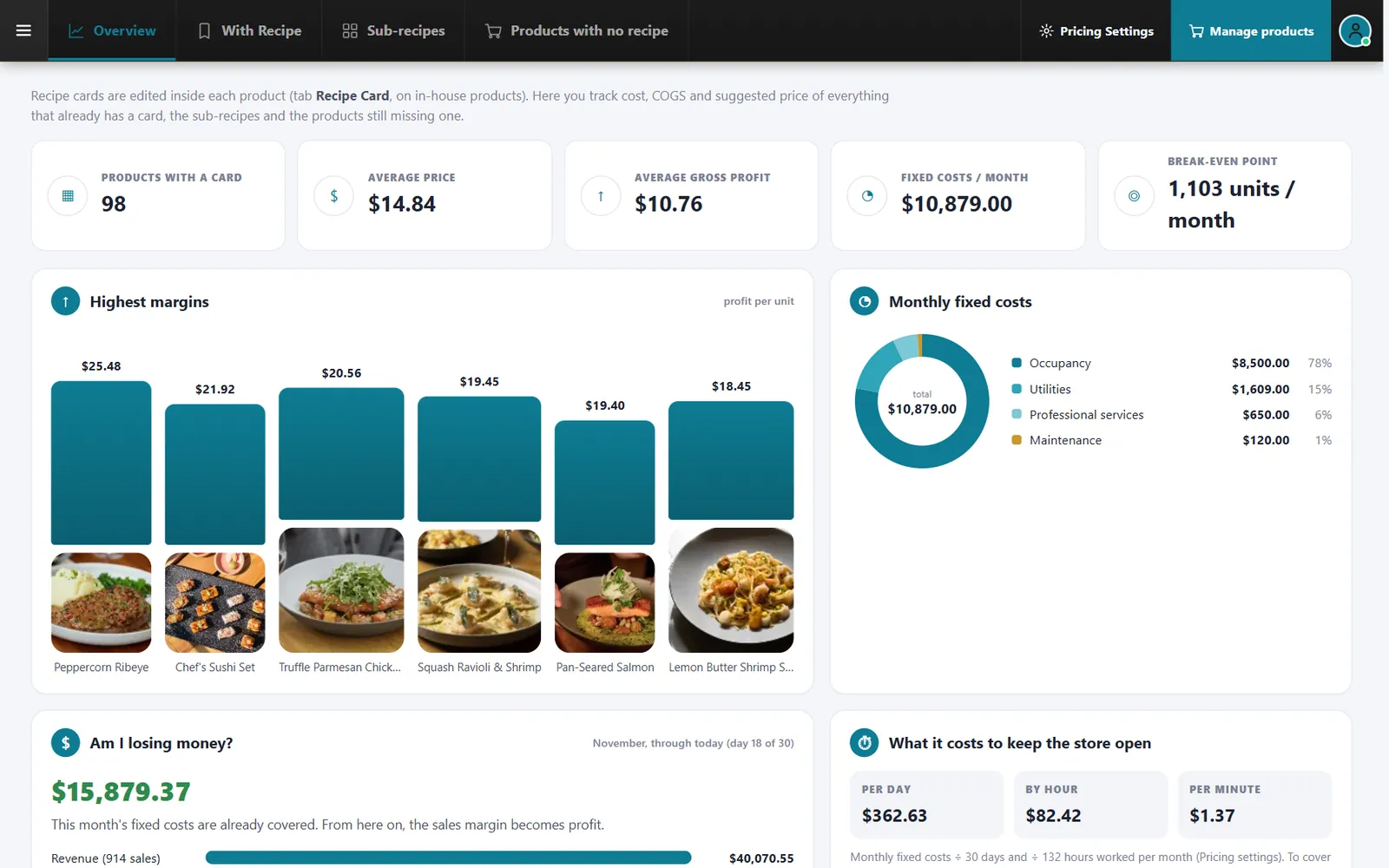
CounterChef supports two relevant functions: Recipe cards connect to menu items and show cost and gross profit; kitchen prep posts production and deducts ingredients.
The operating principle is straightforward: use recipe costs to establish what a product should cost, then compare those figures with actual production and sales records.
Regardless of the tools you use, make sure someone reviews the differences rather than assuming the recipe cost tells the whole story.
Frequently asked questions
What is a good bakery profit margin?
There is no single margin that works for every bakery. A wholesale bread operation, a retail pastry shop, and a bakery specializing in decorated cakes have different labor, rent, production, and waste structures.
Treat any typical margin range as a rule of thumb that varies by concept, not a target you must achieve.
Start by calculating your own product margins and comparing them over time.
Should labor be included in bakery product cost?
Yes. Direct production labor should be included when calculating the full cost of making a product.
Track hands-on time and multiply it by the loaded hourly labor rate. Include preparation and cleanup when they are directly associated with production.
If you exclude labor, you may incorrectly favor products that require substantial finishing work.
How should a bakery account for unsold products?
Record unsold products separately from sales and reconcile production quantities at the end of each day.
Products that are discarded, donated, discounted, or transferred into another recipe should have their own recorded movement.
The production cost has already been incurred, even when the finished product generates no revenue.
Should I increase prices when my bakery profit margin falls?
Not automatically.
First identify what changed. Ingredient prices may have increased, portions may be too large, labor time may have grown, or production quantities may exceed demand.
Correct operational problems where possible before changing prices. If the product still does not generate an acceptable contribution after those adjustments, review its selling price, portion size, recipe, or place on the menu.
The most useful bakery profit margin calculation is one you can repeat every week. Cost the batch, measure the labor, reconcile the unsold goods, and use the results to decide what to produce next. That is how you turn recipe costing into better operating decisions.
Related feature: Recipe costing.